
 Contact
A “groundbreaking” ceremony was held today for a building that’s already been built but hasn’t been used recently. The former Sears store at Cross County Center in Yonkers will be the new home for a 130,000-square-foot Target store.
Elected officials joined with representatives of the open-air shopping center to mark the beginning of the transformation of the first two floors of the four-floor building. The new Target will be the chain’s first store in Yonkers and is scheduled to open next year.
The Cross County Center, owned by Marx Realty and Benenson Capital Partners, is at the intersection of the Cross County Parkway and Interstate 87. It has more than 80 stores and restaurants along with a Hyatt Place Hotel in its 1,150,000 square feet. It attracts approximately 11 million visitors a year.
“It’s a very big deal,” Craig Deitelzweig, president and CEO of Marx Realty, told the Business Journal about the Target store.
“It really speaks to the success of Cross County Center, the success of Yonkers in attracting retailers and it also really speaks to how open-air shopping centers are really the future of retail. People feel very safe going to an open-air shopping center.”
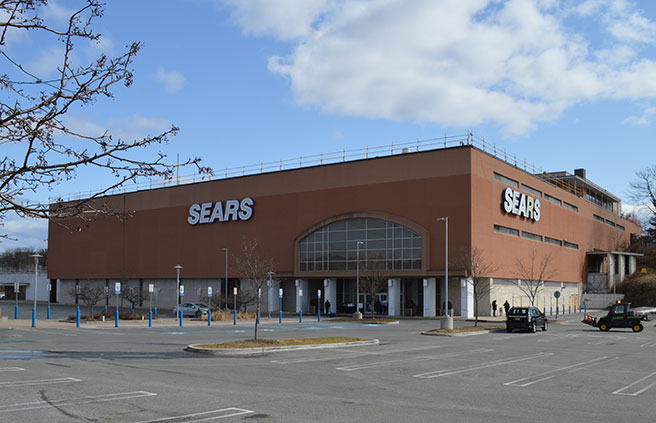
Deitelzweig said bringing in Target on a 40-year lease reflects the commitment the ownership and management of the center has to Yonkers.
He said that he expected an announcement would soon be made regarding a lease for 40,000 square feet of the remaining 60,000 square feet in the building.
“Of the remaining 20,000 square feet, we have lots of different retailers who are very interested in that space so we think it’s going to be really exciting,” Deitelzweig said.
“We also have the ability to have the roof so a restaurant could have a lot of outdoor dining out there, and it’s a very large roof, so it could be really exciting.”
Deitelzweig noted that the current owners of the center have been in place for 65 years and have worked to make it a part of the community.
“We are recommitting but we’ve always been very focused and committed on making this a really dynamic place and part of the community,” Deitelzweig said.

Photo by Peter Katz
The center has been careful to make shoppers feel comfortable during the pandemic, he said, by providing masks for people, adopting additional sanitation protocols and making available apps enabling people to make reservations and do advance planning through the use of their personal devices.
“During this time you have to really be understanding and everyone’s sort of a little bit more flexible than they were before, not just for the tenants but for the customers as well. We just want to really think about how to make it the best experience possible and work with our tenants, our retailers, our customers, to make it the best place to be,” Deitelzweig said.
“This should really be the place that people to go after a high school graduation, to celebrate a big event. It’s really part of your life and I think that’s the future of retail and I think being an open-air center is really how that becomes critical. It’s an experience for sure.”
Yonkers Mayor Mike Spano told the Business Journal that in the past Target had wanted to come to Yonkers but was unable to work out a deal.
“They were supposed to go to Tuckahoe Road, at one point they were supposed to go to the other side of the highway here and they are opening up now in Cross County, one of the most successful malls of its type in North America,” Spano said.
“We are very aware of what’s happening in the retail market. Retail is changing. It’s been changing even before Covid.”
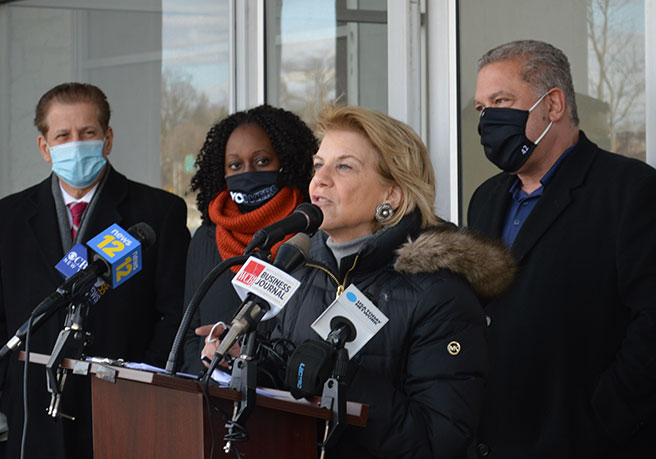
Spano said that in addition to sales tax and property tax revenue for the city, Target is creating about 700 jobs.
“That’s obviously huge,” Spano said. “People come here, they’re not just shopping here at Target. They’re going to go to maybe some of the local eateries. They’re going to make investments of time and money here in our city and when people do that revenues increase for us and that allows us to do the things we need to do to protect the quality of life for the people here in Yonkers.”
State Sen. Shelley B. Mayer, in speaking to the gathering before the ceremonial shovels were plunged into the pile of earth that had been brought in for the ceremony, said, “It takes a great act of boldness in this time of economic challenge to have a groundbreaking and the beginning of a brand new retail store.
“This is what positive work and energy, belief in our retail sector, belief in our community can really mean: jobs, a wonderful shopping environment that actually works and will survive, and it’s credit to the believers in Yonkers, the believers in Target and I’m a shopper in Target, and the believers in the future of retail if it’s done right and that’s what Cross County has done and will continue to do.”
Officials break ground on Target at Cross County Shopping Center“Not many deals of this size were happening post-COVID, and this is just a commitment to Cross County and the city of Yonkers,” says Craig Deitelzweig, president and CEO of Marx Realty.
February 17, 2021 Jon Banister, Bisnow Washington, D.C.
With office vacancy rates at all-time highs, leasing demand stagnant and the future of the workplace still uncertain, today might not seem like the best time to put tens of millions of dollars into renovating a vacant D.C. office building. But that isn’t stopping Marx Realty.
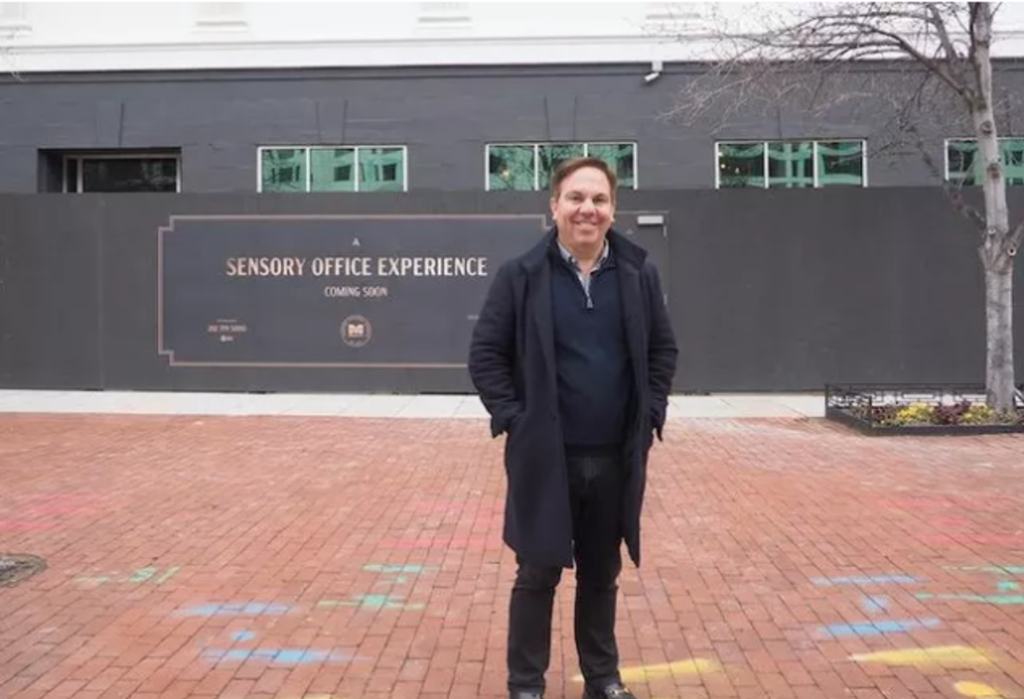
Marx Realty CEO Craig Deitelzweig in front of the office building at 1307 New York Ave. NW, which his firm is renovating.
The New York-based investor acquired The Herald office building at 1307 New York Ave. NW for $42M in April, a deal that had been under contract before the coronavirus pandemic began. The crisis hasn’t deterred Marx from pursuing an ambitious renovation effort, investing another $41.5M to overhaul the 134K SF office building.
“Even though there’s supply here, there’s a lot of supply of commodity product, there’s zero supply of product that we deliver,” Marx Realty CEO Craig Deitelzweig told Bisnow. “There’s no other building that has these ceiling heights, no other building that has this heritage, no other building that has the hospitality-infused office that we offer.”
The building became fully vacant in December when the group of associations that previously owned it moved out following a short-term leaseback arrangement. The developer is working with JLL‘s Evan Behr, Doug Mueller, Nathan Beach, Kristen Mathis and Emily Balkam to lease the building.
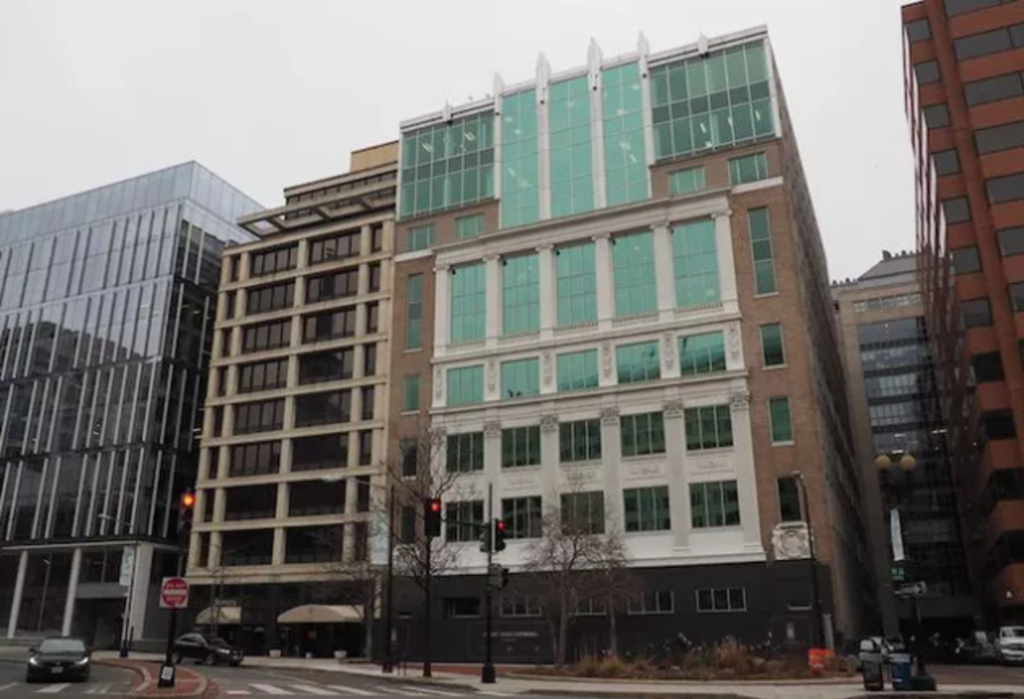
The office building at 1307 New York Ave. NW, branded as The Herald.
The team hasn’t closed any lease deals yet, but Deitelzweig said it has experienced strong touring activity and has received at least six lease proposals from tenants. He said the team was preparing for a tour with a prospective two-floor tenant Friday afternoon, after showing Bisnow around the under-construction property, which is sheathed at the ground level with wood fencing stamped with the slogan “A Sensory Office Experience, Coming Soon.”
“We have confidence because we’re seeing the tenants,” Deitelzweig said. “Tenants are touring the building. They’re asking for proposals. They’re the best tenants that any building could desire. They’re name-brand tenants. The rent proposals that are coming in are actually higher than our initial underwriting.”
The office spaces are scheduled to be ready for occupancy by May, and Deitelzweig expects to have at least one tenant signed on by then. He said the building has garnered interest from financial firms, tech companies, media organizations, law firms and government affairs offices.
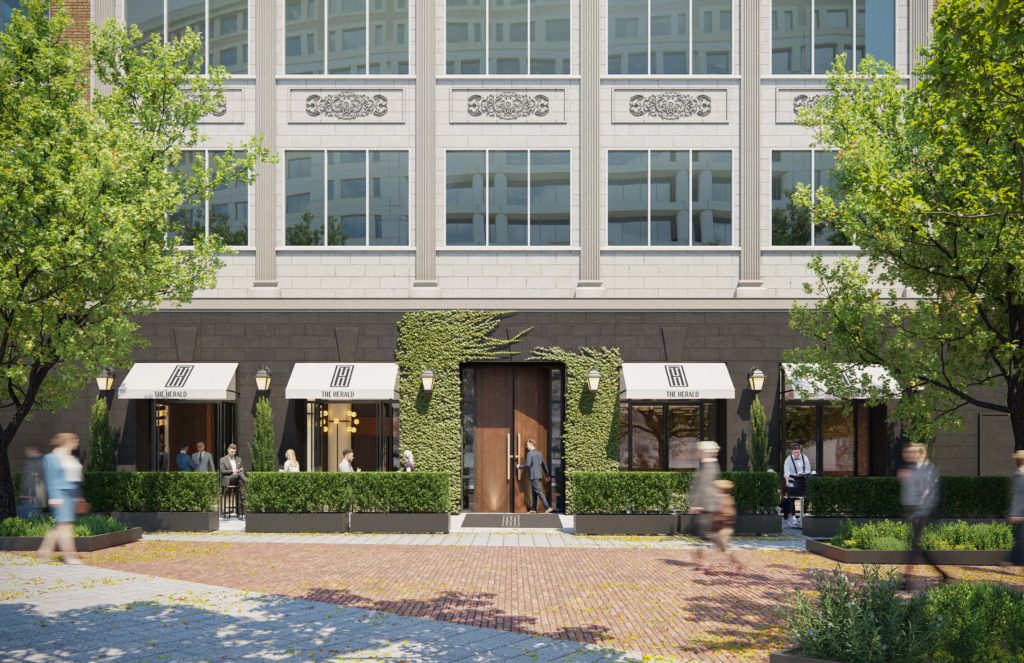
A rendering of the renovated entrance to The Herald office building.
Deitelzweig said there was a noticeable spike in government-related activity following the November election. Office market experts have been expecting the change in administration and unified federal government could lead to a bump in D.C. office demand.
“We saw it immediately after the election,” he said. “Literally that next week we had people knocking on our doors for government affairs offices. Some were making switches and they wanted new space, some were thinking of growth, and some were looking at the type of spending that’s going to be happening in D.C. and knowing they need to step up their game.”
The building’s asking rents are in the $60 per SF to $74 per SF range. Deitelzweig said it is offering concessions including tenant improvement allowances and a period of free rent to compete in today’s tenant-favorable market.
But ultimately he believes it won’t be the concessions, but the quality of the building that will help Marx Realty win over tenants.
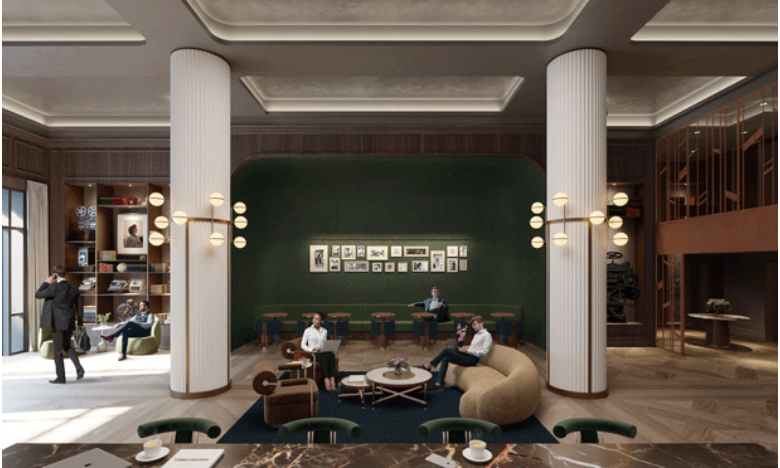
Built in 1923, the Beaux Arts-style building is the former home of the Washington Herald Examiner. Jacqueline Kennedy Onassis, who was then Jacqueline Bouvier, worked in the building as a photographer and reporter for the newspaper.
The renovation pays tribute to the former first lady with the Bouvier Club, an 8,800 SF lounge just inside the entrance to the building featuring a fireplace and bookcase with walnut and copper finishes. The walls are lined with historical photographs, artwork and newspaper printing memorabilia.
The building’s first floor, with 22-foot ceiling heights, also features a European-style café, a 40-seat boardroom and a 5K SF office space with its own building entrance. The renovation was designed by Studios Architecture‘s David Burns, who also worked with Marx Realty on the renovations of 10 Grand Central and 545 Madison Ave. in Manhattan.
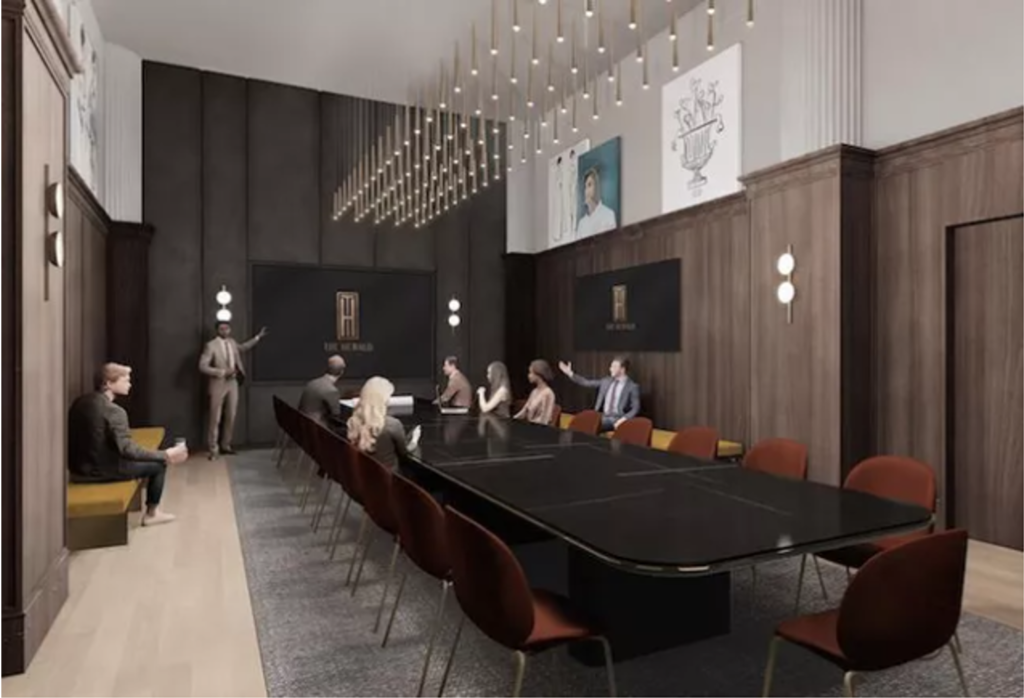
A rendering of the boardroom at Marx Realty’s office building, The Herald.
As part of its strategy to infuse hospitality elements into its office buildings, Marx Realty will have a doorman outside the large wooden entry doors, and it will have a signature scent in the common area.
In front of the building, at the intersection of New York Avenue and H Street NW, sits a small pocket park that Deitelzweig said it plans to work with the National Park Service to beautify.
The owner has also created a mobile application using its own Marx Connect software that will allow the building’s occupants to complete a health survey before entering, register guests, reserve conference space, arrange valet service and order salad deliveries through the Sweetgreen Outpost service.
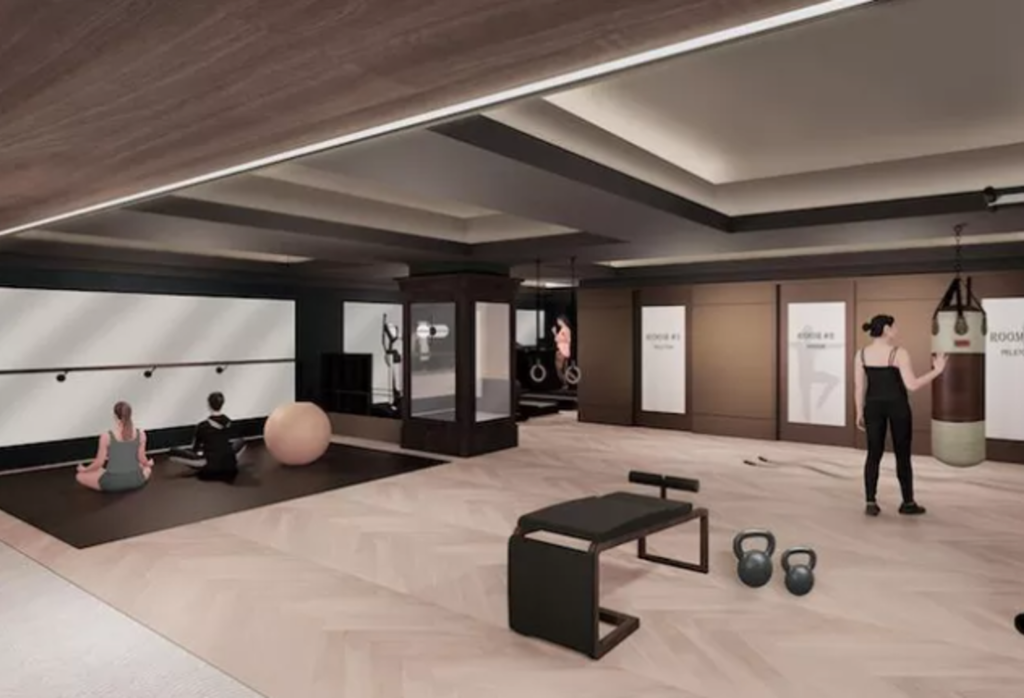
A rendering of the fitness center at The Herald office building.
The 7K SF fitness center features boxing equipment and private workout rooms with Peloton bikes and smart-glass mirrors that play workout instruction videos. It also has locker rooms with Herald-branded towels.
The office spaces throughout the building have ceilings heights between 13 and 15 feet, much higher than the standard office ceiling height of roughly 9 feet. On the seventh floor, the owner is creating pre-built suites with conference rooms and a café.
Marx Realty, which owns four buildings in D.C. and five in Northern Virginia, is continuing to search the market for new acquisition opportunities, Deitelzweig said. He said its ability to lease up the Herald building will factor into its timing for making another investment, and it also wants to make sure it finds the right type of building.
NYC office towers welcome workers back with new tech, toilet protocols“We don’t want a commodity asset. We think those commodity assets are toast,” he said. “We really want a building that has the bones and the infrastructure to be really special. We love buildings with heritage and with these types of ceiling heights, but they’re hard to find.”
By Lois Weiss Jan 25, 2021
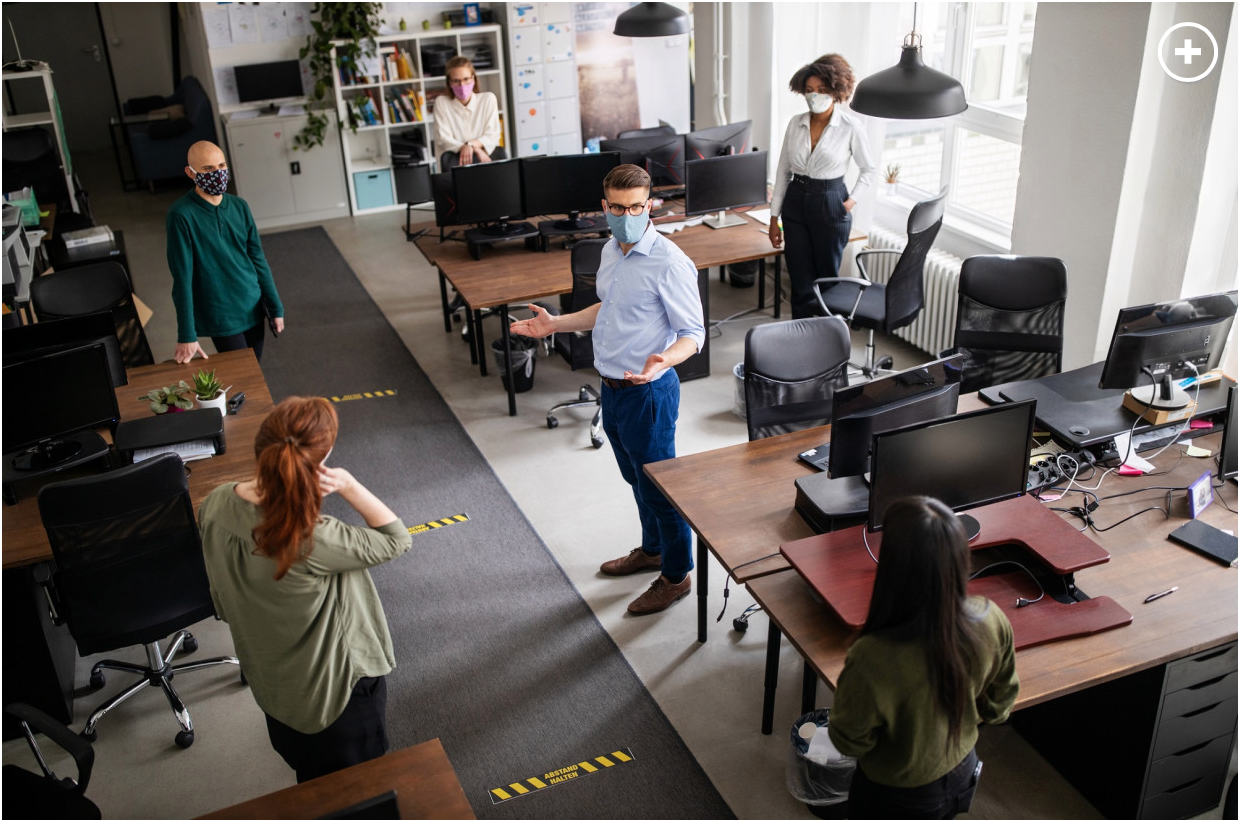
Building owners, health experts and designers are collaborating to get workers back to the office quickly and safely.
Vaccinations are being distributed, the lifting of all COVID-19 lockdowns is in sight, and with that, confidence is returning to both employers and commercial building owners.
Many real estate executives now believe companies will call their workforces back into the office starting in June and July. But how exactly they will do that safely and efficiently remains a matter of opinion — with buildings owners, health experts and designers all weighing in.
As a result, everything from build outs, technology and even toilets are currently being reimagined in an attempt to get tenants back to the office quickly.
“They are all trying to position themselves as the better building,” said Peter Turchin of CBRE, which manages 2.7 billion square feet of office space worldwide — 20 million square feet of which is in New York. “They are looking at their competition very acutely and at what they need to do for their buildings.”
While pre-COVID some companies were down to as little as 60 to 125 square feet per person with benching, the amount of space per employee is now rising.
Most clients have scrapped plans to double the size of their offices to accommodate six feet of social distancing and are instead having employees come into work every other day or rejiggering the furniture to alternate chairs and desks.
“There will be less density and they are not putting employees back in elbow to elbow,” said Nelson Mills, president and CEO of Columbia Property Trust, which owns the Times Building at 229 W. 43 St. and 315 Park Ave. South among others in Manhattan.
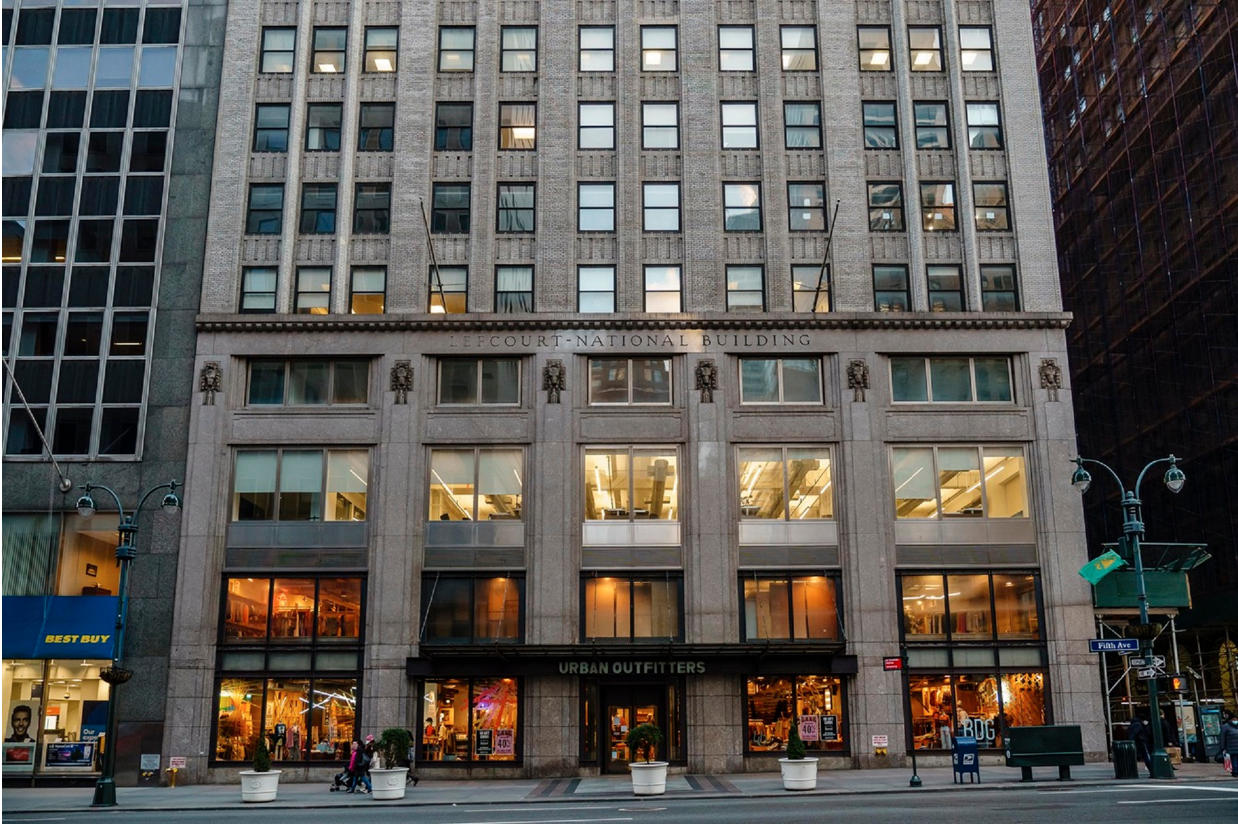
To air things out, Savanna’s Grand Central-area office building, at 521 Fifth Ave., will soon have usable outdoor terrace space at every setback.
Examples of the race to restructure can be seen at SL Green Realty Corp.’s 1.1 million-square-foot Midtown office tower, 1185 Sixth Ave., where thermal scanners and giant air filters in the lobbies have been installed, and at private equity giant Savanna’s Grand Central-area office building at 521 Fifth Ave., which will soon have a usable outdoor terrace at every setback.
At both 545 Madison Ave. and 10 Grand Central (155 E. 44 St.) Craig Deitelzweig, president and CEO of Marx Realty, has overseen the installation of UV lights in common areas and the bi-polar ionization system AtmosAir to target — and hopefully kill off— most COVID particles.
“Once people start coming back, others in the same industry will see they have a competitive advantage,” said Deitelzweig, whose company also owns properties that include 430 Park Ave., 201 E. 57 St. and the Cross County Center in Yonkers.
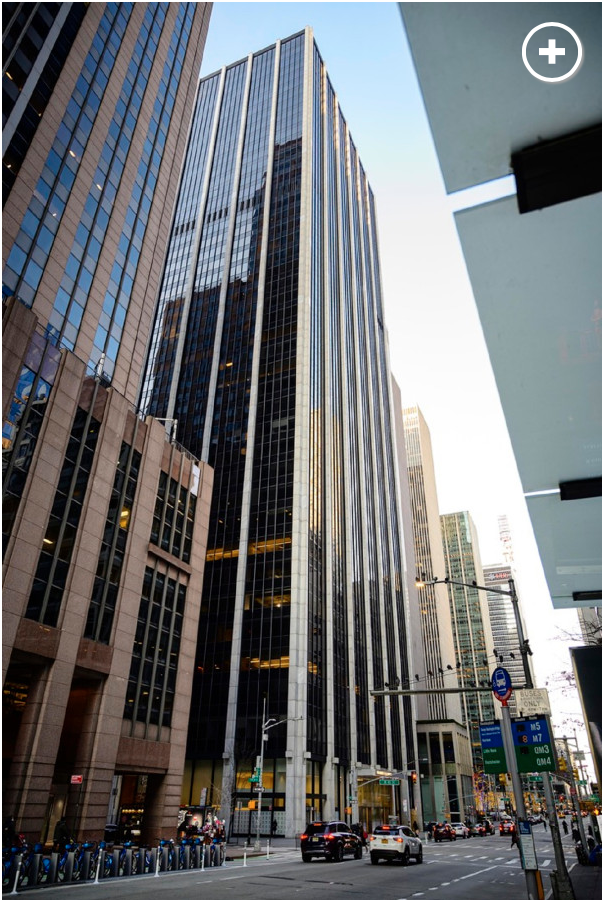
Thermal scanners and giant air filters have been installed at 1185 Avenue of the Americas in Midtown.
In most offices, new air-filtration systems with upgraded MERV filters were added, while others are changing the outside air more frequently. Along with a boatload of hand-sanitizer stations, most owners have used the lockdown to install “sneeze guards,” automatic doors and destination elevators, as well as programming phone apps that can be used instead of key fobs.
“Owners are spending money and putting it into the infrastructure and focusing on wellness and health,” said Bill Rudin, chief executive of Rudin Management, which owns among others, 345 Park Ave., 3 Times Square and Dock 72 in Brooklyn. “[Our app] allows our tenants to see how many people are in the lobby waiting for elevators. We have people stationed in the lobby wearing white gloves hitting the elevator button. We have limitations on elevator occupancy and are pumping more fresh air into the elevators and have upgraded filters.”
Where touchless sensors or anti-microbial covers on buttons have not been installed, owners are being as creative as possible to make occupiers as comfortable as possible — and they’re tapping design firms to help.
“Most executives are thinking of a new mix of employees and deciding who needs to be in the office or not,” said architect Thomas Vecchione, principal of the design firm Vocon, which is advising office building owners on cutting-edge new layouts. “When employees come back in June, they are saying they want it to feel post-COVID in a smart way. We’re all worn out and want to come back, but we also want to come back to an office that is fresh, light and inspired.”
But it’s not all about adding flashy tech and piling on amenities. The practical issue of deciding who to bring back first and how to position employees is a hot-ticket conversation going on behind the scenes in virtually every company in New York that leases office space, insiders told the Post.
“Companies won’t go from zero days to five days in eight-hour increments all at once,” explained Jay Neveloff, partner and real estate chair of the law firm Kramer Levin, which advises clients on development, leasing, conversions and financial structuring. “Many businesses are trying to scope out different alternatives in order to phase in employees for both days and hours.”
Businesses are now exploring a hybrid occupancy model where some employees may come to the office just two or three days a week — or more.
“We have been in regular communication with our tenants as to when they will come back and we want to give them confidence that the building is a safe place to be,” said.

Tommy Craig
Meanwhile, Tommy Craig, senior managing director of Hines, which owns a portfolio that includes stakes in One Vanderbilt and the Hudson Square Portfolio, said the focus for most office buildings is on “the path of travel” from entering the buildings, to the concierges, entry gates, elevators, common hallways, bathrooms and into their offices.
At the soon-to-be completed Zero Irving at 124 E. 14th St., Josh Wein, managing director of the developer, RAL Companies, said all the restrooms will be individual rooms with their own sink — similar to what you might find in some restaurants. Along with the now de rigueur touchless auto-flushes and sinks, for added room cleanliness, the porcelain tile floors and walls were installed with minimal germ-collecting grout lines.
Cleanliness is now extremely important to tenants, agreed Robert Ioanna, senior principal at Syska Hennessy Group, a global engineering firm that also provides facilities management, as the science shows smaller spaces are more likely to have COVID germs suspended in the air.
He is advising his client owners and tenants to “put a lid on it” — the toilets that is — because fecal matter carries COVID for 30 days while flushing sends a nearly invisible plume of particulates into the air.
“Get in and get out of the bathrooms and bring a Lysol spray and don’t talk to anyone when you are in there,” Ioanna said. “Face the wall and don’t talk in the elevator.”
While that may sound a tad dystopian, building owners are assuring tenants that nothing will boost company moral quite like being back in the office.
“When everyone is back this summer, we’re having a ‘No More Zoom & Gloom’ party for the tenants,” said Deitelzweig.
Year in review: Crain’s most engaging real estate stories in 2020
December 28, 2020
A look at the real estate stories that were most popular among readers in 2020:
Investors are looking for chances to repurpose now-empty hotels
By: NATALIE SACHMECHI | Published: Oct. 26, 2020
Craig Deitelzweig has done that at properties around the city, but now that tourism is in tatters and hotels sit empty and in danger of default, the chief executive of Marx Realty is looking at a new strategy: buy cheap hotels and turn them into offices. READ MORE
Retailers, landlords battle over who foots the pandemic bill
By: NATALIE SACHMECHI | Published: Oct. 26, 2020
An explainer on the relationship between landlords and shops as many retailers are now either unable or unwilling to pay New York’s high rents. READ MORE
Let’s make a deal: Landlords are slashing prices on empty units
By: NATALIE SACHMECHI | Published: June 16, 2020
With people leaving the city, working from home and searching for more space, the appetite for city apartments just isn’t the same. Landlords across the five boroughs are slashing rents on once-coveted units that they’re trying to take off the market. READ MORE
Amazon lands another massive deal on Staten Island
By: EDDIE SMALL | Published: Oct. 15, 2020
The e-commerce giant is leasing an additional 975,000 square feet of space at Matrix Global Logistics Park, Matrix Development Group told Crain’s on Thursday. The firm will occupy the entire fourth building at the complex. READ MORE
Manhattan vacancies reach record high with more than 15K empty apts
By: EDDIE SMALL | Published: Sept. 10, 2020
Manhattan’s vacancy rate also hit a record high of 5.1%, the first time its vacancy rate cracked 5% and the fourth consecutive month when it set a record, according to the report. The vacancy rate in August 2019 was just 1.95%, although that was well before the coronavirus pandemic upended the city’s real estate market. READ MORE
Bronx mall owner taking tenants to court over $2.6M in unpaid rent
By: NATALIE SACHMECHI | Published: Nov. 20, 2020
Six years and one pandemic later, the developer is battling his tenants over more than $2.6 million in unpaid rents at the Bronx shopping center. READ MORE
Ashkenazy takes on Gindi family in a battle for cash and reputation
By: NATALIE SACHMECHI | Published: Nov. 16, 2020
The family behind bankrupt department store Century 21 is starving developer Ben Ashkenazy of cash for his pandemic-racked real estate empire and smearing his name in the industry. READ MORE
New Yorkers scramble to find summer alternatives to the Hamptons
By: NATALIE SACHMECHI | Published: June 4, 2020
Hamptons, shmamptons. Suburbs from New Jersey to Long Island’s Gold Coast and even the Hudson Valley are about to see a summer like no other. READ MORE
Foreign buyers taking a step back from New York real estate
By: NATALIE SACHMECHI | Published: July 30, 2020
Be they international students, workers from out of town or foreigners in search of a cosmopolitan pied-à-terre, travel bans and other pandemic-related restrictions are keeping buyers away from some of the world’s most sought-after properties. READ MORE
950-unit Gowanus project to go 100% affordable
By: EDDIE SMALL | Published: Nov. 19, 2020
One of the largest projects on its way to Gowanus will now consist entirely of affordable housing. READ MORE
Old US shopping mall finds secret to survival as Covid rips through retailCommunity links and open-air setting give Yonkers complex the edge over struggling newcomers
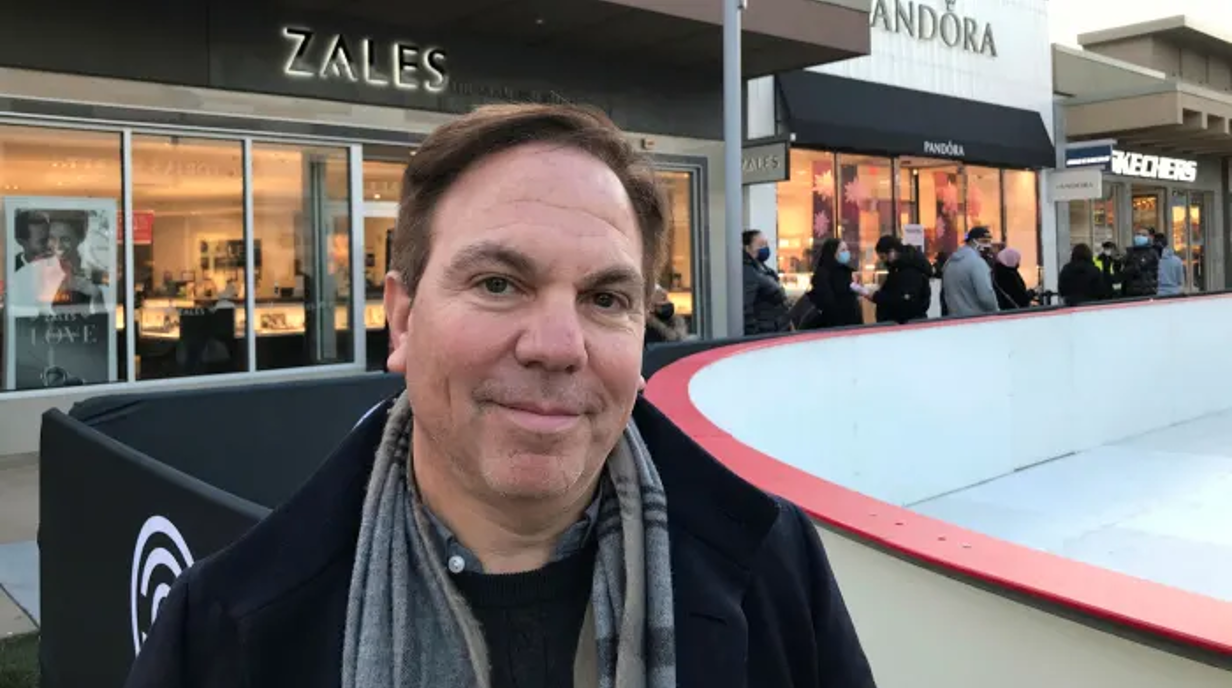
Craig Deitelzweig, chief executive of Marx Realty, says the 66-year old Cross County Center in Yonkers, New York, has enjoyed success by sticking to a tested formula © Joshua Chaffin/FT
Joshua Chaffin
Craig Deitelzweig looked like a proud shopkeeper as he took in what has been an all too rare scene at America’s decimated shopping malls: throngs of customers, many laden with bags, strolling around the Cross County Center in Yonkers, New York.
Shopping malls have become one of the most challenged parts of the real estate industry in recent years, thanks to the rise of ecommerce. The coronavirus emergency is hastening their decline — so much so that some mall owners are considering converting their properties to ecommerce warehouses.
Yet the Cross County Center, a 66-year-old mall that is not terribly flashy or innovative, is rumbling along while newcomers such as the gilded Hudson Yards on the west side of Manhattan or New Jersey’s vast and excessive American Dream are struggling.
After a Covid dip, its owner, Marx Realty, is collecting 95 per cent of the rent due from tenants each month. Occupancy is running at 99 per cent. When one anchor tenant, the Sears department store, went bankrupt Marx signed a deal in September to replace it with a 130,000 sq ft Target — at an almost 30 per cent increase in rent. Construction on its spruced-up location begins in January.
To Mr Deitelzweig, Marx’s chief executive, the ultimate sign of the mall’s health may be the sight of shoppers — all wearing face masks — lined up outside stores including jeweller Pandora. Its October sales were up 63 per cent over last year, he said. At Gap, they rose 6 per cent.
“It’s sunny days,” he declared. “I think people still enjoy shopping. If you look around, almost everyone has bags.”
The only gloomy note on a recent afternoon was a storefront where a lonely Santa Claus was sitting behind a Plexiglas screen at a safe distance from an elf.
What accounts for the Cross County’s success? It has long benefited from its location in Yonkers, a working-class town sandwiched between the New York City borough of the Bronx, just to the south, and the affluent towns further north in Westchester County.
The fact that it is an open-air mall — once seen as a disadvantage — turns out to be a big plus during a viral pandemic. Several shoppers echoed the sentiment of Madeline González, who said she had come to the Cross County from the Bronx because she was “tired of being locked up”.
“There was a time when enclosed malls were the thing and we were considering putting a roof over it,” Mr Deitelzweig said. “Thank God we didn’t.”
Ultimately, he attributes the mall’s success to something that is harder to quantify, and to replicate. Over decades, it has become woven into the local community — a place where families come to celebrate school graduations, watch July 4 fireworks or just to see and be seen on a weekend afternoon. “That’s really the secret,” Mr Deitelzweig said. “It’s really a town centre more than a mall.”

The American Dream mall in New Jersey contains a theme park, water park and ski slope © Samantha Nandez/BFA.com

Manhattan’s Hudson Yards is part of a giant development including the Vessel tourist attraction © Reuters
A few years ago Marx considered tinkering with the formula. At the time, the $3bn American Dream was under construction and the talk of the mall world. To attract customers, its owners invested in thrills, throwing in an amusement park, a water park, a helipad, a zoo and a 16-storey ski slope, among other amped-up attractions.
“We ultimately sat back and realised we didn’t need that,” Mr Deitelzweig said. “Your Main Street doesn’t need a giant Ferris wheel to be part of the community. You need cafés.”
Marx did opt to tweak the name — ditching the Cross County Mall to become the Cross County Center.
Whatever you call it, the Cross County’s appeal was tested when Covid-19 struck. Its April rent collections dipped to 44 per cent as New York City and surrounding areas went into quarantine. ‘It was concerning,” Mr Deitelzweig said.
Marx allowed some restaurants and a health club, which were legally required to close, to defer their payments. But it otherwise took a hard line. “This is probably your most successful store, so pay here first,” Mr Deitelzweig recalled telling tenants — many of whom were withholding rent at other locations.
While that might sound harsh, he was unapologetic. “We really shouldn’t be their lender. We have our own lender who wasn’t supplying relief to us.”
Most have paid up. Still, Marx is currently suing to evict Gap, which Mr Deitelzweig said had only recently begun paying 50 per cent of its rent. The company, he said, was trying to “use the pandemic to absolve their legal commitments”.
Gap declined to comment specifically on its Cross County location. But it said it had been forced by the pandemic to close stores for months, adding: “As we work through remaining negotiations with landlords to equitably share the burden caused by the pandemic, we’ve paid what we believe to be fair rent under the evolving circumstances.”
If it comes to eviction, Mr Deitelzweig is confident he will find a replacement. As weaker malls succumb, he expects retailers to pay a premium to move to higher ground.
Hope In ‘The Emptiness Of It All’: How Midtown Could Reinvent Itself After COVID“If you’re a retailer, times have changed and you want to focus on your best locations,” he said, adding: “Retail is not dead. If it’s an area that really speaks to people, emotionally, they’re coming back.”
December 2, 2020
Midtown — the epicenter of Manhattan office, retail and hospitality — has seen a stark transformation over the past eight months. The hundreds of thousands of office workers and tourists who used to fill the streets and businesses every day now only trickle down the hallowed corridors of Fifth Avenue, Park Avenue, Madison Avenue and Broadway.
Dozens of boutiques, showrooms and restaurants that paid millions in rent every year have already shuttered in the world’s priciest retail cluster. It will be months before the financial giants, law firms and advertising behemoths that made Midtown office buildings the most valuable real estate in the country tell their workers to come back.
“For the most part in the city, it’s really Midtown that hasn’t recovered yet,” GFP Real Estate Chairman and principal Jeffrey Gural said in an interview Monday. “If you look around, there are parts of the city that are not as empty, it’s really Midtown that is empty.”

The fountain in front of 1251 Sixth Ave., across the street from Radio City Music Hall, usually bustling with people this time of year.
Midtown’s identity hinges on the tenets of society that have been shaken over the past eight months. As the world’s largest office district, it has been hard hit by the sudden shift to working from home. Its retailers, which were propped up by the enormous amount of daily foot traffic its expensive streets received, are bearing the brunt of a steep decline in tourism coupled with the acceleration of the consumer shift to e-commerce. With the loss of business and leisure travelers, many of its hotels have decided to keep their doors closed until the end of the crisis, while others have folded permanently.
Many are hopeful that a vaccine or treatment for the coronavirus will be able to turn things around. But a vaccine will be only the beginning of the area’s recovery.
Starting in the spring or summer, Midtown will need to market itself to a new world on the other side of the crisis, one in which the way people work, shop and travel — which more people have done in Midtown than anywhere else in the U.S. for years — could be changed forever.
“The recovery of Midtown certainly is a challenge, one of the biggest challenges for New York’s recovery,” said Ethan Kent, executive director of PlacemakingX, a New York-based global public space planning and development nonprofit.
A reinvented Midtown could have less car congestion along major streets, expanded outdoor public space, microbreweries or mini-logistics delivery centers where retail storefronts used to be, affordable housing in buildings that are currently hotels and amenitized office spaces with outdoor fire pits to lure in employers that now have the option of keeping their staff working from home, a variety of land use experts, public space advocates, market researchers and property owners told Bisnow over the past two weeks.
“I think there is both an interior space question and then a new development question,” said urban planner Mitch Korbey, partner and chair of the Land Use & Zoning Group at Herrick Feinstein. “Those two things have to come together. … I think there will be a premium and emphasis on open space.”
When approaching new development and reimagined use of space in Midtown in the future, the city needs to incentivize the rethinking of interior architecture, underground space, pedestrian flow and public urban plazas in order to ensure a future where the city keeps pace with peers of its size and influence on the global stage, he said.
“We need to recognize that our city needs to be competitive with other cities,” Korbey said. “We have to be able to compare ourselves to cities in China, in Japan … to cities like London.”
The pandemic may have opened a door to create positive evolution in Midtown, but it could close soon after the pandemic ends as well, Kent said.
“We have to think of the emptiness of it all as an opportunity to allow people to use their creativity to reinvent this, there’s a short window to this,” he said. “It’s sort of a race, in a way, to create places that bring people, not tourists, but locals back into the area.”
A Season To Forget
The holiday season has descended, but time in Midtown seems like it stopped in March when New York first shut down. Around Rockefeller Center, Silver Bells and other holiday classics are piped in through a speaker. The echoes of the song bounce off Fifth Avenue, which would typically be filled with the sounds of tourists, locals and office workers looking to find the perfect gift in time for the holidays or take selfies in front of one of New York’s iconic emblems.
An estimated 125 million people typically pile in to see the Christmas Tree at Rockefeller Center each year. The plaza on 50th Street between Fifth and Sixth avenues overlooking the tree and rink is usually so packed this time of year that it’s nearly impossible for a tree-watcher not to bump shoulders with the stranger grabbing a photo of the tree beside them.
This year, in the evenings when the tree is at its most brilliant, it’s easy to maintain more than the 6 feet of distance between the spectators.
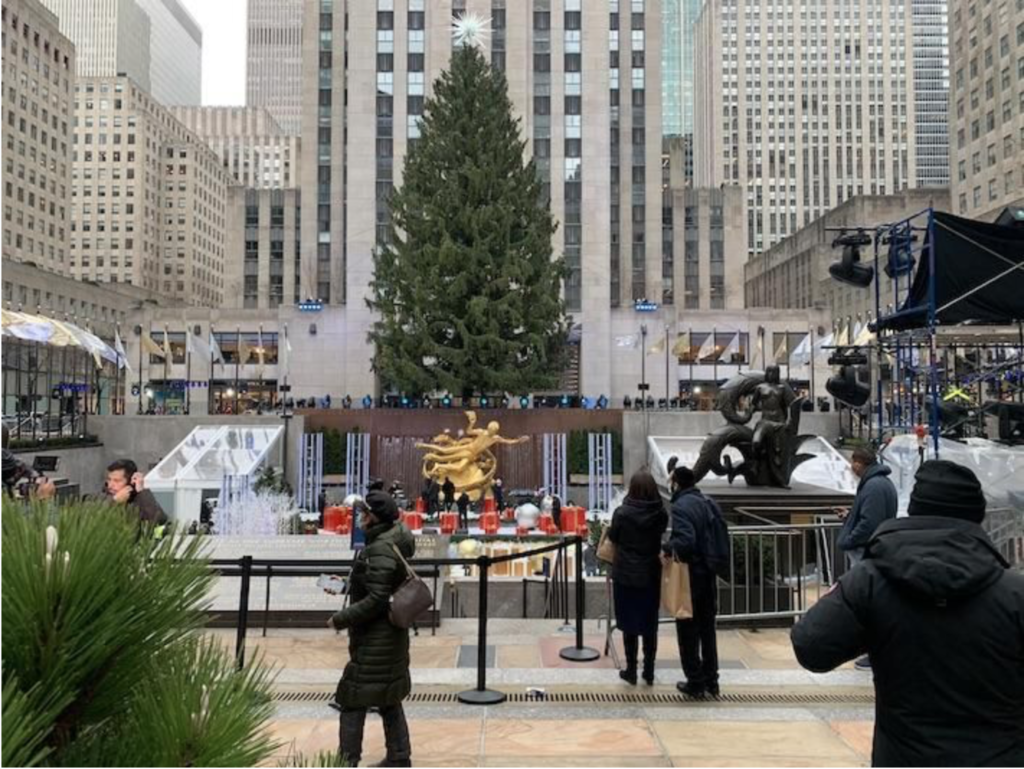
Rockefeller Center in early December 2020.
While retailers like Forever 21 in Times Square or the American Girl Store at 75 Rockefeller Plaza have been open since June, the quintessential New York City experience in Midtown stands still. Scores of posters for Broadway musicals, movies and TV shows advertising premiere dates for spring and summer 2020 still adorn the marquees and billboards of Times Square, frozen in time. The buzz from the throngs of people, taxis and performers has been replaced by piped-in holiday music.
The buildings that house the traditional Midtown tourist and office hubs are still standing, but the reality of the space is different. On sunny days this fall, key landmarks such as Grand Central Terminal, Bryant Park and St. Patrick’s Cathedral host a fraction of their usual barrage of office workers and tourists elbowing each other to try and get to the next experience or meeting. On rainy days, one of the world’s biggest urban attractions feels like a ghost town
Hotels in the area, which were beneficiaries of the city’s over 65 million touristsand millions more business travelers annually, have taken the hardest immediate hit. The Roosevelt Hotel, The Times Square Hilton and the Courtyard by Marriot in Herald Square have closed their doors permanently, and an estimated 20% of hotel rooms citywide are predicted to never reopen.
Meanwhile, swaths of retailers are filing for bankruptcy as retail rents along the area’s priciest strips plummet.
Beyond the tourist-driven business, the Midtown that was the world’s foremost office district has taken a punch to the chin. In the third quarter of this year, Midtown office tenants added 9M SF of sublease space to the market, more than those in Midtown South and Lower Manhattan, according to Savills.
Next to the skyscraper-dominated heart of Midtown, on side streets in neighborhoods like Murray Hill, Koreatown, Hell’s Kitchen and the Flatiron District, outdoor restaurants were some of the few rays of light. This summer, when outdoor dining began, restaurants showed their personalities, furnishing their new Parisian setups with in-season blooms from local florists. Into the unseasonably warm autumn, some Midtown restaurants had to turn customers away because waitlists for their outdoor tables were too long.
These same restaurants have built huts and igloos, decorated with evergreens and sleigh bells, with signs boasting their heated seating and holiday menus. Their creativity has inspired hope for the recovery ahead.
“Outdoor dining is really compelling,” L&L Holding Co. Managing Director David Orowitz said. ”It brings people out, so COVID or not, that is here to stay.”
The pandemic has sped up everything from the work-from-home movement to the so-called death of retail to pain in an already oversupplied hotel market, sources say.
“COVID has really just exacerbated existing trends,” real estate advisory firm HR&A Advisors principal Sulin Carling said.
While companies are expected to come back to the office eventually, it will be different. Nearly 1 of every 5 workers can work completely remotely, a report from the World Economic Forum released this week shows, and after the pandemic, work-from-home is set to continue, most likely in a hybrid way, with most workers spending two to three days in the office.
Some 38% of 800 corporate leaders in a McKinsey & Co. survey said they are planning on decreasing the number of required days in the office by one or two, the World Economic Forum report showed. Another 19% said they planned on decreasing the number of required days in the office to three or more. Even when office workers do come back, Midtown’s daily crush of office-related traffic could never recover its pre-pandemic form.
Office will not be the only asset class permanently changed. With tourism not set to rebound to pre-pandemic rates until 2025, hotels face a long recovery ahead of them. Brick-and-mortar retail, which has been a cash cow in Midtown, seems to be in a state of permanent decline.
In order to survive in a new world, the No. 1 office market in the country must evolve if it hopes to maintain its crown.
‘A Wonderful Canvas’ For A Post-Pandemic New York
Urban planners, when asked what a reinvented Midtown should look like, imagine a place where side streets are filled less with cars and more with colorful café seating, where a microbrewery sits on Fifth Avenue next to a logistics center where cyclists pick up e-commerce packages for delivery, where shuttered hotels are turned into affordable housing and an elevated green streetscape runs over Park Avenue.
To more immediately address the area’s issues of vitality, office landlords need to infuse hospitality into their offices and amenitize their spaces to attract tenants and prove to employers that the office can provide something that working from home just can’t, Marx Realty CEO Craig Deitelzweig said. Marx owns the 430K SF office and retail building at 10 Grand Central and the 130K SF office building at 545 Madison Ave.

Fifth Avenue in Midtown in December 2020.
Deitelzweig paints a picture of an office building where plants and greenery overflow into public areas and plazas, making the area warm and inviting for workers to come to every day. In one of his buildings, he installed a fire pit on a terrace that he said is incredibly popular among the workers who are still coming in.
“Unfortunately some of the public space that has come to the market recently has been kind of sterile,” he said. “I think people now more than ever are looking to provide warmth to their environment … the Central Parks of the world, the Bryant Parks of the world, that’s the kind of environment people are looking for.”
While he believes that Midtown will come back strong because of its transportation hubs in Grand Central and Penn Station, he also thinks office landlords who don’t adjust to a new reality will slip through the cracks.
“I do think there are haves and have-nots,” he said. “And the buildings that are not adapting will have to go back to their lenders.”
Deitelzweig also believes that the rollback on regulations for outdoor dining is an opportunity to elevate the city to new heights.
“I think this winter, New York City has the opportunity to look like Aspen,” he said.
Winston Fisher, partner at Fisher Brothers — which owns Midtown office buildings such as 1345 Sixth Ave., Park Avenue Plaza and 299 Park Ave. — said Midtown could differentiate itself globally as an art-infused office district by investing in public art and community infrastructure, which his company had already done pre-pandemic.
“Now more than ever, we’ve wanted to help Midtown be attractive for all types of tenants,” Fisher said. “I think New York is a wonderful city and I think people are going to come back, but we do need some creativity … I think that Midtown is a wonderful canvas for these types of experiences to happen.”
Fisher Brothers hosted a movement art performance in the lobby of one of its buildings, something that drew interest from its tenants, Fisher said. In 2018, Fisher Brothers hosted a competition that solicited designers for plans for an elevated public walkway and greenscape over Park Avenue in Midtown. The developer dubbed the proposal “Center Line,” an homage to the West Side’s High Line. The proposals envisioned a basketball court, waterfall and cubic art exhibit, according to Dezeen.
Out of the 150 entries the competition received from urban planners, students and others, 17 were shortlisted.
Fisher said he hopes the city takes up and funds the winning idea post-pandemic, because the convergence of public art and Midtown’s work culture could help ensure its comeback.
“You want to show employees you can work from home, but the office can be even more exciting … you want to make it fun and interesting,” he said. “We could lean again deep into the art community to create increasing streetscapes.”
Rockefeller Group, which owns 1271 and 1221 Sixth Ave. across the street from Rockefeller Center, is also looking to renovate its office spaces to bring them into a new work era for Midtown.
“Work-from-home, in some form or fashion, is here to stay,” Rockefeller Group Executive Vice President for Core Holdings Bill Edwards said. “For us, we’re trying to take the approach of how we’d identify places we can amentitize the space so that it makes it a more difficult decision to work from home.”
The developer said that it was finishing up renovations at 1271 Sixth and scoping out where it could add more amenities to its buildings. With a retail vacancy at 1221 Sixth, the developer is looking to pivot the space for public use.
“Part of that project is to create that public space,” Edwards said. “The question we ask is how to activate that space for the public, especially the renovation of that plaza.”
Public space is a key element of the future of the area. This was in part propelled by the burgeoning and popular outdoor dining scene, said Kent, the urban planner.

Bryant Park during December 2020. Typically the park is crowded with guests shopping at the park’s outdoor Holiday Shops.
The public fervor for this kind of public space creates a unique opportunity for the city and stakeholders, he said.
“There’s an opportunity to bring locals to a few key places, there are people who want to connect with the heart of their city,” Kent said.
Kent said the city should restrict the number of cars on the widest streets in Midtown so that street vendors and restaurants could serve pedestrians better and bikers could more safely get around the area.
He suggested capping traffic to a maximum of two lanes along avenues in Midtown and removing parking. The city could also create expanded protected bike lanes as well as commercial drop-off zones, he said. Urban planners at the Regional Plan Association have proposed a plan that would create 425 miles of protected bike lanes throughout the city.
Kent also believes that these public spaces will help attract workers back to the city, he said.
“The future of work is increasingly in shared space,” he said.
As for retail, HR&A Advisors’ Carling, who previously worked for the City Planning Commission, said Midtown’s future ground floors should more closely mirror the consumer demands of the day.
Enormous retail spaces could be repositioned into micro-distribution centers or hubs, such as an Amazon locker, where delivery associates on bikes could pick up packages to deliver across the city. Makerspaces — such as microbreweries, apparel manufacturing and other small mixed-use manufacturers — could take up ground-floor retail where big-box retailers currently are. Ghost kitchens are also likely to proliferate.
“I think it’s going to require, on the landlord’s side, some creativity around how we fill those spaces,” Carling said. “The other half of the equation will be put around centralized planning.”
The city could rezone the area so that apartments would line side streets instead of ground-floor retail, she said.
Landlords will have to pivot and adjust prices to meet the new reality for retail, Rudin Management Co. Chairman and CEO Bill Rudin said.
“Owners are going to have to be realistic about what the value is in these spaces, work with the tenant or be aggressive to attract new tenants,” he said.
While tourists will return to hotels, the hospitality market will be a lot different. Hotels need to make people feel safe again, LW Hospitality Advisors President and CEO Daniel Lesser said. This may include new technology such as touchless check-ins and other ways to mitigate the spread of germs.
The hotel market in the area was already oversupplied before the pandemic, so an obliteration of demand entirely has put the final nail in the coffin for many. An estimated 20% of the city’s hotel rooms won’t reopen, which would leave a lot of empty space throughout Midtown.
Beyond increased public space, repositioning, redevelopment and creative office renovations, the future of Midtown relies most heavily on New York City’s economy on the whole. The city needs federal assistance to close budget holes and continue its quality of life to retain and attract residents, the lifeblood of the city, experts said.
“Manhattan is an island, and Midtown is part of that island,” Lesser said. “If the rest of the island doesn’t come back, I don’t know how Midtown does.”
Construction Underway on Marx Realty’s $41M Hospitality-Themed Repositioning at The Herald Building in Washington, DC

New Renderings Reveal a Building of ‘Firsts’ with Soaring Ceilings, Luxe Lounge Space and Historic Touches Reminiscent of Storied Past
Marx Realty (MNPP), a New York-based owner, developer and manager of office, retail and multifamily property across the United States, announced that construction is underway at The Herald building in Washington, DC. The firm has begun a $41 million transformation that will bring a first-of-its-kind hospitality-infused aesthetic to the Washington, DC office market. The significant upgrades will combine form and function as well as health and wellness. Asking rents will be in the $60-74 psf range and construction is expected to be complete in early Spring 2021. Marx Realty acquired the 114,000-square-foot building in April 2020 and is seeing strong demand from Fortune 500 companies, associations and various technology firms, among others.
“It’s exciting to see the new face of The Herald come to life as construction begins in earnest,” said Craig Deitelzweig, president and CEO of Marx Realty. “Our reputation for having pioneered a hospitality-infused ambiance in office buildings is well-known and we’re seeing significant interest from a variety of high-profile tenants seeking a modern office space with a top-to-bottom sensory experience. The Herald will bring a new brand of workspace to the DC market with meaningful updates designed to pay homage to the building’s incredible ceiling heights and past life as home to the Washington Herald’s printing and office operations.”

The Herald was built in 1923 in a Beaux Arts style and is the former home of the printing presses and offices of the Washington Herald Examiner, where Jacqueline Kennedy Onassis (then Bouvier) once worked as the “Inquiring Camera Girl,” both as a photographer and reporter. Marx Realty will build on the historic elements of the building, including an updated entry portal with an intimate foyer that opens to an expansive lobby with a striking floor-to-ceiling copper and glass wall inspired by traditional linotype printing machines.
A uniformed doorman will attend the oversized wooden entry doors in another nod to the hospitality aesthetic as the entry, foyer and lobby come together to effectively blur the lines between a commercial office asset with wellness undertones and a luxury hotel product with a welcoming vibe. The lobby space will boast walnut wood and copper accents, ample seating areas and soaring 22-foot ceilings. Tenants and guests will be welcomed with mood music and Marx Realty’s signature scent infused throughout the building– a sensory experience similar to the world’s finest hotel properties.
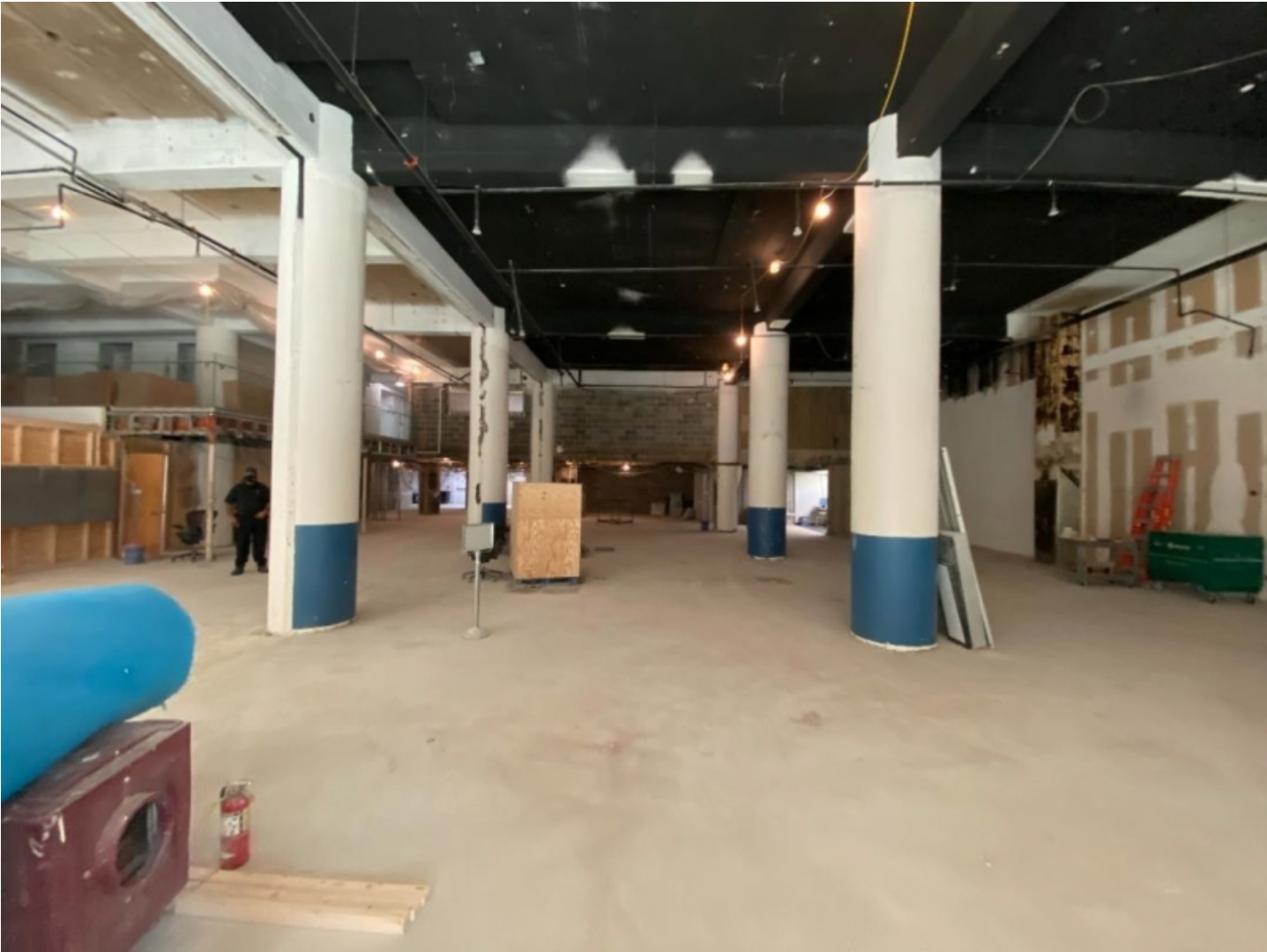
“This building and its one-of-a-kind hospitality aesthetic will represent a new benchmark for office buildings in the DC market,” continued Deitelzweig. “It will translate the rich and important history of The Herald to a warm and welcoming workspace ideal for current and future generations of office tenants in governmental affairs, media, technology and financial services. The incredible ceiling heights are unheard of in this market and will serve as a significant differentiator at The Herald as tenants continue their return to the office.”
The level of detail is stylish and functional at every turn. A 40-seat board room and well-appointed 8,800-square-foot Bouvier Lounge on the ground floor, adjacent to the European style cafe will round out a total package of hotel-like ambiance giving tenants an inspirational experience from the time they enter and throughout their entire day. From historic photos, curated artwork and newspaper printing memorabilia to the brass and copper elements, a cafe and a fireplace, the club floor combines contemporary style with the building’s storied past. The seating spaces feature velvet banquettes with antimicrobial properties while a café with outdoor seating gives tenants and guests an al fresco option.

The fitness center — Press Fitness – will feature boxing, private workout rooms with individual pelotons and Mirror fitness system, and an overall aesthetic that combines classic and contemporary touches and speaks to the building’s rich history. The doorman and club floor personnel will work in tandem to reduce the need for tenants and visitors to come in contact with surfaces. Marx Realty’s proprietary Marx Connect software interface will be implemented in order to minimize physical interaction and offer every convenience through a touch of your phone.
This project represents the next installment of the successful collaboration between Marx Realty and David Burns of Studios Architecture, continuing the hospitality-meets-office repositioning success at 10 Grand Central and 545 Madison Avenue, both in New York City.
Marx Realty Breaks Ground on $41M Redevelopment of Hospitality-Themed Office Building in D.C.
The Herald will feature historical art throughout the property, including an ode to Jacqueline Kennedy Onassis (then Jacqueline Bouvier), who worked at the Washington Herald Examiner as a photographer and reporter.
WASHINGTON, D.C. — Marx Realty has broken ground on The Herald, a 114,000-square-foot office building in Washington, D.C. The New York-based developer is investing $41 million to redevelop the property into a hospitality-themed office building. The lobby will feature 22-foot ceilings, a doorman, European-style café, 8,800-square-foot lounge, a fitness center, historical art and several seating areas, similar to a hotel lobby. The asset was originally built in 1923 as the printing press and offices for the Washington Herald Examiner. Marx Realty will update the entrance to the lobby to include floor-to-ceiling copper and glass walls inspired by linotype printing machines. Marx Realty expects construction to be completed in the spring. David Burns of Studios Architecture designed the asset.
This renovated D.C. office building will feature an old-school hands-free technology: a doorman

Commercial real estate owners are increasingly looking to harness touch-free technology for their office tenants to help slow the spread of Covid-19, and Marx Realty is no exception.
Well, maybe a slight exception when it comes to who’s doing the touching. The New York-based commercial real estate firm has kicked off a $41 million renovation to the former Washington Herald Examiner building at 1307 New York Ave. NW after acquiring it earlier in 2020. The finished product will include plenty of technology and other improvements to keep the virus from spreading via high-touch surfaces such as door handles or elevator buttons. But it is also turning to an older form of touch-free service many commercial real estate owners shifted away from years ago: a uniformed doorman. In addition to the doorman to greet visitors and tenants, the building will feature curated mood music, oak wood flooring, even a specialized scent infused into the building’s common areas through the duct work. In marketing materials, the developer boasts The Herald will be a “hospitality-infused office like no other.” The pandemic has accelerated many commercial real estate trends that were already in the works previously, including a shift toward hospitality and the need for building owners to create spaces that will stand out from the crowd. Craig Deitelzweig, president and CEO of Marx, hopes to do that by creating the sort of environment that makes employees want to come back into the office again after months of working from home.
“I think that’s what it takes to bring people back to work,” Deitelzweig said. “All of it is geared toward making you feel good and that going to work is more like checking into a hotel. It will look very much like a hotel. It will also have a real D.C. sensibility to it, with walnut, velvet, fluted columns, and real wood floors in a herringbone pattern.”
Deitelzweig joined Marx in 2017 after heading up the office division for another high-end New York landlord, Rockrose, which sought to elevate the bar with projects like its renovations to 1776 Eye St. NW. He is bullish on the future of office and believes that, after months of working remotely, many employees are itching to get back to work once conditions permit their safe return. Marx retained Studios Architecture to help create those conditions at The Herald, which will include features like individual exercise rooms with antimicrobial bronze paneling and mirrors to ensure people feel comfortable using common area amenities like the fitness center. Other amenities will include The Boardroom, a walnut-paneled meeting room with seating for 30, and the Bouvier Club, a club floor featuring an outdoor, European-style patio and a cafe, among other things. The club floor is named after Jacqueline Bouvier, who was known as “the Inquiring Camera Girl” at the Herald long before she became First Lady Jacqueline Kennedy. The building, which includes plenty of other nods to its newspapering heritage, is slated to deliver in April. Deitelzweig declined to disclose the building’s asking rental rate but said it will likely not be the cheapest option for tenants seeking office space in the District. Marx has retained a JLL leasing team including Doug Mueller, Evan Behr and Nathan Beach to market the space to prospective tenants. Marx faces plenty of competition for those tenants, with D.C.’s office vacancy rate in record-setting territory, but Deitelzweig believes The Herald’s amenities and design by Studios Architecture principal David Burns will help set it apart from the competition.
“I think it is competitive, but for us, what we’re delivering is so unique there really isn’t a whole lot of competition for the space we’re delivering,” he said. “That’s what you have to do in this environment, is really be distinct.”