
 Contact
WeWork’s plan for a brighter financial future includes firing nearly 20 of Neumann’s family and friends and selling his $60 million private jet.
By Alison Durkee | September 27, 2019

With founder Adam Neumann now out as WeWork’s CEO, the company is taking drastic measures to preserve its future by distancing itself from the controversial former leader. The Wall Street Journal reports that new co-CEOs Artie Minson and Sebastian Gunningham are planning to slim down WeWork through extensive cuts, with an eye toward finally seeing out the company’s recently-postponed public offering likely next year. “We will closely review all aspects of our company with the intention of strengthening our core business and improving our management and operations,” the co-execs wrote in an email to employees after Neumann stepped down. “We anticipate difficult decisions ahead.” But there’s one move that doesn’t seem to be so difficult for the new leadership to take: showing Neumann’s closest allies the door.
Per the Journal, Minson and Gunningham are reportedly planning to lay off nearly 20 We employees who are friends and family members of Neumann and wife Rebekah Paltrow Neumann, who will be departing the company herself. The highest-level execs to depart, multiple sources are reporting, are Vice Chairman Michael Gross and We Co. Chief Product Officer Chris Hill, Neumann’s close friend and brother-in-law, respectively. Gross was one of several We leaders who frequently “partied with Neumann in work settings and beyond,” WeWork employees told Bloomberg Wednesday, and WeWork reportedly paid Gross’s parents as the broker for a real estate deal in Miami. (Bloomberg reported Wednesday that two other of Neumann’s party buddies, Special Projects Zvika Shachar and Director of Development Roni Bahar, are now undergoing scrutiny as well.) A group of 10-plus staffers referred to internally as the “oval office” will also be exiting the company, according to the Journal, including several friends who worked on Neumann’s personal deals. Beyond personnel, Minson and Gunningham will reportedly be relieving We of the businesses it’s acquired outside of its core leasing business, like event startup Meetup.com and office management platform Managed by Q.
One of the biggest hallmarks of Neumann’s WeWork legacy set to leave the company in his wake, though, is the former CEO’s $60 million private jet, which the post-Neumann WeWork is now planning to sell. The Gulfstream G650, which sources told Business Insider was a “corporate governance red-flag” to investors in the run-up to WeWork’s failed IPO, had recently reportedly been a sore spot for employees, as Neumann lavished money on the plane and parties while employees were denied bonuses and salary raises over a lack of resources. “The company was spending $60 million on an airplane, and I can’t get a decent raise? It felt like it was ‘We over me,’ unless me was Adam. And We was Adam,” a mid-level employee told Business Insider. Neumann spent even more money by renovating the jet, adding two bedrooms and Apple TVs—complete with shows and movies that staff members spent “three days straight” downloading—to the private jet, which the then-CEO frequently used as a meeting space. “I know of instances where people got on the plane, flew across the country, and flew commercial home,” one executive told Business Insider. (The Journal notes it’s unclear what will happen to other Neumann-era luxuries, like the driver for Neumann’s Maybach luxury car—which is itself worth more than $100,000—and the “spa and ice bath” attached to his office.)
“Adam’s Fantasyland Became A Reality”: Inside The Crash of WeWork’s Magic Millennial Real Estate KingdomNeumann’s ouster was prompted by the intense scrutiny focused on the big-spending exec in the wake of WeWork’s IPO crashing and burning, which included tales of Neumann getting kicked off a private plane for having too much marijuana, throwing an in-house concert with a member of Run DMC directly after laying off 7% of his staff, and telling employees WeWork could “solve the problem of children without parents” and end world hunger. So it’s no surprise that the company would immediately seek to distance itself from its controversial former leader in order to move forward. But now, the question is: Will it work? The company hemorrhaged nearly $2 billion last year and was desperately in need of the cash infusion that an IPO would have provided. “I think this company may go down to zero unless they take drastic moves right away. They’ve gone from heroes to targets in 30 days,” Scott Galloway, a marketing professor at NYU’s Stern School of Business, told my colleague Gabriel Sherman before Neumann stepped down. It looks like Minson and Gunningham are now taking the dramatic measures needed—but as Marx Realty CEO Craig Deitelzweig told Sherman, even those steps may not be enough to overcome the company’s flawed business model, which is based on long-term leases and short-term tenants. When the next recession hits and tenants decide to walk away from WeWork’s luxury spaces, Deitelzweig said, WeWork’s operations won’t be sustainable—even without Neumann blowing through money at We’s helm. “I do not think it’s a viable business, period,” Deitelzweig told Sherman.
With staff rushing for the exits, and the IPO on life support, Adam Neumann’s goal of being the world’s first trillionaire may be out of reach—but WeWork still has major real estate markets hostage. “It’s an all-around s–tshow,” said a WeWork executive.
BY GABRIEL SHERMAN | SEPTEMBER 23, 2019

Not long after Adam Neumann started WeWork in 2010 with a single coworking outpost on Grand Street in SoHo, the then-31-year-old Israeli entrepreneur showed up at a real estate industry conference on Park Avenue wearing his now-familiar uniform, T-shirt and jeans, with shoulder-length surfer hair that looked like it hadn’t been washed in days. Neumann, who is six foot five, was an instant object of fascination among the suit-clad executives in the room, many of whom were twice his age. But it was his hyper-confidence that one attendee recently recalled. “I remember Adam asked me what company leases the most office space in New York. I told him JPMorgan. They have about 3.5 million square feet. And he said, ‘Well, I’m going to lease more than they do.’”
The boast came true. Last September, WeWork surpassed JPMorgan to become New York’s largest private tenant, with more than 5 million square feet of office leases spread across more than 50 locations in the city. Fueled by more than $10 billion in venture capital from Japanese conglomerate SoftBank, Neumann grew WeWork to employ more than 12,500 people and was barreling toward an IPO this month that would have valued the company at $47 billion. On paper he was worth close to $7 billion. In the media Neumann was heralded as the millennial prophet who foresaw a new kind of office culture, one in which the beer and kombucha flowed and MacBook-toting freelancers would love coming to work (at WeWork’s headquarters, Neumann threw “Thank God It’s Monday” parties).
But for WeWork, the last two weeks have been comparable to the end of tulipomania, a complete phase-shift in the company’s prospects. There were stories about Neumann’s reported erratic behavior and drug use. WeWork’s IPO prospectus revealed that Neumann held ownership stake in buildings WeWork leased from, essentially paying himself, and that his wife, Rebekah Paltrow Neumann—Gwyneth Paltrow’s first cousin—was one of the people with the power to choose his successor. Investor demand for the stock dried up, forcing the company to slash its valuation by more than half, and then delay the IPO entirely. A string of high-profile executives walked out the door, including the chief communications officer, the co-head of WeWork’s real estate fund, and the global head of WeWork’s real estate partnerships. WeWork hemorrhaged almost $2 billion last year, which means the company desperately needs the IPO to happen to raise cash, or else must find other sources of funding. “I think this company may go down to zero unless they take drastic moves right away. They’ve gone from heroes to targets in 30 days,” said Scott Galloway, a marketing professor at NYU’s Stern School of Business.
WeWork’s board is expected to hold a meeting this week to discuss potentially removing Neumann as CEO. And inside the company, morale is sinking as fast as the share price. “It’s an all-around shitshow,” a WeWork executive told me.
It’s hard to overstate the degree to which WeWork’s business is built on the egomaniacal glamour and millennial mysticism of Neumann and his wife. Neumann sold WeWork not merely as a real estate play. It wasn’t even a tech company (though he said it should be valued as such). It was a movement, complete with its own catechisms (“What is your superpower?” was one). Many major players found this special sauce irresistible. After meeting Neumann, Mort Zuckerman, the billionaire cofounder of developer Boston Properties, told one real estate executive that Neumann was creating the future of work, according to a person briefed on the conversation. Rupert Murdochalso took meetings with Neumann, a source said. The big-money investors bought it, none more so than Masayoshi Son, CEO of Japan’s SoftBank Corp., who ran the $100 billion Vision Fund backed by Saudi Arabia and Abu Dhabi. In 2017, SoftBank and its Vision Fund invested $4.4 billion in WeWork, and would ultimately invest nearly $11 billion.
Last year Rebekah, a devout follower of Kabbalah, launched a school called WeGrow; WeGrow and WeWork hired a production company to film an interview Rebekah did with Red Hot Chili Peppers frontman Anthony Kiedis at a company retreat, a source said. (In an interview with her cousin that Paltrow posted to the Goop website, Rebekah said, “WeWork is a physical structure through which we can put positive energy and consciousness into the world.”) “He has a wife who wants to leverage this to be her own major character,” said a source who’s interacted with Rebekah. “If you hang around her, she acts as if she’s this fascinating spiritual woman of the world.” But employees bristled at Rebekah’s nebulous, free-ranging role at the company. In August, SoulCycle cofounder Julie Rice, who’d been recruited to WeWork to become the company’s chief brand officer, quit because Rebekah decided she wanted Rice’s title and took it, sources said. (A source close to Rebekah said that Rebekah, as a WeWork cofounder, had always had that title.)
In conversations with people inside and outside the company, Neumann’s pronouncements became wilder. Neumann told one investor that he’d convinced Rahm Emanuel to run for president in 2020 on the “WeWork agenda.” (Emanuel did not respond to a request for comment.) Neumann told another finance executive that JPMorgan Chase CEO Jamie Dimon was his “personal banker” and that Dimon might leave JPMorgan to run the Neumanns’ family investment fund, a person briefed on the conversation said. (A source close to Neumann denied this, and a source close to Dimon told me Dimon has no plans to leave JPMorgan.) Neumann told colleagues that he was saving the women of Saudi Arabia by working with Crown Prince Mohammed bin Salman to offer women coding classes, according to a source. “Adam’s fantasyland became a reality,” a former WeWork executive said.
WeWork’s core business—leasing office space to companies on a short-term basis—has already proven it can be viable. IWG, the parent company of WeWork’s main competitor, Regus, recorded a $130 million profit last year and is valued at more than $3 billion. “WeWork could be a nice little company,” Galloway said. Neumann had the foresight in the wake of the 2008 financial crash to see that landlords needed tenants, and that legions of underemployed professionals would pay for an appealing alternative to working in a Starbucks while they got back on their feet. “What Adam figured out is that people who were working solo or in small groups really want company. They want stimulation,” said a New York real estate executive. “He was the first to infuse these offices with communal elements. What he overlaid on that is the tech vibe of the moment. He was throwing in all the ingredients that were perfect for that moment.”
The ever-rising valuation of WeWork’s stock allowed Neumann to cash out some $700 million in the private market and buy five homes. When Neumann showed an executive his $35 million Gramercy home last year, he pointed out that the staff lived on the first floor. “He said the bottom floor is the servants quarters. What he’s learned is you have to separate the help,” the executive recalled. “It’s very difficult for anyone to control themselves if you have a sugar daddy like Masa,” a former WeWork employee recalled. In meetings with nonprofits to discuss philanthropy, Neumann claimed he would be the richest person they would ever meet, a person briefed on the conversations said. The Wall Street Journal recently reported that Neumann told people his goal was to become the world’s first trillionaire.MOST POPULAR
Being seen as a visionary is part of Neumann’s business model—but in recent months, he’s increasingly been seen as a flake. Neumann skipped crucial meetings or showed up late for no reason, according to two sources. They told me he basically stopped attending WeWork board meetings because he had control of the company. Neumann’s habit of going AWOL had consequences, though. Last fall Neumann was scheduled to meet Khaldoon Khalifa Al Mubarak, the head of Abu Dhabi’s sovereign wealth fund, at the St. Regis in Manhattan. Already, Mubarak was having doubts about SoftBank’s massive bet on WeWork and wanted to meet with Neumann to discuss the business. People familiar with the meeting said Neumann showed up late wearing sunglasses and looking hungover. Last December, not long after the meeting, the Journal reported that Abu Dhabi and Saudi Arabia were hesitant to participate in SoftBank’s planned $16 billion investment in WeWork. (Mubarak did not respond to a request for comment.)
The Vision Fund’s biggest backers weren’t the only ones growing skeptical of Neumann. Around the same time, Neumann came up with an idea to partner WeWork with Apple, sources said. Neumann flew out to Apple’s Cupertino headquarters and pitched Apple CFO Luca Maestri on doing a deal with WeWork. It’s unclear why Apple would want to invest in WeWork, and not surprisingly, the company passed. “This was the Hail Mary,” a source briefed on the Apple talks told me. “There was Adam’s idea that there was some way out.” (A source close to Neumann said the potential Apple deal was a small one.)
Without a white knight to bail out WeWork, Neumann needed the IPO to go off successfully. The stock sale was supposed to raise $3 billion, as well as unlock another $6 billion in loans. A WeWork source said the company plans to go ahead with the IPO next month, but a source close to the board dismissed that as unlikely. What happens next is being debated. The source close to the board said the company has no legal power to force Neumann out, given the scale of his voting shares. This could lead to a civil war for control of the company if Neumann digs in. Scott Galloway said WeWork could survive by getting Neumann to step aside, slashing costs, and trying to raise prices on current tenants. But Craig Deitelzweig, the CEO of Marx Realty, told me even if WeWork takes those steps, the fundamental business model of taking on long-term leases and signing up short-term tenants isn’t sustainable. When the next recession comes, WeWork tenants can walk away, but WeWork is on the hook for its leases. WeWork hasn’t come close to turning a profit in a bull market. “I do not think it’s a viable business, period,” Deitelzweig said.
Neumann’s bet may be that he will be able to force landlords into renegotiating his leases to lower prices. Essentially it’s a bet that WeWork is too big to fail and the real estate industry will have to cut it a break. Neumann recently made that argument himself. “In the major cities in the world, WeWork is propping up the office market,” he told a real estate executive. “If I say ‘pencils down’ to my people, the value of buildings will plunge and I can go in and buy them on the cheap.” The executive was chilled by the conversation. “We’re not talking about a Harvard Business School analysis here. This has a predatory aspect to it.”
Landlord fetches Park Avenue rents—on Third AvenueDaniel Geiger
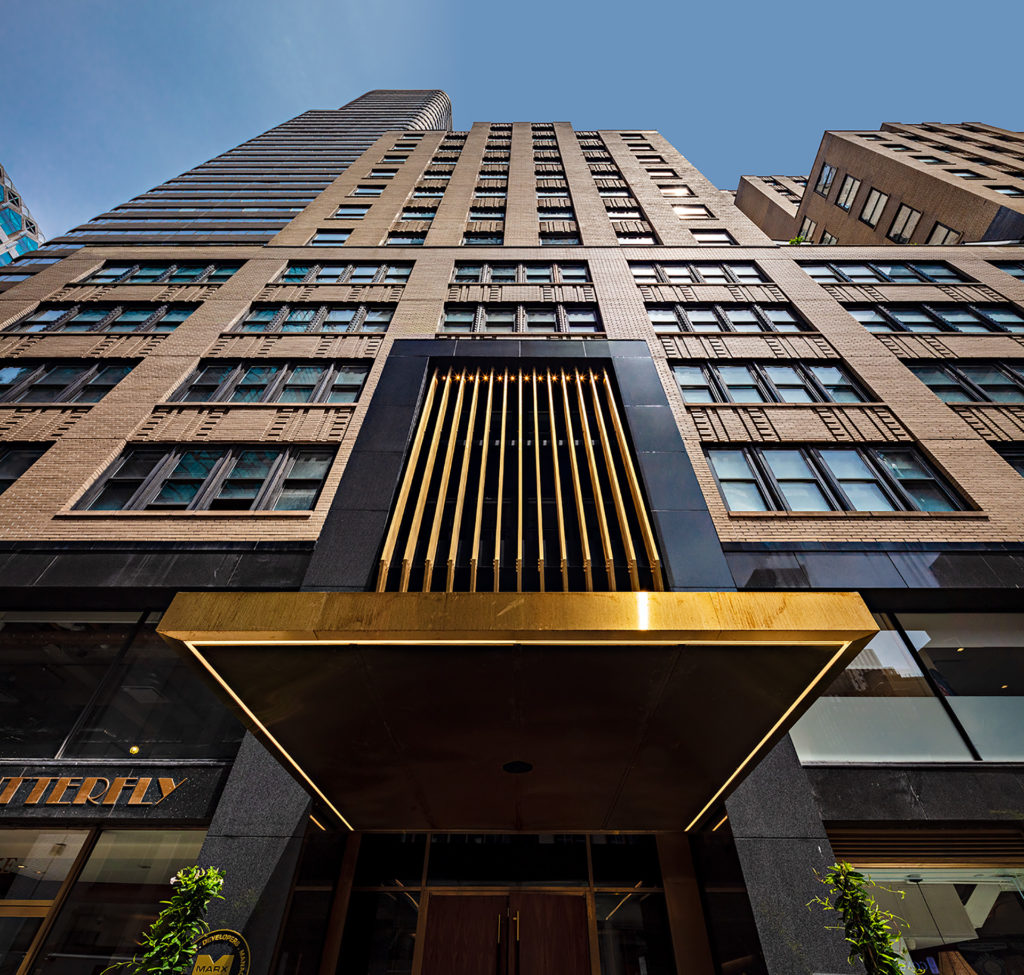
On Park Avenue, office tenants pay lofty rents to be in Midtown’s most exclusive office district. A move to east to Third Avenue generally brings a discount, but also a significant loss of prestige.
Marx Realty has sought to flip that script at the 36-story, 1931-vintage office building it owns at the corner of East 44th Street and Third Avenue.
Once known as 708 Third Ave., the company rebranded the property under the new moniker 10 Grand Central last year and recently finished a multi-million dollar renovation of the building.
The upgrades included the installation of hotel-like amenities such as a doorman-staffed entrance, a concierge in the building’s refurbished lobby, a lounge on the 7th floor with an outdoor terrace and even a signature scent that wafts through its common areas along with a soundtrack.
Rental rates that last year were in the $40s per square foot have now doubled and even tripled for some of the 430,000 square foot building’s best spaces.
Crux Informatics, for instance, just signed a deal to leave the Seagram Building, one of Park Avenue’s most sought-after addresses, and take 10 Grand Central’s entire 18th floor. Asking rents were $85 per square foot for the roughly 18,000 square-foot space
“This building embraces everything you love about a hotel and that’s something that is resonating with tenants,” said Craig Deitelzweig, Marx Realty’s president and CEO, who joined the firm two years ago and has been focused on re-imagining its assets in the city and around the country. “If you’re coming from Park Avenue, this building is more than equivalent, in many ways it’s better.”
Among the other attributes that Deitelzweig pointed to are the building’s abundant outdoor spaces: its numerous setbacks create 44 terraces for tenants.
Next up, Marx Realty is looking to fill 10 Grand Central’s top 5 floors, which it has branded the “penthouse collection,” that features luxurious office installations, outdoor spaces and soaring views, including a close up vista of the nearby Chrysler Building.
A duplex penthouse on the topmost floors, 35 and 36, will feature 20 foot ceilings, a hardwood staircase, library and bar. For now, the asking rent is $130 per square foot for those 2 levels, but Deitelzweig has toyed with the idea of bumping up the price because of interest it has received.
Acclaimed Repositioning of a Historic Building“We might make it $150,” he said.
By Ingrid Tunberg | September 06, 2019 at 06:00 AM




ATLANTA, GA – The Department Building in Atlanta, GA stood out among numerous, impressive historical preservation projects for GlobeSt.com’s 2019 ADAPT awards. We proudly honor the project as the winner for best repositioning of a historic building. We will be recognizing the project at our awards ceremony in Baltimore on September 16th.
Considered one of downtown Atlanta’s most iconic, historic structures, The Department Building was first occupied by Regenstein’s Department Store, a go-to, high-quality women’s fashion emporium among locals in the 1920s.
Upon initially purchasing the building in 1954, Marx Realty decided lead a $10.5 million adaptive reuse and repositioning effort more than 60 years after the original acquisition. In order to preserve the nearly 100-year-old building’s art deco architecture and transform it into an office building, the real estate company partnered with design firm ASD | SKY to manage redesign efforts.
With a deep understanding for the original art deco architectural significance, the team aimed to utilize period details and highlight distinctive features in order to embrace the building’s history, before rebranding and reintroducing the space as a boutique office building.
Marx Realty president and CEO Craig Deitelzweig led the preservation and modernization efforts, seizing the opportunity to blend authentic historic aspects with a state-of-the-art technology-driven details from fixtures to furnishings.
The renovations on this 48,000-square-foot building included restoring 18-foot high terracotta barrel vaulted ceilings, fluted columns, brush walls and original wood floors, as well as implementing new elevator systems, loft-style floor plans, oversized windows, a dedicated lobby and rooftop amenities with downtown city views. The process required extreme care when handling various façade accents and dealing with the building’s original wood flooring, in order to return it back to its former glory.
Catering to the demand of high-quality workspaces and fine dining options in the neighborhood, Marx Realty has quickly filed the street-level retail spaces with prominent stores and restaurants, while working with the country’s top technology firms, streaming media platforms and additional companies to fill office space and welcome a new generation of creative professionals, as the remodel nears completion. The project’s neighborhood impact has also allowed the building to request higher rent from tenants than in years past.
A previously forgotten building, The Department Building has exceeded all expectations, generating a go-to destination, once again, for high-quality experiences in the downtown neighborhood. With an ever-changing city landscape, Marx Realty chose to showcase a stand-out, constant building.
Most Mindful Overall TransformationBy Ingrid Tunberg | September 03, 2019 at 06:00 AM


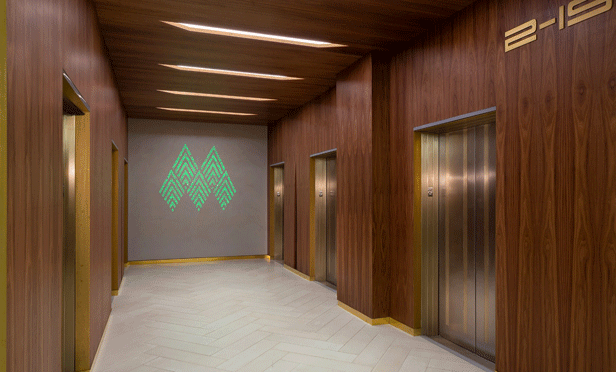


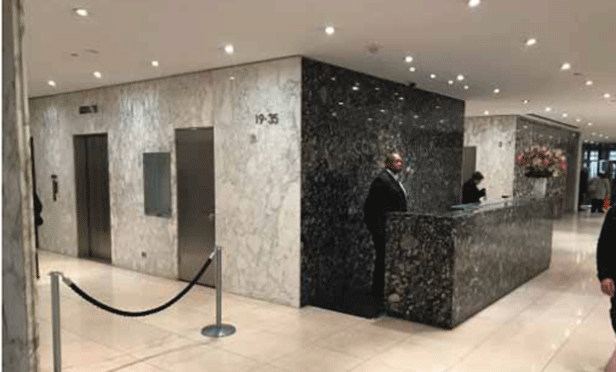
NEW YORK – For our pre-event coverage of GlobeSt.com’s ADAPT awards, we considered numerous adaptive reuse projects. We have determined the winner of the most mindful overall transformation to be 10 Grand Central in New York. We will be honoring the project at our awards ceremony in Baltimore on September 16th.
10 Grand Central is a 500,000-square-foot office tower, designed by Ely Jacques Kahn in 1931. The building, located at 155 E 44th Street in New York City, had lost all of its Beaux Arts architectural charm and lacked a defining character, until Marx Realty launched a $48 million repositioning and rebranding effort in July 2018.
Acknowledging the building’s desperate need for a powerful transformation, Marx Realty president and CEO, Craig Deitelzweig teamed up with Studios Architecture to lead the entire restoration project for the historic tower to increase occupancy while honoring the original architecture.
The recently completed renovations consisted of a four-story entry portal, a new marquee, lobby reimagination and a “club floor” for tenant amenities. Many structural beams had to be removed in the renovation process due to age, in order to create the high ceiling design. The redesign efforts revealed brushed brass finishings, polished concrete accents, oversized walnut doors and digital art installations for an overall 1930s inspired, hotel-like aesthetic, equipped with a uniformed doorman.
The most prominent, distinguishing change to the structure was the relocation of the building’s entryway, which returned to its original address on 44th Street. This was in an effort to better position the building toward the iconic neighborhood and to showcase the building’s proximity to Grand Central Terminal; something that was not evident with its previous 3rd Avenue address.
Additionally, the firm created an entire floor designated for tenant amenities, including a café space, a 36-person conference facility and an indoor/outdoor lounge with a fireplace, all within the 7,500-square-foot space. No detail too small: the terrace featured plants specifically chosen to reflect 1930s gardens.
The unique project embodied significant historical preservation, as well as a modern office transformation, which was delivered in full in May 2019. Since the project’s completion, the building has seen a 91% occupancy rate, a 38% ROI, more than 75% increase in rents, with an increased building value of more than $150 million.
Mindful of the structure’s original architecture, Marx Realty saw an opportunity to embrace the hospitality and office features and set a new benchmark for office tower design. 10 Grand Central balances classic and contemporary design, with an end result exceeding expectations.
WeWork’s Largest Markets Brace For IPO ImpactAugust 28, 2019 | Mike Phillips and Miriam Hall
LONDON and NEW YORK — In 2010, the biggest office tenants in these two metropolises would have been just as recognizable in 1910, and sum up the history of these places.
In New York, it was JPMorgan Chase, the bank founded by the financier who helped fund the creation of modern America. In London, it was HSBC, the former Hong Kong and Shanghai Banking Corp., a company that ties together London with its former Far East colonial empire.
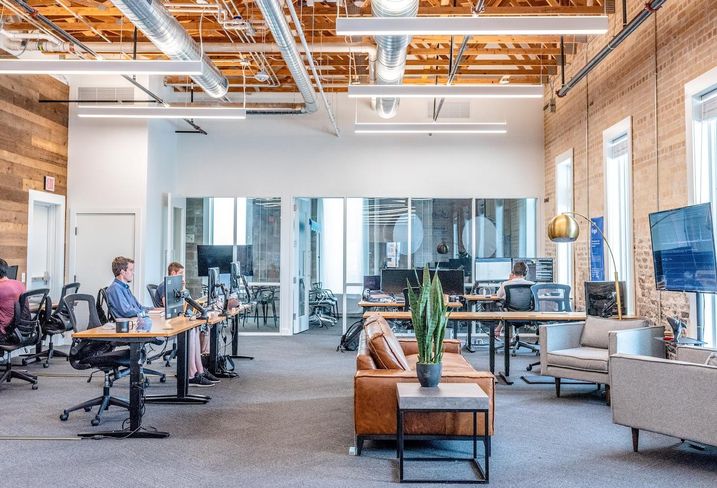
Today, WeWork has eclipsed both of them, becoming the biggest private sector office occupier in both cities less than a decade into its existence. It occupies or is about to occupy 7.2M SF in New York and 4.4M SF in London.
It is an unprecedented scenario: The world’s two biggest commercial property markets by investment volume have, for some time now, been sister cities in the minds of global investors, each ranking a consistent first or second, depending on the year. They are both also currently racked by turmoil sending tremors through their respective real estate communities.
In New York, Amazon recently decided not to build a major new office in the city following public protests, which sparked fears the city could be viewed as anti-business. Meanwhile, strengthened rent control laws across the state have further slowed the investment sales market and caused some big-name developers to suggest they will no longer do business in the city.
In London, the office market has held up well following the UK’s decision to leave the European Union in 2016, but recent actions from new Prime Minister Boris Johnson are making it more and more likely that come 1 November, the UK will have no trade agreement with its biggest trading partner, Europe. That could have a severe impact on London’s position as a preeminent global financial sector.
Now, for the first time, the two cities share the same dominant office occupier, one whose business model and financials are being debated like no other in real estate history, and one which has permanently disrupted the traditionally minded office market in both cities.
In this new world order, office investors and developers in New York City and London have the most to gain or lose from WeWork’s success or failure, along with the cluster of coworking companies that have surged forward in its wake.
Landlords on both sides of the pond are combing through WeWork’s initial public offering prospectus, waiting to see how the float performs and wondering what a newly public and more transparent WeWork says about where the coworking sector is heading.
There is fear and excitement in both cities about how successful the IPO will prove and the impact it will have on the respective markets. But those sentiments are about more than just WeWork.
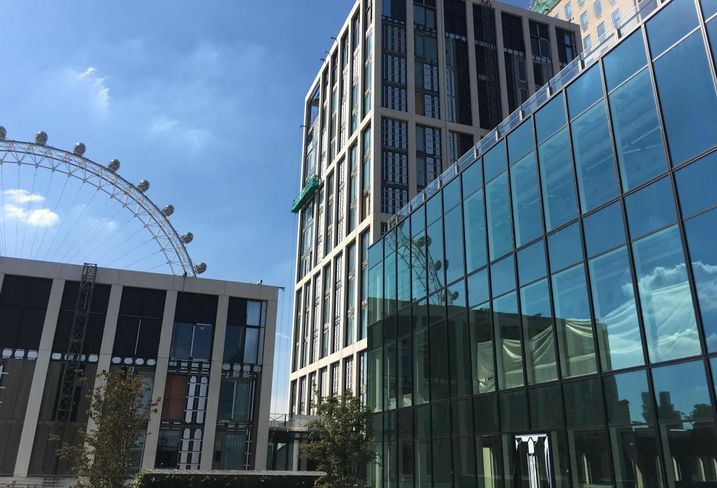
Two residential buildings at Southbank Place with the London Eye in the background, taken from the terrace at Shell’s new One Southbank Place office (the glass building on the right).
Flexible offices are a major driver of leasing in both London and New York, accounting for around 15% to 16% of leasing in both cities last year, according to data from Cushman & Wakefield and CBRE. It has become important in the way that financial services was in the early 2000s, and is almost as important as direct tech leasing in both markets.
“There is an enormous division in the commercial real estate community on the viability of this,” said Bryan Woo, a New York City developer currently building around 1M SF of offices.
Woo’s company, Youngwoo & Associates, has yet to do a deal with a coworking company, he said, but he said that doesn’t mean he’s a skeptic.
“On the one hand, there are people who think this business model is sound … [and] there are people out there who don’t believe in the business,” he said. “And that goes for the financing world as well … It’s black and white. People love it or hate it.”
‘Some landlords will be right, and some will be wrong, and we shall see.’
Though WeWork has charged forward with enormous growth in both cities, New York is where the coworking giant got its start — kicking off with a one-floor lease in SoHo back in 2010. Now the biggest private office tenant in the city, its growth has run alongside the city’s rampant expansion. New York’s population went up by 11% between 2000 and 2016, and job growth jumped by 16% — marking the longest periods of expansion since World War II.
Office leasing has hit new highs, with 2018 seeing the highest lease volume in 17 years, even though vast numbers of new office buildings have been added to the city’s supply. Coworking has played no small part in that office ecosystem; flexible leases accounted for 16% of Manhattan leasing in the first half of this year, according to CBRE. WeWork itself has at least 7.2M SF across New York, according to figures provided to Bisnow last year.
While some New York landlords and real estate observers have embraced the growth of WeWork and its ilk, others point to a gnawing anxiety about their voluminous growth and what it will mean for the city’s entire market.
Right now, flexible space takes up 3.6% of the overall Manhattan office market, and 6% for London, per CBRE.
But the details in the prospectus, and the IPO when it hits, won’t do much to sway opinions one way or another, New York sources said.
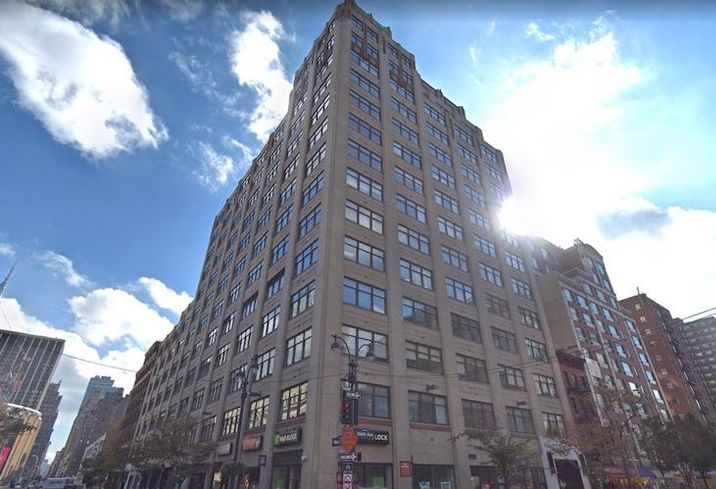
“It’s [either] going to get people more excited or calm people down,” said the head of Normandy Real Estate Partners’ leasing group, Paul Teti.
Last year, the coworking company leased 117K SF at 575 Lexington Ave., a building Normandy co-owns with Angelo Gordon & Co. and George Comfort & Sons.
“I have seen all the unflattering news,” Teti said. “It’s something we have to follow responsibly as landlords … It’s hard to paint them with one broad brush.”
Others think it is pretty easy.
“[The details in the IPO prospectus] reaffirmed everything I had concerns about … They are losing about $5K per minute,” said Marx Realty CEO Craig Deitelzweig, who has been vocal over his distrust of coworking.
The thesis has a fundamental flaw, he believes, which is that WeWork forms long-term deals with landlords and short-term arrangements with its members. Most WeWork members are allowed to cancel with as little as one month’s notice, according to the prospectus. WeWork typically signs 15-year leases, it says, but it is trying to move more toward management agreements.
Deitelzweig is already eyeing buildings in New York City that have significant coworking exposure, with the view of buying them at a discount in the event of a dip in the market. He thinks WeWork’s flip from private to public could cause some landlords to take a step back.
“The IPO has enabled some landlords to rethink how much exposure they have in this sector and be a bit more cautious,” he said. “[But] there are landlords that do not share that concern. Some landlords will be right, and some will be wrong, and we shall see.”
Time Equities CEO Francis Greenburger, whose company has about 12M SF of office space in the U.S., Canada, Germany, Holland and Italy, said while he believes in coworking as a concept, WeWork’s financials don’t make sense to him.
“Is there some expense they have that is going to go away?” he asked. “Is there some revenue source that is suddenly going to be there? I don’t get it.”
BentallGreenOak President Sonny Kalsi said his firm has always been more conservative about coworking than the market average, and has done around 10 deals with flexible workspace companies and would not lease more than 30% of a building to one. The IPO has done little to change that, he said.
“I don’t think [WeWork will] blow up,” he said. “If there’s a downturn they will restructure.”
He added that when BentallGreenOak leases to any coworking firm it insists on corporate credits or other kinds of enhancements for leases.
“If they decide they have to downsize … the [locations] that have a corporate guarantee are the last ones they are going to give back,” he said.
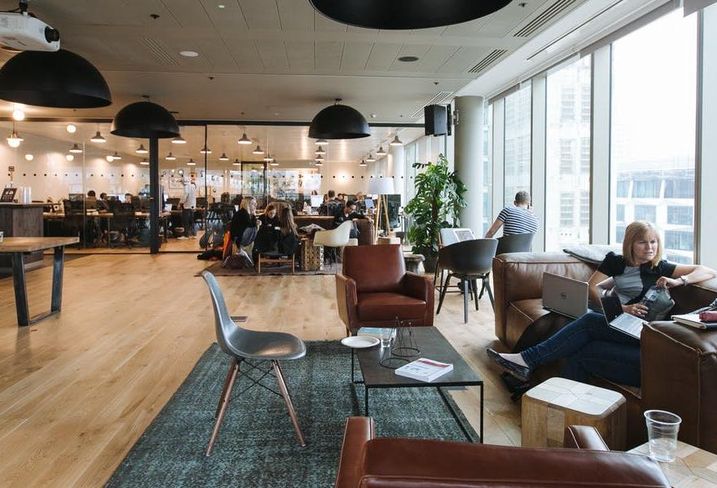
More volatility, more visibility
WeWork has, for some time, used London as a bit of a poster child for how the company can eventually make a profit. In financial results released in 2018, it flagged how one of its earliest and largest London locations, Moor House in the City of London, started turning a profit two years after opening.
And in its IPO prospectus, it highlighted London as an example of how it can increase occupancy when it wants to. It said that it deliberately slowed its growth in the wake of the Brexit vote in 2016, and as a result, occupancy rose by 10 percentage points.
London is the only city for which it discloses overall occupancy, which was 93% as of June this year. That is higher than the company’s overall occupancy level of 89% and, given WeWork said that its break-even occupancy level was significantly below 89%, the facilities open and stabilised — WeWork-speak for two years old or older — in London are presumably profitable.
As of the end of 2017, WeWork was on the hook for £3.2B of rent in the UK, the vast majority of it in London. That figure has risen dramatically, given WeWork’s London footprint has increased by more than 50% since then, according to Colliers.
Occupancy may have improved when the pace of growth slowed, but the company said in the IPO document it had picked up the pace in London again, and earlier this month, Property Week reported that it had signed for another 330K SF across 11 buildings in London.
The significance of the IPO for London’s landlords is the greater transparency it will offer, not just about WeWork’s fortunes, but of the opaque flexible office sector that is currently a major driver of the London office leasing market.
That growth in flexible offices could increase the volatility in the London office sector more generally. And some are also expecting WeWork’s IPO to herald a period of consolidation for the coworking sector.
“They have been growing so fast, and the pace of growth won’t change, but the market will be able to have some clarity,” St Brides Managers Senior Partner Robert Houston said. “Not straight away, but 12 months after the IPO, there will be the ability for shareholders and analysts to ask probing questions about the sustainability of the business model.
“And if they can get the IPO away [at] a decent price, then it will demonstrate to the non-believers that it is not just SoftBank that believes in them, but the wider market, too.”
Whether the IPO is successful or not, London will have more clarity on which are the profitable and successful locations, and this will be beneficial for the market as a whole, one investor and developer argued.
“There is a real lack of transparency about occupancy in the serviced office sector in London, which is a concern given the market share of overall leasing that the sector has,” Seaforth Land Chief Executive Tyler Goodwin said. “If the IPO is not successful, we’ll see which locations are not successful because they will be rationalised.”
And if The We Company does go public, depending on its level of disclosure, then insight into the London performance of the largest office tenant in the city will be a crucial data point for the market more generally. As flexible offices become a bigger part of the Central London office leasing market, they could potentially increase the volatility of the sector.
According to a recent analysis by Fitch, using data from Cushman & Wakefield, flexible office operators accounted for 15% of all London leasing in 2017 and 2018, and now account for 5% of all office space in London.
In a downturn, flexible office operators will see income suffer and will be quick to try and renegotiate rents or break leases, much more so than traditional office tenants, Fitch warned.
“Landlords are therefore locked into the success of flexi-office operators they rent to and are more exposed to their requests for a rent reset when a downturn happens,” Fitch said.
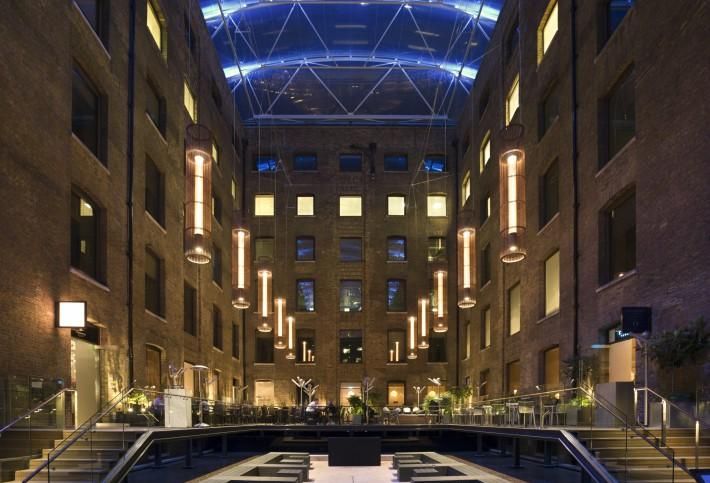
With that in mind, Goodwin said that the IPO might represent a line in the sand for the London flexible office sector, with consolidation in a fast-growing sector starting to occur, and landlords pushing back against a practice that WeWork has utilised extensively in its rapid growth: leasing buildings through individual special purpose vehicles with no recourse to the parent company.
“The real question is what happens next,” he said. “It feels to me like the serviced office sector has grown very quickly, and that should be followed by a period of consolidation where the strong get stronger and the weak get absorbed.”
That has an implication for landlords: a lot of these operators, including WeWork, have given limited covenants, and there is a risk that in a restructuring, underperforming locations are just rationalised and landlords get the space back, Goodwin said.
He added that landlords were becoming less likely to accept these leases with no recourse to the parent company: The lack of new space currently being built in London meant that vacancy rates were likely to hit cyclical lows in 2021, giving office owners a stronger position in negotiations with tenants.
To keep up the pace of growth in London, operators like WeWork will need to increase its liability for their rented locations or move to profit-sharing agreements with landlords, a strategy the company is already pursuing.
On the general prospects for the company in London and beyond, one of the city’s best-known landlords likens the negative coverage that has surrounded WeWork’s IPO to another major London real estate listing that had plenty of doubters.
“There is a huge negativity about WeWork’s IPO, at present, which there was in a similar way when we floated Canary Wharf in 1999,” Almacanatar Chief Executive Mike Hussey said. “People need to visit an outlet and experience the difference before making too many blind assertions. The prejudice against the Canary ‘disruptors’ soon died away when people saw the quality and differentiations in our offer.”
Almacantar is in the middle of selling an office scheme containing one of WeWork’s largest single locations globally, Southbank Place, where it occupies 250K SF.
The £850M sale could be seen as a vote of confidence in WeWork’s covenant, and Hussey said that contrary to the general assumption, he thought that the financial and accounting benefits against taking space on a direct lease as well as the “softer” benefits of well-designed, amenity-rich space meant that in harder times, flexible office space would not be the first corporate space to be jettisoned.
“If WeWork has got it all wrong, which I doubt, most landlords would relish the opportunity to grab the space back and secure the higher operating margins generated from the coworking model, as it is now an established part of our market and, whether or not in WeWork form, it is here to stay,” Hussey said.
Houston put the company in a wider macroeconomic and historical context. He cites the example of Whitaker Wright, a 19th-century British gold prospector who made a fortune in California and was once declared the richest man in the world before his fall from grace which saw investors — including prime ministers — lose their money.
“People couldn’t get dividends elsewhere, and wanted to get rich quick,” he said. “Today, Greek 10-year bonds are currently yielding 1.8% — come on, this is Greece we are talking about. If you can only get 1.8% from buying Greek debt, then why wouldn’t you buy a City of London office building, or shares in WeWork? After all, Apple launched at $20 a share, and look where it is today.”
Foot Locker Opens NYC Power Store in Washington Heights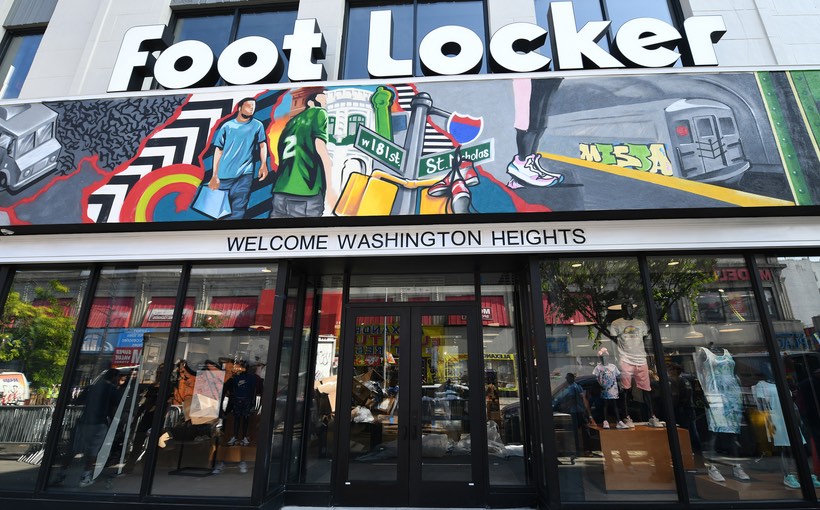
August 15, 2019
Foot Locker is continuing opening-week festivities at its Power Store in Washington Heights, the first of its kind in New York. The 9,000-square-foot store in Marx Realty’s 606 W. 181st St. is also the first among Foot Locker stores to showcase Nike App at Retail digital technology.
“The launch of the Washington Heights Community Power Store serves as an opportunity for us to enhance the in-store customer experience by working in tandem with one of our strongest partners, Nike,” said Frank Bracken, VP and general manager, Foot Locker & Kids Foot Locker US.
Foot Locker currently operates Power Stores in Detroit, Philadelphia, London, Liverpool and Hong Kong, and is expected to open more than a dozen new Power Store locations this year. Upcoming stores are planned for Los Angeles and Vancouver.
The retailer signed a lease with Marx this past April, relocating from its existing space at 625 W. 181st.
Event Recap: ‘Hotelification’ of Real EstateJuly 9, 2019 | By: Laszlo Syrop

On Wednesday, June 19th, ULI New York brought together a group of industry leaders whose organizations are disrupting the residential, office, and retail asset classes to speak on the topic of “The Hotelification of Real Estate.” Ellen Sinreich, Founder and Managing Principal of the Sinreich Group – a New York City-based real estate law firm that represents commercial landlords and tenants – moderated a wide-ranging and rich discussion that explored how changing customer expectations, macro-economic trends, and technology are driving a hospitality-inspired convergence in tenant experiences across asset classes.
She was joined in conversation by David Barry, President of Ironstate Development Corporation; Craig Deitelzweig, President and CEO of Marx Realty; Ken Himmel, President and CEO of Related Urban; and Ryan Simonetti, Co-Founder and CEO of Convene. Ironstate is a Hoboken, NJ-based developer of apartments and boutique hotels, including its hospitality-inspired residential brand Urby. Marx Realty owns and operates office and retail assets in 16 states plus the District of Columbia, including the 10 Grand Central office building in New York City. Related Urban develops and manages large-scale mixed-use assets as a part of the Related Companies, including Hudson Yards in New York City, CityPlace in West Palm Beach, FL and a 240-acre development in Santa Clara, CA. In contrast to the three more traditional real estate companies, Convene is a technology-enabled and vertically-integrated branded operating platform for commercial real estate. The company partners with class A office asset owners to create premium spaces that it manages as part of two primary lines of business: a meeting and event venue business and a third-party commercial property management business.
Kicking off the session, Sinreich prompted the group to explore what the term “hotelification” means in the context of their respective businesses. Several prominent themes emerged. Ultimately, the panel agreed, the trend reflected the emergence of an emphasis on core tenets of hospitality delivery: anticipating customers’ needs, providing comfort and flexibility, and utilizing human-to-human interaction to create emotional connection. Moreover, the term implies an attempt to avoid commodification by pursuing differentiation and authenticity.
“As opposed to commoditized, sanitized [product]… to talk about hotelification [is] to talk about inspired product, true product – something that’s authentic,” reflected Barry.
In service of these ambitions, hotelification involves dedicating significant attention to matters of aesthetics and design, operating partner selection, and programming – particularly the incorporation of multiple use types within a single asset.
“What separates our projects and the way we execute them is a level of taste, it’s about curating a project directly, it’s about having the kind of relationships with restaurants and hotel companies who have the confidence that you’re going to be successful with what you’re doing,” explained Himmel.
Using a specific building to illustrate this further, Deitelzweig discussed 10 Grand Central: “[it] was built in the 1930s, it’s Beaux Arts style. So we try to bring all of that in… We’re very into the details of making sure that it is authentic… we’ve got walnut wood and brushed brass and herringbone floors and we don’t do it in the Disney way, we do it in a modern interpretation… It’s really the attention to details that makes the difference and the tenants can tell.”
But the panelists were also careful to emphasize that the approach they were describing went beyond the level of design and programming that would be a standard part of any new development. Speaking from a philosophical perspective, Barry described a commitment to “elevating the product in a holistic way.”
Deitelzweig built on this by elaborating how his firm achieved a similar type of elevation on a tactical level, explaining “we look at hotels for inspiration and the reason for that is hotels are spaces that make you feel good… [Our spaces incorporate this emotional response with a] holistic approach for the entire building – as you approach, our buildings have doormen like you would see at a hotel, we have oversize doors… we look to all of your senses, outside there’s music playing, for instance, in our lobby we have a signature scent.”
Zooming out even further, Himmel described the process for approaching mixed-use projects and how different aspects of the projects create an interplay. “You’ve got to start with the programming… if you build hotels in your projects… you’ve got to decide who that operator’s going to be, the brand of that hotel… you’ve got to decide today, in mixed use projects, how much retailing you’re going to do… [Retail’s] not dead, it’s just being reinvented like so many parts of our business. So you’ve got to decide how you’re going to curate the retail… [it’s] the toughest question today.”
This attention to detail across design, programming, operations, and other dimensions can be understood as part of a broad shift in relationships within the real estate industry, opined Simonetti. “What’s happening, really, is the customer is being redefined and the expectation of the customer is now what the building owner has to do.”
Re-focusing on the end user experience in this way also demands a deep understanding of who these end users are and what they want. Data, intuition, and interactions with tenants can all help to inform that base of customer knowledge.
Convene is increasingly focusing on leveraging data and technology to do this, Simonetti explained. “Personalization within brick-and-mortar real estate is going to happen and it can’t happen without technology… In order to get to personalization… I have to actually know you, the individual: how you move through space, which spaces you actually go to, when do you work, when do you not work, which services you consume?”
Ironside takes a more analog approach, per Barry. “You need to think through the pieces… what does this resident need and where is the market going?” he explained. “It’s intuitive. Some of it is data-driven, in that other projects we have [allow us to] source feedback off the sites… [and ask the properties’ management staff] ‘What’s being used? What renewals are occurring and what reasons are people giving for that?’”
The panelists also took time to highlight a number of broad difficulties they faced. Scale and project complexity emerged multiple times in the conversation as critical drivers of execution risk.
“We always say that hospitality is the emotional, human-to-human delivery of a service experience, and that’s really hard to scale,” Simonetti added.
The scale and complexity of these types of projects also intensifies the uncertainties relating to developing product for future delivery, which all real estate projects face.
“You’ve got to really anticipate what’s going on for the next three to five years,” Himmel added. “Some of the programming items are so important to get right because you can’t change them… You can’t build a box for Restoration Hardware. Restoration Hardware is a bespoke product.”
Part of delivering a hospitality-like experience, is anticipating customer needs and providing seamless, end-to-end solutions. Historically, Simonetti pointed out, a significant amount of uncertainty fell on the shoulders of office tenants, who needed to understand what their future space needs would be. The advent of flexible space – either for core operating space or special-purpose event space – has begun to put asset owners in the position of delivering an office experience as opposed to static, un-activated space. That has shifted complexity and uncertainty to them, which – he added – is where partnership with an operator like Convene can add value.
Another major challenge facing the space is the tension between short- and long-term investment horizons. The scale of large mixed-use projects often requires an extended timeline to realize gains.
“I’ve been working in West Palm Beach for 21 years… finally that community has matured enough where it’s become a real city… but it’s taken a long time,” shared Himmel.
Returning to a more philosophical frame of reference, Barry mused that “we talked about how long it takes to plan these projects – eight years or ten years – but they sit around for fifty or a hundred years or longer. And so, in a sense, there’s a responsibility beyond just creating whatever thing can be created [easily] for return.”
Deitelzweig drew another parallel with the hospitality industry: “when [the macro-economy] gets bad, the hotel industry is the first one to feel it.” In other words, with shorter lease terms playing an increasing role in the office market, asset owners may experience increased market volatility.
Additionally, assets competing in the premium end of the market through increased investment in capital and operating costs may not find easy comparisons, thus incurring complexity in the financing and sale processes.
“Our rents are higher so when we look at a new acquisition we don’t really comp well… because we’re highly-amentized we have trophy-like rents and so it’s interesting when you’re educating capital partners on that. Some of them get it and some of them don’t but at the end of the day it’s about the NOI and we believe we’ll get that in NOI,” Deitelzweig shared.
This is particularly pronounced for assets comprising a mix of uses, which remain the exception rather than the norm. While “blended” rates may eventually emerge to account for different market standards that apply to the various component portions of hybrid products, there remains little consensus about how to value and assess such assets across the capital markets.
“There is no consensus in the debt capital markets and equity capital markets on how these assets will be valued… [but] my sense is in the next three to five years, we’ll get to a point where the capital markets know how to value [these types of assets],” Simonetti forecast.
Despite these challenges – significant as they may be – the night’s panelists made it clear that successfully applying hotelification strategies presented substantial opportunities to increase profits and mitigate risk.
“Our rents were $44 per square foot, we hoped to increase our rent by about $10 per square foot and we actually increased it by about $30 or $40 per square foot by delivering this hospitality-infused office,” noted Deitelzweig. “We had a full return in less than a year on that [investment].”
“This approach has been getting us 15-20% more per foot or per unit if it’s going head-to-head with other product,” Barry shared.
“If there’s a Convene in your building, you’ll get higher rents, your velocity is higher, and your retention is higher,” Simonetti asserted. “In our meetings and conferences product we can generate anywhere from four to seven times market rent [and in our workspace as a service product] we tend to see a two-and-a-half times revenue premium.”
“A lot of this is about deciding, programming, curating it, mixing it, the right way. That’s what’s fascinating about it: no two projects will ever be quite the same. That’s what I love about our business compared to what’s happened over the years in the commodity mall business where everybody had a formula. They had a formula, they thought they got it right, and they did forty of them,” added Himmel. “[Of] those forty, thirty of them aren’t going to be there in the next five years.”
Closing the session, Himmel neatly summarized the overall lesson of the conversation: “These are crazy wild undertakings and you have to staff yourself to be able to deal with it… We say, ‘how can we truly differentiate ourselves from our competition?’ There’s nobody [that’s] going to take on the kind of thing I’m describing to you. But if you could do it and you’re really equipped to execute it with the caliber of people we’re dealing with, it’s what the market’s looking for.”
As Coworking Conquers Markets, Landlords Wonder How Much Is Too MuchAugust 7, 2019 | Miriam Hall, Bisnow New York
WeWork, which has grown from a one-floor lease in SoHo to New York City’s largest private office tenant in the span of nine years, is expected to go public next month, targeting a $3.5B raise.

But amidst the hype of the highly anticipated initial public offering, the commercial real estate community continues to wrestle with how to hedge against the exploding coworking and flexible workspace sector, and how to capitalize on it.
While some say an IPO could quell lingering anxieties, concern about landlords’ growing reliance on coworking providers — particularly this late in the cycle — remain.
“I’m really excited,” said Jamie Hodari, the CEO of Industrious, one of the largest coworking providers in the U.S. “WeWork’s IPO and its eventual stability as a public company will be beneficial, and will be a powerful stimulant of landlord comfort with the industry, regardless of how the actual pricing comes out. [Landlords] are trying to understand our industry … Transparency is always helpful in solidifying a maturing industry.”
There is no questioning the voracious growth of the sector. Coworking leases in Manhattan increased by 200% last year, according to CBRE, with firms like Knotel, Convene and Spaces all taking space at a rapid clip.
Many well-established landlords have rushed to sign up WeWork and its counterparts, both with direct leases and revenue-sharing agreements.
But some remain cautious — others downright skeptical. Last year, Empire State Realty Trust CEO Tony Malkin likened the sector to “the Donald Trump of this cycle” — referring specifically to “when he borrowed so much money in the late ’80s so that by the early ’90s, the bankers got together and said, ‘It’s better to put him on an allowance and support his lifestyle than to let him go bust,’” he said.
Last year, WeWork reported losses of $1.9B against $1.8B in revenue, and its sky-high valuation of $47B has many in the market questioning the company’s future ahead of its IPO.
Marx Realty CEO Craig Deitelzweig said in an interview he fears heavy reliance on coworking could — if and when the downturn hits — lead to a similar situation after the dot-com bubble burst in the early 2000s.
“We think it is one of the larger risks out there in the real estate market during a recession,” he said.
WeWork’s IPO would allay his concerns “none whatsoever,” he said, and the company will continue to limit its exposure to coworking. WeWork has a small location at Marx’s 430 Park Ave.
“We don’t believe in the model,” Detzelweig said. “We know as a landlord it makes more sense to do a 10-year deal with long-term tenants that are creditworthy.”

Concerns about the model stem back to Regus’ bankruptcy during the 2001 crash. The argument goes that if the economy heads south, small companies and freelancers will go back to working from their couch or the local coffee shop. On the flip side, proponents of coworking and their ilk say offering flexibility will be a blessing, not a curse, in the advent of a recession.
Hodari said that over the past 18 months, Industrious’ model has shifted to forming partnerships with landlords as opposed to arm’s-length leases. Those types of arrangements make up 30% of Industrious’ portfolio, according to the company.
With those agreements, he said, landlords can better understand the underlying fundamentals of the coworking company — far more so than with a lease.
“There was a sense of threat,” he said of the real estate view of coworking. “[Now] for almost any landlord I talk to, there’s been another evolution into seeing opportunity.”
On the whole, the rise of coworking has reshaped the tenant expectations of how an office should look and feel. That — along with the new office construction boom in New York — has forced landlords to step up.
“There is no doubt that our customer expectations of what they want in the workplace has changed,” RXR Realty CEO Scott Rechler told Bisnow.
RXR has begun experimenting with more partnerships with companies that embody the sharing economy. At RXR’s 75 Rockefeller Plaza office building, for example, there are plans afoot for Airbnb to convert 10 floors into 200 units, WeWork is taking 90K SF across four floors in a cost- and profit-sharing agreement and Convene is running a member’s club in the 32nd floor penthouse.
As a result, Rechler said, RXR is in the process of refinancing the building, though he declined to give specifics.
“In this instance, it was easier to get a new lender comfortable with the concept than the pre-existing lender,” Rechler said. TIAA loaned RXR $300M to refinance the building in 2017.
“In fairness to the prior lender, it made a loan assuming a traditional leasing scheme would go through,” Rechler said. “The new lender has the benefit of seeing and buying into the planned mix of these uses.”
He added that at this stage, he believes a portfolio should only be 20% to 30% exposed to coworking, although the company remains open-minded about that.
“There is a shift in the marketplace where companies want fully curated, one-stop procurement that they are able to get from flexible workspace providers,” Rechler said. “That’s something that is here to stay.”
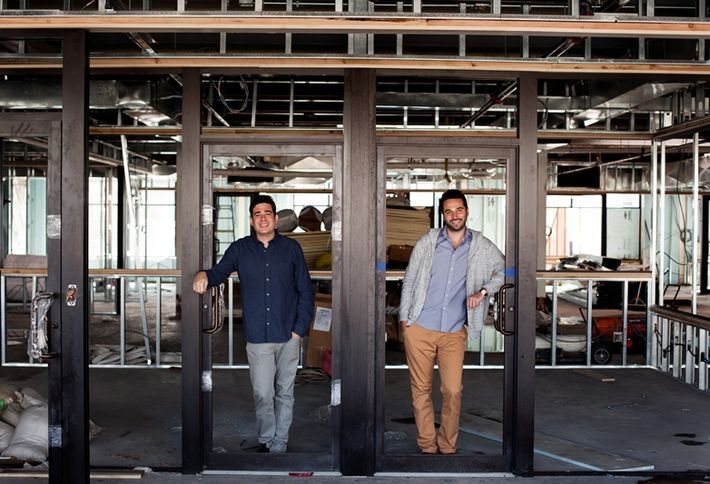
Industrious CEO Jamie Hodari and President Justin Stewart
The question of exposure to coworking, and how the banks view it, is one that has become something of a parlor game in the industry.
Earlier this year, Tishman Speyer Senior Managing Director Chris Shehadeh said more than 25% coworking exposure means a lender will get “itchy.”
“What’s funny, is it used to be 10%, so 18 to 24 months ago it was 10%, now it’s 25%,” said Convene co-founder Ryan Simonetti, adding that he believes most landlords are now expecting that between 5% and 10% of their portfolio has to be allocated for flexible uses.
“That’s a massive shift,” he said, adding that there are now questions about how much of the office market, as a whole, should be flexible. “Is five, 10 or 15% the right number? Is 30%, 40% or 50% the right number?”
From a building sale perspective, there is little data to indicate what that right number would be. A Cushman & Wakefield report last year found that eight buildings that traded hands since 2016 where WeWork occupied more than 40% of office space all sold with higher-than-average cap rates, indicating the sales were considered riskier because of the exposure to coworking.
WeWork declined to be interviewed for this story.
Recently, Rudin listed 110 Wall St. — its Financial District tower 100% occupied by WeWork and WeLive — but pulled it from the market after selling another property, One Whitehall Street, to settle estate taxes. The marketing materials noted there were risks associated with the fact the building is entirely leased to The We Company, The Real Deal reported.
However, Rudin said those were standard comments for a building with just one tenant, and not unique to the coworking company.
“There was good and broad interest,” Rudin Vice President of External Affairs Nick Martin said. “Folks recognized the value of the asset, which included WeWork as the anchor tenant.”
Meanwhile, Adam Neumann, WeWork’s CEO and co-founder, reportedly plans to list a Greenwich Village office building that is almost fully leased to WeWork for more than $110M.
And in Washington, D.C., an office building that is entirely leased to WeWork sold last month for $119M, Bisnow reported last month, eclipsing $1K a SF, one of the highest per-square-foot prices in D.C. history.
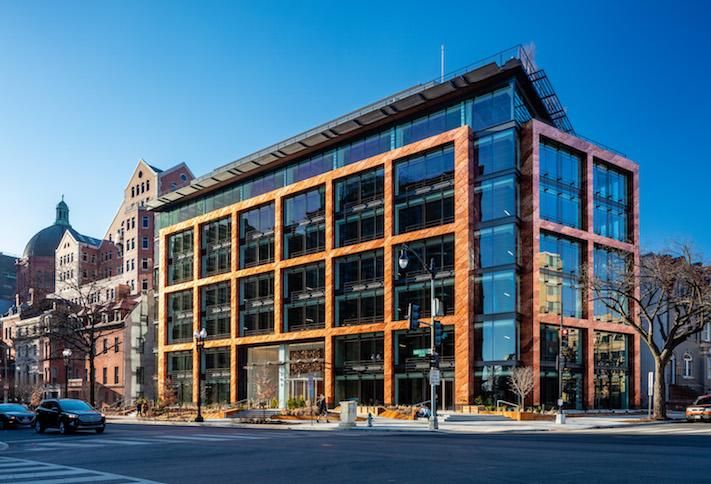
“As more of those transactions come to light and the market can see that there are buyers out there that will pay good prices … I think that just helps their case,” Columbia Property Trust CEO Nelson Mills said. “There are not many examples of that yet, but we haven’t really seen anything going the other way.”
CXP’s portfolio is less than 4% coworking, Mills noted. His company last year agreed to lease the entire office portion of 149 Madison Ave., a 12-story building in NoMad, to WeWork. The deal is for 115K SF, and CXP is working with the coworking giant to transform the property.
There are no plans to sell that building, Mills said, but hypothetically, he would expect it would trade at a better than 5% cap rate.
“I think a recession would be a test to the model for sure, though you could argue that it would be more attractive,” he said. “I think we traditional landlords have learned a lot from observing and interacting with the WeWork story … More than ‘Will WeWork survive or will they grow or shrink,’ the bigger picture here is what is the WeWork phenomenon teaching us about the needs of tenants?”
This Week’s N.Y. Deal SheetAugust 13, 2019 | Miriam Hall, Bisnow New York
This week, a Midtown East building locked down a massive lease, part of a development site in Gowanus traded hands and two Manhattan hotels scored financing.
TOP LEASES
Life insurance giant MassMutual is taking 22K SF at 10 Grand Central, building owner Marx Realty announced. The lease is for the entire 12th floor, and the company is moving from 200 Park Ave. In total, the landlord has locked down 160K SF of leases at the building since it was repositioned, and is in negotiation with three tenants considering relocation into the Seagram Building, according to Marx’s release. JLL’s Howard Hersch, Sam Seiler, Brett Harvey and Cynthia Wasserberger are handling leasing for the building, where rents range between $72 and $120 per SF.