Contact
Lobby And Exterior Renovation Nears Completion At 10 Grand Central, Midtown East
Sebastian Morris
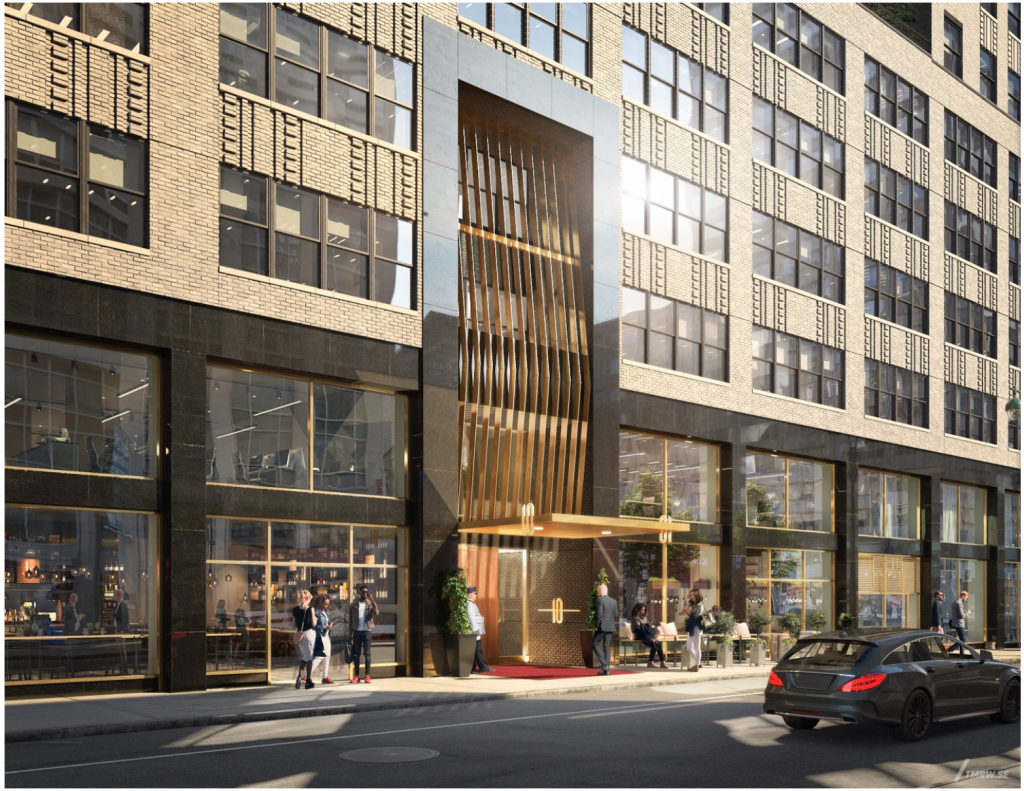
Commercial developer Marx Realty has returned with the first completed images of its newly branded office tower at 10 Grand Central. The $45 million project entails a redesign and repositioning of the building’s lobby to its original 44th Street location to provide more immediate access to Grand Central Terminal.
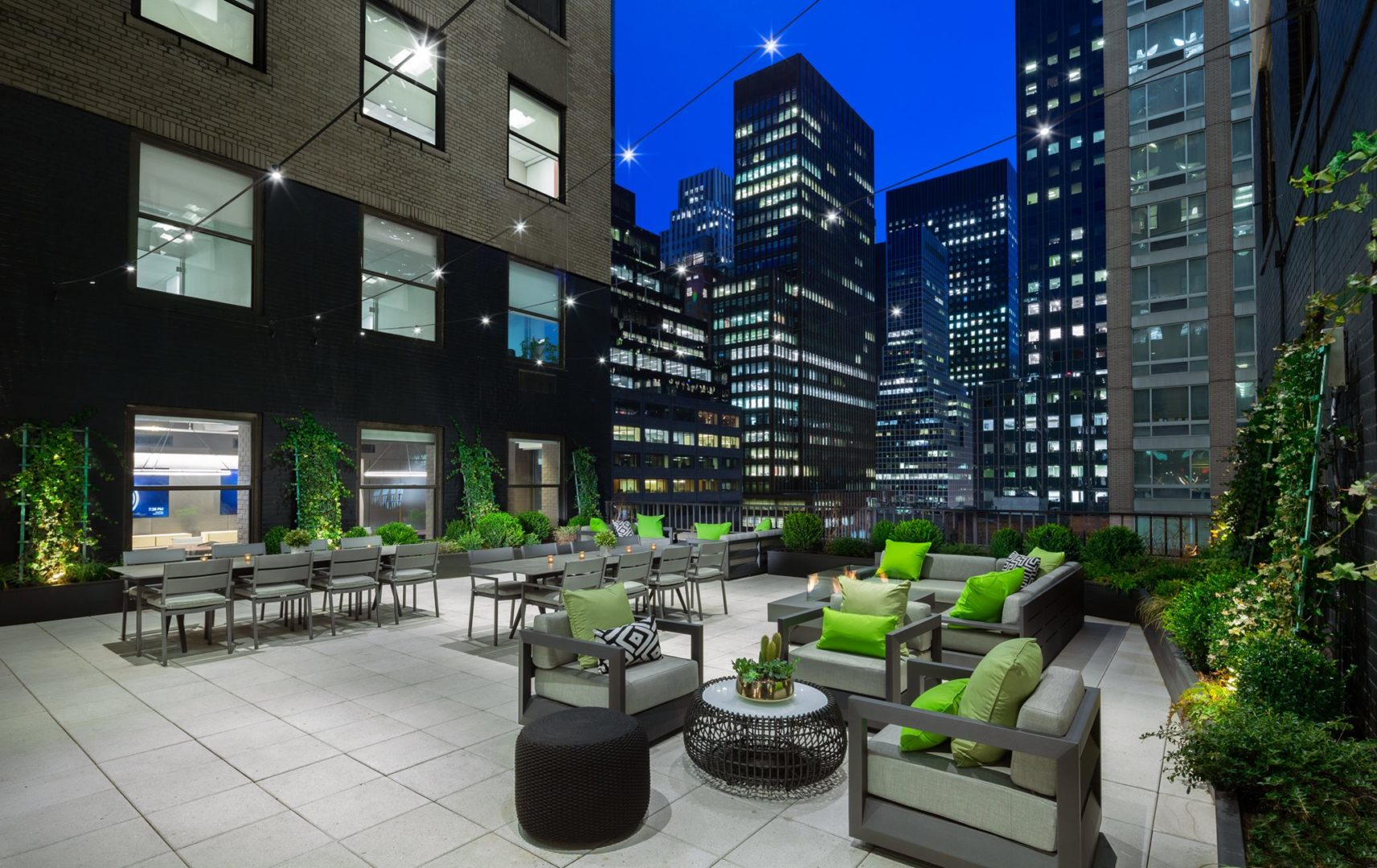
As previously reported by YIMBY, ten modernized office suites within the building will range in size from 2,500 to 8,000 square feet, in addition to a 22,000-square-foot, full-floor unit. Other components include an interior lounge, outdoor terraces, and expanded conference areas. The 35-story office tower was originally designed by architect Ely Jacques-Kahn and opened to the public in 1931. The structure features numerous setbacks and Beaux Arts details, which the updated design will partially maintain. The most prominent alteration is a four-story sculptural form designed by Studio Architecture that adorns the new entrance with glossy brass fins and black masonry.
10 Grand Central, design by Studio ArchitectureNew lobby are at 10 Grand Central – Marx Realty
As a final touch, uniformed doormen will be positioned at the entrance to greet tenants and their guests.
“The redesigned lobby fulfills our vision to transform the space at 10 Grand Central to an office experience unlike anything currently available in the New York City office market,” said Marx Realty’s president and CEO, Craig Deitelzweig. “We have translated this repositioning strategy into a wildly successful hotel-meets-office package that sets a new standard and creates a space that embraces hospitality in a meaningful way. It’s a truly special atmosphere with a highly stylized look and feel that begins right at the front doors and transitions throughout the building while paying tribute to the building’s original design aesthetic.”
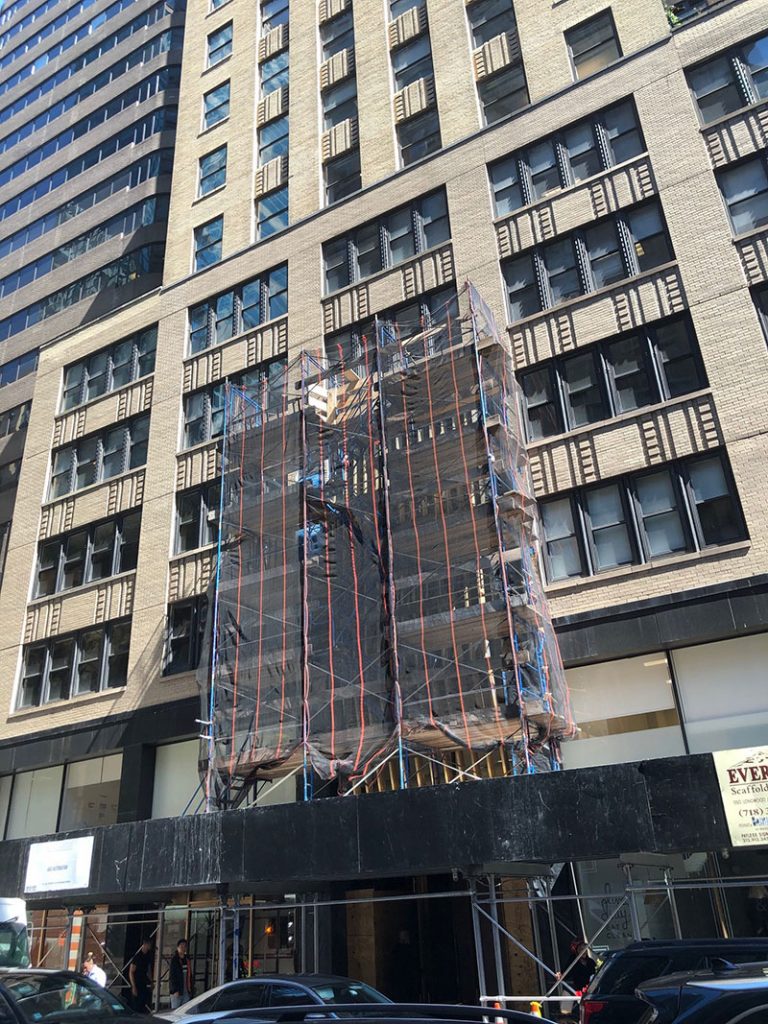
According to the developer, scaffolding is expected to come down in the next few weeks. JLL Team is exclusive leasing agent for the office space.
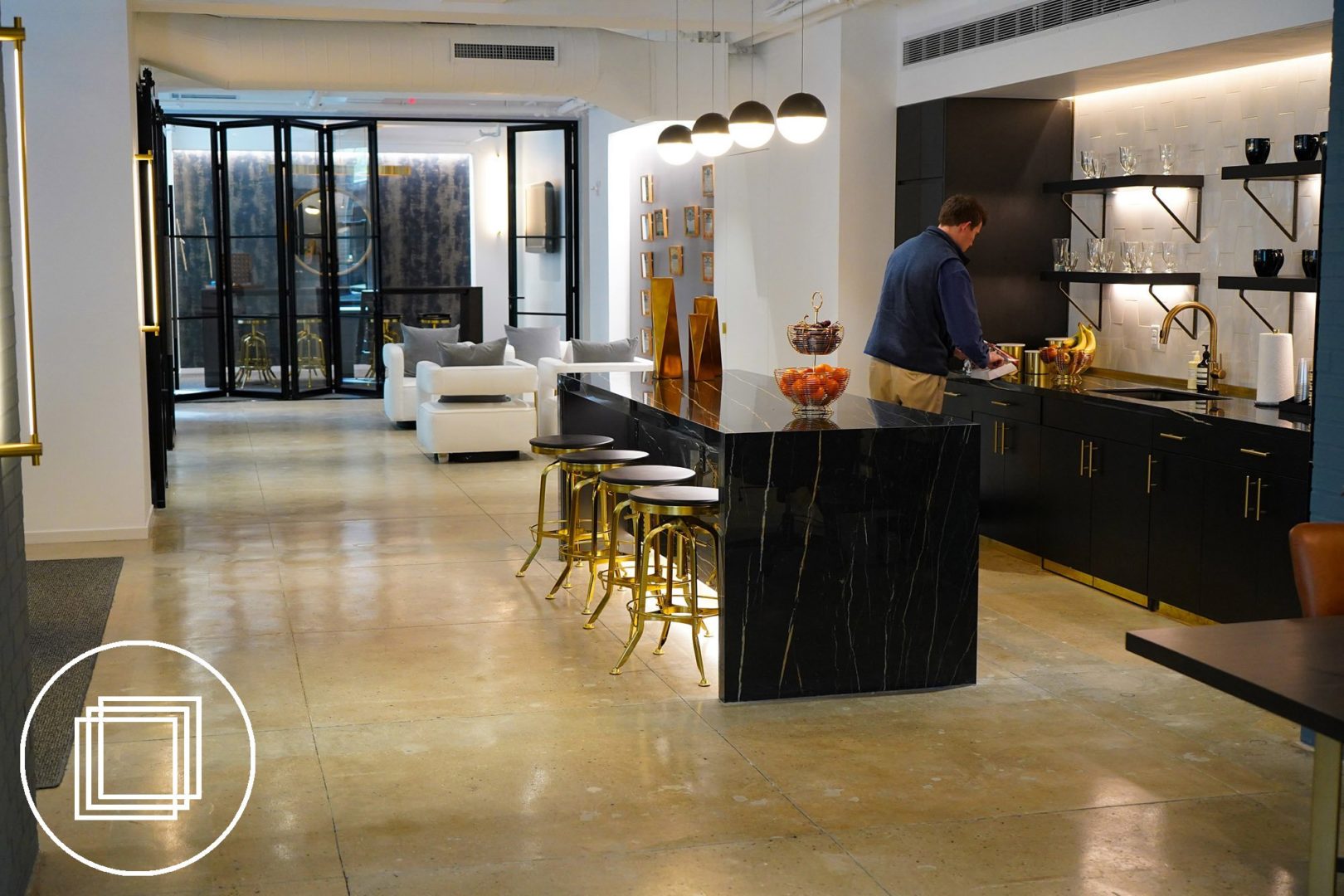
PHOTO: Melissa Goodwin/For Commercial Observer: The choice of furniture design and brushed brass decor at 10 Grand Central is a modern nod to the stylings of the nearby Grand Central Terminal.
Owners of Famed Chrysler Building Reach Deal to Sell Tower
New York City landmark set to be sold for about $150 million, a substantial loss for the current owners
By Keiko Morris | March 10, 2019 10:33 a.m. ET
The owners of New York City’s Chrysler Building have reached a deal to sell the iconic skyscraper for a little more than $150 million, unloading the 77-story office tower at a substantial loss, according to people familiar with the matter.
The New York real-estate firm RFR Holding LLC, which owns the Mies van der Rohe-designed Seagram building in Manhattan, and the Austrian real-estate firm Signa Holding GmbH signed a contract to acquire the Chrysler Building say people familiar with the matter.
The Abu Dhabi Investment Council in 2008 acquired a 90% stake for $800 million.
While widely considered one of the world’s most recognizable buildings and a classic of art deco style, the Chrysler building faces a number of challenges that enabled the buyers to nab it for a fraction of the previous sales price.
The tower‘s owners don’t own the ground beneath the property and pay rent on the land to the Cooper Union school.
The annual ground-lease rent the owners pay to the school jumped from $7.75 million to $32.5 million in 2018 and will go up to $41 million in 2028, according to Cooper Union’s financial documents.
Those fees have eaten away at much if not all of the building’s revenue, some brokers said.
The tower also has about 400,000 square feet of space that is vacant or that will become available in the coming years, according to people familiar with the building. That could require about a $200 million investment in the building to attract new tenants, one of those people said.
RFR, led by developer Aby Rosen, emerged the winner after bidding heated up over the past week, say people close to the sales process. Developers Ashkenazy Acquisition Corp. and RXR Realty were among the other bidders, according to these people.
While it isn’t clear what RFR’s strategy is to address the tower’s issues and squeeze profits out of the building, RFR has tangled with ground leases before. The company has been trying to refinance the loan on the classic Modernist Park Avenue tower called the Lever House because the ground rent would rise from $6.15 million to more than $20 million in 2023, an unsustainable level, according to Trepp. The property is in foreclosure, according to Trepp.
RFR may need to upgrade the building significantly to make it more appealing to new tenants and allow the new owners to boost rents, said Craig Deitelzweig, chief executive officer of owner and developer Marx Realty. Renovations to 10 Grand Central, a 1930s building Marx owns in the same neighborhood, resulted in significant rent growth, he said.
Mr. Rosen, known for his substantial art collection, has also made a name for himself in New York’s world of fine dining. At the Seagram Building, he declined to renew the lease of the Four Seasons, the storied restaurant, with a who’s who list of regulars, that had been run in recent years by Alex von Bidder and Julian Niccolini.
Instead, Mr. Rosen tapped the Major Food Group, a restaurant company that has emerged as one of the prominent players in the downtown dining scene. The bet paid off—at least critically: Major Food Group opened two restaurants, the Pool and the Grill, in the space, with the Grill earning high praise from several reviewers.
The sale marks the latest twist in the storied history of the 89-year-old building.
Chrysler Corp. founder Walter P. Chrysler took over the project from its previous developer, jumping into a race to become with world’s tallest building with the developer of the Bank of Manhattan building at 40 Wall St. Mr. Chrysler shifted plans for the building, which was completed in 1930, adding the crowning dome and spire. The Chrysler Building only held the title until 1931 when the Empire State Building took top place.
Tishman Speyer, which bought the building and two adjacent properties out of foreclosure in the late 1990s, initially spent $100 million in improvements on the properties. Tishman still owns 10% of the building but is selling that stake to the new buyers.
The tower is considered a quintessential New York character, making appearances in several movies, including “Spider-Man,” “Men in Black 3” and “The Wiz.”
The Chrysler Building’s sellers were represented by Darcy Stacom and William Shanahan of real-estate services firm CBRE Group Inc. The Real Deal previously reported that RFR was nearing a deal to buy the tower.
The Marx Realty CEO on preserving the character of buildings, his favorite surfing spots and pushing for the Guggenheim to move to LIC.
By Meenal Vamburkar | June 01, 2019 01:00PM
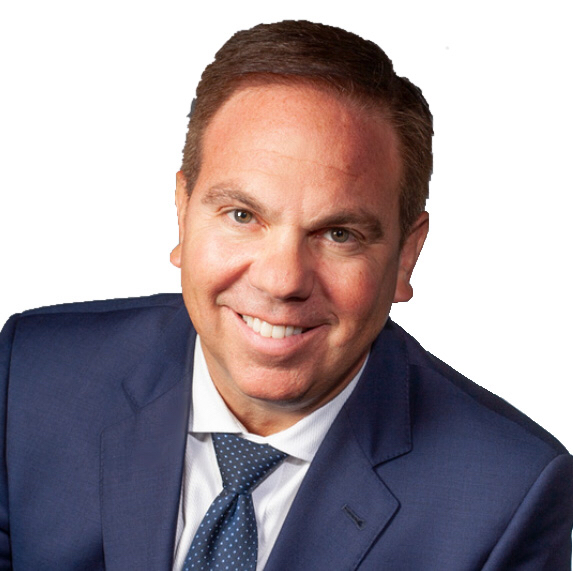
Craig Deitelzweig (Photo by Emily Assiran)
Craig Deitelzweig’s first foray into real estate was as an attorney at Skadden Arps in the late 1990s, where he realized he wanted to be more entrenched in New York’s property business. More than a decade and a half later, Deitelzweig joined Marx Realty — the development and management arm of Merchants’ National Properties — as its president and CEO in 2017. Prior to that, he served as managing director at Stamford-based Building and Land Technology, where he oversaw a national portfolio of office, multifamily and hotel buildings. Deitelzweig, 45, also previously headed Rockrose Development’s office division and led leasing and asset management at Ruben Companies. Today, he is focused on Marx’s effort to blend aspects of the hospitality business into its office spaces — adding amenities not traditionally seen in commercial buildings, such as doormen. The firm’s portfolio, spanning 2.2 million square feet in New York City, includes 10 Grand Central, where Marx’s headquarters is located. Deitelzweig has a spacious, sparingly decorated corner office on the seventh floor. The Queens native now lives in Westchester with his wife and teenage daughter.
Deal book
Marx Realty’s founder, Leonard Marx, who died at the age of 97 in 2002, had a tradition of assembling binders that tracked and displayed the firm’s real estate purchases. This leather-bound volume sits on the coffee table in front of Deitelzweig’s couch. “This one has a lot of Woolworth stores,” he said. “It’s interesting to see how the company has evolved through all the different real estate that was purchased.”
Guggenheim sculpture
During his stint at Rockrose, Deitelzweig was in talks for a deal involving Manhattan’s Guggenheim Museum. That included potentially moving its office space from the Upper East Side to Long Island City — with an additional museum opening there. But Deitelzweig was disappointed in 2012 when, after about a year’s worth of work, the deal didn’t pan out. So, his son, who’s now in college, made this sculpture of the Guggenheim to cheer him up.
Surfing sign
This sign points to one of Deitelzweig’s favorite hobbies. Locally, he frequents Long Beach and Montauk, but Deitelzweig said he’s also gone surfing in different countries. Tel Aviv is his favorite international spot to date. “It was really fun, and we did it all as a family,” he said. “I love surfing and the ocean; it makes me feel peaceful.”
Mets program
Deitelzweig is a big fan of the New York Mets. And this program, signed by all the team’s players in 1986 (the last time the Mets won the World Series), was a gift from a tenant. A private equity firm gave it to him as “a kind of appreciation,” he said. To Deitelzweig, that demonstrated that “if you do right by tenants, they do right by you.
Small Bible
This pocket Bible has been Deitelzweig’s good luck charm since high school. His grandfather, who used to carry it around with him, passed it on to Deitelzweig before he died. “If I have an important meeting, I put it in my pocket,” he said, adding that it’s gotten him through everything from SAT and LSAT exams to job interviews.
Copper eagle
This eagle was perched on top of one of Marx’s buildings, dating back to the 1920s, in Atlanta. The statue was carefully removed for the building to undergo renovation, and it now sits on Deitelzweig’s windowsill. It reflects the significance of maintaining a building’s history even amid efforts to modernize, he noted. “It’s amazing all the character you see in all these buildings,” the CEO said. “Keeping a little piece of it is meaningful.”
For the second year, Crain’s New York Business is featuring the Coolest Offices in New York. To be eligible, offices needed to have been opened, renovated or otherwise modified between Jan. 1, 2018, and March 31, 2019. Through online surveys, companies submitted descriptions and photos to demonstrate just what makes their office cool. Crain’s editorial staff combed through dozens of candidates, seeking spaces that showcase the latest trends and are built for the future of work. Fifteen winners and finalists were selected in five categories: new construction, retrofit, amenities, décor and collaborative space.
What’s next? Read how the coolest offices are getting smart.
COOLEST NEW SPACE
MARX REALTY
10 Grand Central // Midtown East
ARCHITECT: OTJ Architects CONTRACTOR: Phase 3
Marx Realty also made its mark with its new digs at 10 Grand Central. The real estate management and development firm created a 1930s hotel–like feel, installing polished concrete floors, black steel–framed windows and brushed-brass fixtures. The office also has a 2,200-square-foot outdoor terrace with ample seating.
The Leadership Issue | Cover Story: Best Bosses in the Business
By Erika Morphy June 03, 2019 at 09:00 AM
How easy is it to identify a “best boss” anyway? We at Real Estate Forum had the experience of finding that out as we shifted through…
How easy is it to identify a “best boss” anyway? We at Real Estate Forum had the experience of finding that out as we shifted through numerous nomination forms that contained shining examples of leadership from colleagues, employees and team members. Surprisingly, it was a hard decision to make. We say ‘surprisingly’ because statistically speaking, best bosses—or put another way, good leaders—are hard to come by. For instance, only 14% of CEOs have the leadership talent to execute on their strategy, according to one survey. The effect this lack of leadership talent has on a company and its workers cannot be overstated. According to another estimate, there is a 50% difference in the impact that a top performing leader has compared with an average performing one.
Perhaps it is different in the commercial real estate space. Perhaps the rigor needed to navigate our industry and the ease at which it is possible to fail intuitively attracts the best of the best. To borrow from a well known expression, if you can make it in CRE you can make it anywhere.
What is perhaps most astounding about the leaders you will read about in the following pages is the way they make it seem so easy. Juggling multibillion dollar books of business, implementing vision statements and strategic goals and they still always seem to know the name of even the lowliest employee in the office. Smarts, intuition, honor, skill and charisma. You can read about it over the next few pages.
The Best Boss
The Innovator:Craig Deitelzweig “It is an unbelievable privilege to work under the guidance of someone who is an innovator in the field of commercial real estate.” That is according to one colleague describing to Real Estate Forum Craig Deitelzweig, president and CEO of Marx Realty and Merchants National Properties.
Marx Realty is a division of Merchants National Properties. Founded in 1915, its current portfolio of properties includes over 4.7 million square feet of commercial office, retail and residential space as well as five mixed-use projects currently under development. Marx Realty is vertically integrated and involved in all phases of real estate management, development, construction and leasing. The company’s assets comprise 68 properties in 17 states across the continental US.
According to the colleague, “It’s leaders who push the envelope and set new standards for the spaces in which we live, work and play that inspires young professionals to do the same. This, in turn, is what changes the game for the industry as a whole and leads to tangible success in CRE.”
When talking about Deitelzweig, the colleague says that while every firm endeavors to stay relevant in commercial real estate, only a few rise to the top. “I have worked closely with Craig on several high-profile projects in two of the most important office markets: New York and Washington, DC. Office tenants in these markets—and indeed across the country—office and retail tenants are seeking spaces that are more than just a place to do business. They want to be in a place that is an extension of their brand, where they and their employees can ‘see and be seen.’ While there are many ways to accomplish that goal, Craig has a knack for raising the bar via forward-thinking design and I can’t say enough about what that has taught me as I move through my career in commercial real estate.”
One particular thing the colleague learned from Deitelzweig was the importance of being thoughtful and purposeful. In one particular project they worked on together, for example, the colleague said that Deitelzweig didn’t seek to just add amenities for the sake of adding amenities but instead, he transformed this property into a trophy asset.
The Flagship Is Sinking: Why Retailers Are Closing More Of Their Priciest Stores
June 3, 2019 – Miriam Hall, Bisnow New York
Flagships have long been considered a key part of any retail brand — and the type of offering considered well-equipped to survive the e-commerce blitz. But a series of major closures this year has many grappling with how these costly flagship stores should be reshaped for retail’s new world order.
On Wednesday, Abercrombie & Fitch became the latest company to step back from flagships, announcing it would close three more locations around the world, including the Hollister store in SoHo, joining a slew of retailers that have moved to close high-profile flagship locations this year.
These costly flagships and their nose-bleed rents have long been considered worth the cost because of their marketing impact. But sources say fundamental changes in consumer behavior, and soaring leases in prime retail strips has meant many retailers have found the benefits may no longer justify the cost. And while industry players say flagships aren’t dead yet, many will have to be readjusted to cut it with the modern shopper — who increasingly looks to well-filtered Instagram pictures over a well-designed store for inspiration.
“There’s a significant role for flagships in the overall retail scheme,” CBRE Vice Chairman Richard Hodos said. “But it has it has to be interactive, exciting and right on point … [it] can’t just be bigger version of the mall stall.”
Hodos’ deals include Ralph Lauren’s flagship store at 711 Fifth Ave., which shut amid declining sales in 2017, as well as Victoria’s Secret and Microsoft’s flagship leases on the same strip.
“The word ‘flagship’ gets thrown around like an old doormat … the real meaning of flagship is one and only,” he said.
He believes most new flagship leases in the country’s most expensive locations will need to include some form of “release valve” for the tenant if sales don’t match up to expectations.
“Landlords are going to have to adjust … retailers can’t afford to make long-term mistakes,” he said.
In some cases, the pullback from flagships represents retailers’ attempts to create smaller offerings for shoppers.
“What we’ve learned from the consumer is they are really enjoying the smaller spaces,” Ambercrombie & Fitch CEO Fran Horowitz told CNBC last week.
“There is a more intimate feel to it. … And the customer likes that one-on-one interaction,” Horowitz said.
Along with its SoHo Hollister flagship, the company announced that it is closing its Abercrombie & Fitch flagship in Milan, Italy, and Fukuoka, Japan. It had already decided to close flagships in Copenhagen and Hong Kong. After the announcement, shares in the company fell by 26% on Wednesday, according to the Wall Street Journal.
Tommy Hilfiger on Fifth Avenue
In March, Tommy Hilfiger closed its global flagship at 681 Fifth Ave., with Daniel Grieder, the CEO of Tommy Hilfiger Global and PVH Europe, saying the move was part of the company’s move to reshape the retail landscape in North America.
In January, Calvin Klein moved to close its Madison Avenue flagship, following a major redesign of the store just two years ago. Lord & Taylor’s famed building on Fifth Avenue is now owned by WeWork.
Versace put its Fifth Avenue space on the sublease market back in December, and the owners of Macy’s are said to be considering building an office tower atop the iconic flagship Manhattan store on 34th Street in an attempt to squeeze out more profit from the site.
Foot Locker has introduced its Power Store concept in North America
“As margins have come down and profits have been squeezed across retail over the last decade, it’s been harder to justify using a box simply as a marketing tool,” said Simeon Siegel, a retail analyst at Nomura Securities.
“For that reason you’ve seen a lot of retailers rethink their flagship strategies.”
He said that, across the board, retailers have been closing brick-and-mortar locations en masse, a trend that is only expected to worsen this year.
This earnings season has been woeful for retailers — last week shares of several major mall-based companies tanked thanks to poor earnings and the threat of tariffs — dimming hopes of a “retail renaissance” that was sparked by some strong numbers posted last year.
“When these big brands start to close down flagships … it really begs the question of what else what might be going on,” said Mark Ryski, the founder and CEO of Headcount Corp., a retail analytics company. “The advantages of having a flagship … is to really put forward to your best offering, your best service experience.”
He believes flagship closures should be considered on a case-by-case basis — though there is no doubt retailers should now be asking themselves the exact purpose of their flagship, and how they can experiment to make it exciting to a consumer.
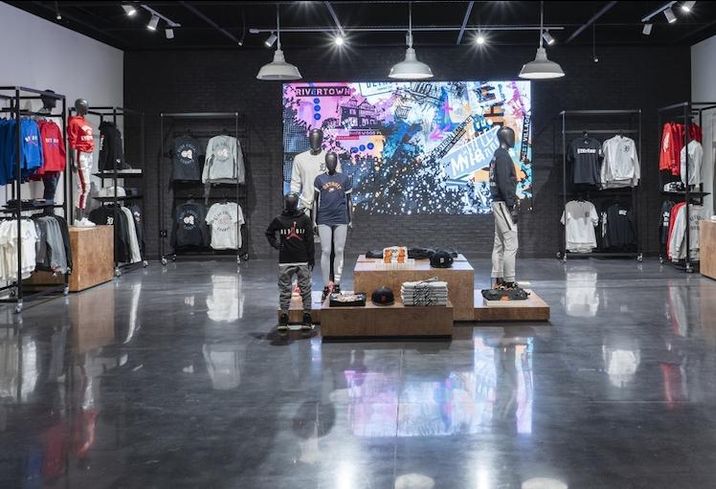
Marx Realty President and CEO Craig Deitelzweig said “experiential and cheaper” is now the name of the game, and that he expects to see greater numbers of flagships, or flagship-style stores in suburban or lower-cost areas. He pointed to his company’s lease with Foot Locker at 605 West 181st St. in upper Manhattan — where the retailer is opening one of its experiential “power stores” that will feature a barbershop and event space — and retail leases in cheaper locations outside of urban areas as a true indication of a safer retail bet.
“[In places like Yonkers] the rents are good but not anywhere near the rent for Fifth Avenue,” Deitelzweig said. “They can offer all those elements that today’s customer wants in terms of making it really special.”
Still, retailers pointed to several flagship success stories in the city. Apple Stores routinely perform well, and Nike’s flagship on Fifth Avenue is said to have lines out the door. Whether or not these stores are generating sales to justify the costs is unknown.
“People just don’t have time or energy to go through these [large-scale] stores anymore,” Lee & Associates Executive Managing Director and principal Greg Tannor said. “But if you have the right store in the right location selling the right products people are going to come.”
JLL’s Americas Director of Retail Research James Cook said many retailers are adding flagship elements and concepts into their stores.
“It almost seems like there’s less of a need for one big flagship if you can have more cutting-edge stores with smaller footprints set out across the U.S.,” he said.
The FAO Schwarz flagship, which is now in 30 Rockefeller after leaving its famed location of Fifth Avenue, speaks to that trend, he said.
The store still incorporates many of the experiential elements of the Fifth Avenue location, but has a smaller space. He said buyers are looking for value, as well as experience, which may mean fewer luxury flagships and some types of apparel stores — but flagships will always have some place in the retail landscape.
“This concept of a flagship is being the home base or the heart of the brand. And it’s kind of like the center of brand building — that’s not going away,” he said. “It’s just changing.”
Google has agreed to pay $600m to acquire a historic building in Manhattan’s Meatpacking District — a hundred times what it was sold for in 1996 — in a deal that reflects the tech company’s growing footprint in New York City.
For Doug Harmon, one of the agents who brokered the sale, it represents a career milestone: Mr Harmon has sold 450 West 15th Street — also known as the Milk Building — five times in a career that has spanned New York’s latest real-estate boom.
“Longevity is a brutal competitive advantage!” quipped Mr Harmon, the chairman of capital markets at Cushman & Wakefield.
The first time he sold the building, in 1996, the cobbledstoned neighbourhood was a gritty outpost with a reliable supply of transgender prostitutes and illicit drugs. It went for $6m to Moishe Mana, an Israeli immigrant who grew wealthy after founding a local moving company, Moishe’s Moving, and his partner, Erez Shternlicht.
Under their ownership, the eight-storey industrial building led the neighbourhood’s turn toward trendy fashion and media companies, including their Milk Studios.
In 2004 Mr Harmon helped them sell the building to investment firm Angelo Gordon for $55m, and then flipped it four years later to Stellar Management for $161m, who then shifted it — with his assistance — to Jamestown, a developer, in 2013 for $284m.
Now comes Google, whose $2.4bn purchase of the nearby Chelsea Market last year reinforced the neighbourhood’s status as New York City’s technology capital. It also helped to cement Mr Harmon’s standing as one of two uber brokers in a real estate-obsessed city.
The other is his arch rival Darcy Stacom, the so-called Queen of the Skyscrapers at CBRE, who advised Google on both acquisitions and regularly battles against Mr Harmon in New York’s favourite blood sport.
“They’re rock stars. They’re simply the best at what they do,” said Craig Deitelzweig, chief executive of New York-based Marx Realty.
For Mr Harmon, a born talker with a touch of showbiz panache, the Milk sale is evidence that there is still juice in the city’s real-estate market — even after a prolonged run whose sheer duration has set many executives on edge, with a sharp retreat of Chinese buyers and a fall in prices for luxury condominiums.
In one sign of the market’s fragility, brokers have taken to selling some buildings privately, approaching potential buyers without making a formal listing to avoid the risk of disappointing headlines.
Rising US interest rates would cause some dislocation, Mr Harmon said. But overall, he argued that New York’s property market was stronger than many sceptics realised — particularly for those who understood how to navigate it.
“This is the market that distinguishes one’s self — show’s one’s skill,” said Mr Harmon, who is also in the midst of closing a $2.2bn sale and leaseback of WarnerMedia’s headquarters at the new Hudson Yards development. “It’s my kind of market.”
The son of a theatre producer and investment banker, Mr Harmon was not entirely sold on real estate after graduating from Brown University in 1984 with a psychology degree. At the time, everybody wanted to be in investment banking, he recalled. He went to London and worked for the Ladbrokes betting parlours — a chain with big real-estate holdings — dabbled in Hollywood and then earned an MBA from UCLA in 1992.
His career was transformed in the late 1990s when a man at a dinner party in Anguilla, where his family vacationed, passed on a tip: Leona Helmsley — Manhattan’s infamous Queen of Mean — was looking to unload a $5bn property portfolio she had inherited from her husband, Harry. Mr Harmon, then 35 and a little-known broker at Eastdil Secured, snagged the mandate.
Mrs Helmsely was so difficult and unpredictable that some at Eastdil did not want the business. So Mr Harmon set up a separate operation within the firm to handle the sale. “Everything hung in the balance,” he recalled. “She could fire you on a whim.”
In addition to burying himself in paperwork, Mr Harmon also put his psychology degree to work. At one point he gave Mrs Helmsley a dog, a Maltese, to whom she would later leave a $12m inheritance. Mr Harmon also became her regular companion at the Four Seasons restaurant, where he eventually discovered that the $10 bills Mrs Helmsley regularly demanded of him to tip the bathroom attendant were not making their way to the intended recipient.
“It was a training ground for the craziness that exists in real estate,” he said.
That three-year assignment introduced Mr Harmon to properties he would trade again and again in his career, just as he has the Milk Building. It also thrust him into a new orbit of buyers and sellers and trained him in the poker game of big auctions.
“You always have to convince someone of something — in a smart way, being truthful,” Mr Harmon said of his approach. (His other tips: “Never let the leverage shift away from the seller” and, if you can, avoid due-diligence at all costs).
Meanwhile, his “sport”, as he calls it, was being transformed from a somewhat disreputable undertaking to a matter of public fascination.
“In the mid-90s, real estate became an industry that everyone was interested in,” Mr Harmon said. “It’s money, it’s the power, it’s everything — and then you get New York.”
Doug Harmon at a gala in New York in 2016
He parlayed his Helmsley experience into the 2003 sale of the GM building to Harry Macklowe for a then-record $1.4bn. For the next decade, his Eastdil team vied with Ms Stacom at CBRE for dominance of the New York skyline. She sold GM for $2.8bn in 2008. They took turns selling the massive Stuyvesant Town and Peter Cooper Village development — she for a record $5.4bn in 2006, just before the financial crisis, and he for either $5.3bn or $5.45bn in the boom year of 2015, depending on who you ask.
After a performance by his Eastdil team that year that Mr Harmon described — with characteristic restraint — as surpassing Goldman Sachs, the New York Yankees and Tiger Woods, he decided the old model no longer worked.
His thesis was that the industry was changing as it drew in more money from private equity firms, pension funds, sovereign wealth funds and the like. “What is happening in the market is this institutionalisation of our sport,” he said. “It’s not just for the cowboys, it’s not just for the people who didn’t go to college, [those] who came up through the streets and had to fight their way.”
To appeal to the new players, Mr Harmon believed he needed to come armed with reams of data and research — about rent trends and retail sales on individual city blocks. In 2016 he and his team jumped to Cushman, a perennial laggard in the New York market but blessed with a big international network as well as leasing agents and investment advisers who could provide market intelligence.
His involvement in WarnerMedia’s pending transaction at Hudson Yards is a good example. While at Eastdil, Mr Harmon brokered the company’s $1.3bn sale of its Time Warner Center headquarters in 2014 to The Related Companies, the site’s original developer.
He reckoned Related would be willing to pay more than others to boost its chances of luring the media company to Hudson Yards, a mega-development it was then still building in an otherwise desolate part of town. Time Warner ended up taking 1.5m sq ft there at a bargain price.
Five years later, Hudson Yards is a commercial success, and Time Warner’s new owner, AT&T, which is eager to pay down debt, is looking to benefit by selling the space back to Related for $2.2bn and taking out a 15-year lease.
“That’s the beauty and the detriment of my sport,” Mr Harmon reflected. “It’s really, really hard to tell who’s better than the next person. And that’s why you have to look at the whole body of the work.”
This article has been amended since publication to correct the value of the 2004 sale to $55m.
Henderson of Marx Realty leases 25,000 s/f to Foot Locker in Washington Heights
May 20, 2019
Craig Deitelzweig, Henry Henderson,
Marx Realty Marx Realty
Manhattan, NY According to Marx Realty, a New York-based owner, developer and manager of office, retail and multifamily property across the U.S., Foot Locker has inked a deal to lease 25,000 s/f at 605 W 181st St. in Washington Heights. The sportswear and footwear retailer will relocate and expand its Upper Manhattan location into an experiential “Power Store” retail destination. The retailer plans to open its doors in the fall.
“We are thrilled to collaborate with one of the most recognizable athletic footwear and apparel retailers in the world,” said Craig Deitelzweig, president and CEO of Marx Realty. “Foot Locker’s new store will enjoy a larger footprint in one of Manhattan’s most vibrant up-and-coming neighborhoods and will be a slam-dunk for the company’s new concept, which has been successfully implemented around the world.”
The new “Power Store” concept has proven successful in cities such as London, Hong Kong and metro Detroit. Foot Locker’s experiential retail services for the new Upper Manhattan flagship location will include a barber shop, sneaker cleaning and gaming zones, as well as, activation spaces for events and an area where customers can “make their own shoes” and create limited-edition sneakers with customized designs. The retailer is moving to the larger space from its current location at 621 W. 181st St. as part of the company’s push to enhance the in-store experience. Foot Locker has launched plans to expand its experiential model into other cities in the U.S. including Los Angeles and Philadelphia.
The heavy foot traffic on 181st St., combined with the daily-needs retailers already in the neighborhood makes the location an attractive option for an immersive retail experience. Located steps from Broadway Ave., the property is situated between St. Nicholas Ave. and Wadsworth Ave.proximate to several dining, entertainment and retail options including Capital Bank, Blink Fitness, Game Stop, and T-Mobile. The location is also walking distance from the 181 St. A and 1 subway stations as well as multiple bus routes, connecting the store to the Bronx and lower Manhattan.
Marketing and leasing for the property was managed in-house by a Marx Realty team led by Henry Henderson, vice president of leasing. Evan Shuckman from RIPCO represented Foot Locker.
Marx introduces hospitality vibe at 10 Grand Central
by REW May 8, 2019
Marx Realty just unveiled the redesigned lobby at the newly rebranded 10 Grand Central office tower.
The company previously announced the completion of a redesigned lounge, terrace, and conference space at the building as part of the $45 million repositioning of the 35-story Ely Jacques-Kahn designed building located at 155 East 44th St.
The repositioning represents a design disruption in the office sector with a hospitality-like appeal that includes details such as a signature scent, customizable mood music and video art installations throughout the building.
The lobby and entry have been relocated to the building’s original 44th Street location, orienting the property towards Grand Central Terminal, as the original design intended.
“The redesigned lobby fulfills our vision to transform the space at 10 Grand Central to an office experience unlike anything currently available in the New York City office market,” said Craid Deitelzweig, CEO of Marx Realty.
“We have translated this repositioning strategy into a wildly successful hotel-meets-office package that sets a new standard and creates a space that embraces hospitality in a meaningful way. It’s a truly special atmosphere with a highly stylized look and feel that begins right at the front doors and transitions throughout the building while paying tribute to the building’s original design aesthetic.”
The company recently delivered 7,500 s/f of seventh-floor amenity space, including a lounge connected to a terrace, and a conference facility.
According to Deitelzweig, the redesign has resulted in over 130,000 s/f of new leases.
A JLL team led by Howard Hersch, Sam Seiler, and Cynthia Wasserberger is handling the leasing effort. Asking rents range from $72-97 psf.
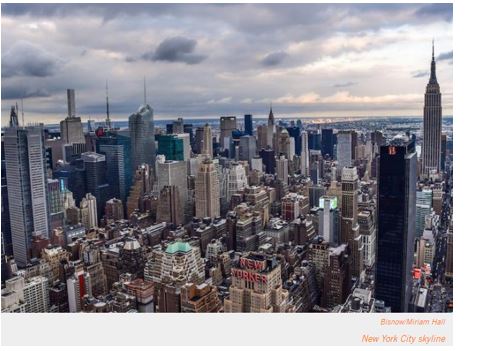
Developers Are Trying To Make Sense Of New York City’s Climate Policies
April 28, 2019 | Miriam Hall, Bisnow New York
The New York City commercial real estate industry is picking over the details of upcoming city laws that will fine building owners if they exceed new emissions caps.
While the industry grapples with the implications of those requirements, Mayor Bill de Blasio has signaled he is not done with legislating building materials over environmental impact, sparking a wave of questions for which the industry wants answers.
This month, the City Council passed the Climate Mobilization Act, which requires large and medium-sized buildings to cut emissions 40% by 2030 and 80% by 2050. The worst-performing buildings have five years to bring their emissions down.
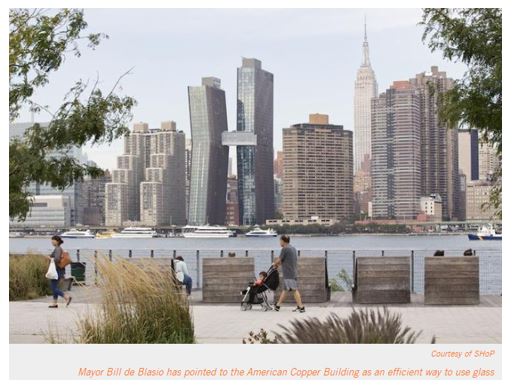
The new laws set emission caps, and would impose hefty fines if landlords don’t comply. Last week, Mayor Bill de Blasio — who wants the city to become carbon neutral by 2050 — took on the glass and steel buildings that have defined the city’s skyline, implying those types of buildings would no longer be allowed.
“We are going to introduce legislation to ban the glass and steel skyscrapers that have contributed so much to global warming,” de Blasio said last week. “They have no place in our city or on our Earth anymore.”
Though the city and the mayor have since conceded that glass and steel would not be entirely outlawed, de Blasio has continued to refer to it as a ban. His office has not released a draft or further explanation of his plan, but the mayor hopes new energy codes will be in place by next year, the New York Times reports.
“It’s a ban, and I’ll tell you why,” he told WNYC in his weekly segment Friday, but then acknowledged there is nothing stopping builders using the materials. “It is true that if a building owner wants to invest a lot more to make sure that that glass is not inefficient — it’s a major investment to do that — they can still have, certainly, a notable amount of glass.”
Members of the real estate industry — many of whom are already bristling against the laws demanding emission caps on building — said they were perplexed by the comments.
“It was absolutely ridiculous, and really the only thing that would work under his statement would be mud huts,” Marx Realty CEO Craig Deitelzweig told Bisnow. “I don’t know how you can attract world-class tenants to New York City if you can’t have glass buildings. It’s very strange. It’s backwards thinking.”
Youngwoo Executive Vice President Bryan Woo, whose firm is co-developing Pier 57, said the lack of clarity is disconcerting.
“If you are not exact and precise about the way that this is going to work … there is a huge chance for a misstep,” he said of de Blasio’s comments. “There’s nothing wrong with doing something for the environment, but we would love to know the details.”
The Real Estate Board of New York, which has criticized the emissions cap laws and believes they will cost the real estate industry at least $4B in building upgrades, is similarly in the dark about further legislation.
“We haven’t seen any law drafted or any policy drafted,” Carl Hum, REBNY’s senior vice president and general counsel, told the Times this week. “We are curious, if the mayor is banning glass and steel, what the alternative will be?”
Mention of the words “glass” and “ban” from the mayor resulted in panicked calls from clients at engineering consulting firm Thornton Tomasetti, Sustainability Project Director Casey Cullen-Woods said. Her view is that the mayor is posturing — though she is pleased to see this level of attention given to climate policy discussion.
“While it is very theatrical to say, ‘We will not allow glass and steel buildings,’ that’s not what the law actually said,” she told Bisnow, adding that building with glass will still be allowed. “It just has to be a high performance [material].”
Over the past 15 years, Cullen-Woods said, there has been a wave of new laws and codes to drive efficiency that have simply not worked fast enough.
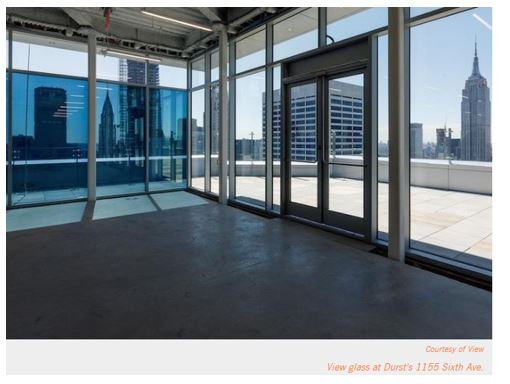
“Sometimes it takes a controversy for people to step away and look at solutions. Arguably changing infrastructure is one of the hardest things for us to do,” View Dynamic Glass CEO Rao Mulpuri said.
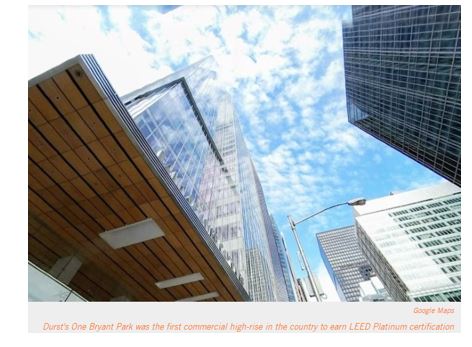
His company makes smart window technology that allows the owner of a building to adjust how much light and glare a window lets in, which has been used in places like Durst Organization’s One Bryant Park and LaGuardia Airport.
“Glass is not our enemy,” he said. “You can build as much glass as you want as long as you build it smartly.”
Putting aside the is-it-a-ban-or-not conversation, there is no denying the industry is now facing a fundamental shift in the way it must build and manage properties.
“Developers will have to meet our new standards,” Mark Chambers, the director of the Mayor’s Office of Sustainability, told the Times. “Business as usual won’t cut it.”
Under the laws, varying emission caps apply to building 25K SF or larger. Rent-regulated and affordable housing, as well as houses of worship, are not subject to the new limits. The city is setting up an Office of Building Energy Performance to monitor building owners, who will be fined $268 for every ton of emissions beyond a building’s limit, the AP reports.
The laws have rattled the commercial real estate industry, with many big landlords claiming it is a punitive plan that will do more harm than good.
“In this legislation it is all stick and no carrot,” Rudin Management Chief Operating Officer John Gilbert said.
Since introducing a machine-learning system that integrates all building operation called Nantum, Rudin has already cut carbon by 44%, reduced steam consumption by 48% and lowered electricity use by 41%, Gilbert said.
His concern, shared with many others, is that all buildings are treated the same under the law, which will penalize companies that have densely populated buildings.
“You want to incent owners to cut their carbon, rather than create unreasonable caps that no one’s going to be able to meet,” he said, adding that he has no clue about what the mayor meant about banning glass and steel.
The Durst Organization, one of the city’s most prominent real estate partners, believes the legislation will wind up punishing densely populated, efficient buildings, and the fact that so many buildings have been exempt undercuts the goal.
“It ends up promoting inefficiency over efficiency,” Durst spokesperson Jordan Barowitz said. ”It’s misguided in that it exempts too many buildings in the city from the more stringent requirements in the bill.”
Marx’s Deitelzweig said the demands of retrofitting older buildings to meet the emissions caps means most people will likely opt to tear down buildings rather than improve them.
“I’m not sure that is good for the environment and wouldn’t meet their goals,” he said. “Many things that are good [for the environment], they are not really wonderful for the tenant experience. You have to find a balance.”





 Marx Realty’s founder, Leonard Marx, who died at the age of 97 in 2002, had a tradition of assembling binders that tracked and displayed the firm’s real estate purchases. This leather-bound volume sits on the coffee table in front of Deitelzweig’s couch. “This one has a lot of Woolworth stores,” he said. “It’s interesting to see how the company has evolved through all the different real estate that was purchased.”
 During his stint at Rockrose, Deitelzweig was in talks for a deal involving Manhattan’s Guggenheim Museum. That included potentially moving its office space from the Upper East Side to Long Island City — with an additional museum opening there. But Deitelzweig was disappointed in 2012 when, after about a year’s worth of work, the deal didn’t pan out. So, his son, who’s now in college, made this sculpture of the Guggenheim to cheer him up.
 Deitelzweig is a big fan of the New York Mets. And this program, signed by all the team’s players in 1986 (the last time the Mets won the World Series), was a gift from a tenant. A private equity firm gave it to him as “a kind of appreciation,” he said. To Deitelzweig, that demonstrated that “if you do right by tenants, they do right by you.
 This pocket Bible has been Deitelzweig’s good luck charm since high school. His grandfather, who used to carry it around with him, passed it on to Deitelzweig before he died. “If I have an important meeting, I put it in my pocket,” he said, adding that it’s gotten him through everything from SAT and LSAT exams to job interviews.
 This eagle was perched on top of one of Marx’s buildings, dating back to the 1920s, in Atlanta. The statue was carefully removed for the building to undergo renovation, and it now sits on Deitelzweig’s windowsill. It reflects the significance of maintaining a building’s history even amid efforts to modernize, he noted. “It’s amazing all the character you see in all these buildings,” the CEO said. “Keeping a little piece of it is meaningful.”