
 Contact
By Keiko Morris and Konrad Putzier | Feb. 21, 2019 7:00 a.m. ET
‘Every deal was contingent on Amazon.’ Retailer’s pull out from Queens scuttled New York property firm’s plans to refinance and sell stakes in Long Island City building
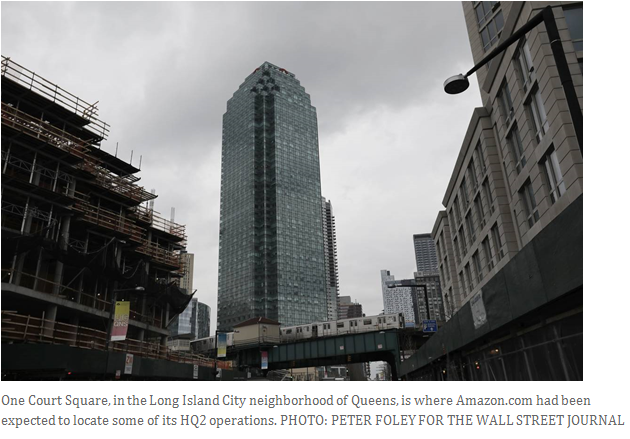
There may be nobody who lost more from Amazon.com Inc.’s pull out of Queens than the real-estate investors at Savanna.
The New York-based property firm was one of the biggest beneficiaries of Amazon’s decision to locate a new headquarters in Long Island City. The retailer agreed to rent about one million square feet in Savanna’s green glass office tower near the East River.
Savanna moved quickly to capitalize. It approached lenders to borrow $750 million against the value of the 53-story tower, which Savanna believed would more than double in worth after landing its famous new tenant, according to people familiar with the matter. It launched talks with investors to sell stakes for most of the building, some of these people said.
Now that Amazon has pulled out of Queens after facing local opposition, Savanna’s most attractive property flipped overnight to one of its biggest liabilities.
“Every deal was contingent on Amazon,” a person familiar with the discussions said.
Savanna needs to fill a million-square-foot hole after its main tenant, Citigroup Inc., leaves sometime next year. The talks to refinance the building or sell stakes to new investors are all but dead, say people familiar with the situation.
“It is going to be hard to get a large commercial real-estate loan on a property that is 70% vacant,” said Joe McBride, a director at Trepp, which tracks commercial mortgage-backed securities.
Amazon’s plan for a second headquarters in Long Island City sparked a real-estate frenzy, with investors bidding up condo prices immediately. Commercial property owners saw a sharp rise—and then fall—in the interest in their buildings with Amazon’s commitment and subsequent reversal. But few investors experienced as dramatic a swing in fortune as Savanna did.
The firm has at least $315 million in debt on the building, known as One Court Square, much of it in several commercial mortgage-backed security deals, according to Trepp.
That debt matures in September of 2020. If Savanna isn’t able to refinance by that time, the company could lose the property to creditors, or a so-called special servicer could agree to a loan modification and extension.
Many people in the real-estate community still expect Savanna to land a new mortgage for the building. But banks would be more reluctant to lend with the property’s gaping vacancy. Savanna would likely have to turn to a private debt fund and pay higher interest rates, according to real-estate consultants.
Savanna gambled on Long Island City when it bought One Court Square in 2014, betting that the decadeslong shift from an industrial neighborhood to a more 24-hour mix of office workers and residents would finally take hold.
“A lot of the tenants who were looking at Long Island City were lower-paying tenants, and there weren’t the signature rent tenants that would drive leasing,” said Craig Deitelzweig, chief executive of real-estate firm Marx Realty. “Amazon was that.”
Around the time Amazon signed a letter of intent to occupy the tower in November at a rent of more than $60 a square foot, Savanna hired brokerage firm Cushman & Wakefield to find investors and brokerage firm JLL to find a new mortgage. Spokesmen for Cushman & Wakefield and JLL declined to comment.
Savanna’s new marketing materials promoted Amazon as the new tenant, according to a person who has seen them. Savanna was in serious negotiations with several potential investors and lenders, though no deal was imminent, according to people familiar with these discussions. Talks with lenders revolved around a mortgage package of $750 million or more, those people said.
Beyond The Bio: 16 Questions With Marx Realty CEO Craig DeitelzweigBisnow New York
Miriam Hall | February 11, 2019
This series profiles men and women in commercial real estate who have profoundly transformed our neighborhoods and reshaped our cities, businesses and lifestyles.
Craig Deitelzweig is the president and CEO of Marx Realty, a management and development company with 4.3M SF of commercial office, retail and residential space. A division of the publicly traded Merchants National Properties, Marx has 67 properties in 17 states, including the office building 10 Grand Central at 155 East 44th St. in Midtown East in Manhattan, and the Cross County Shopping Center in Yonkers, New York. The company is aiming to buy $1B worth of real estate this year in New York City, Washington, D.C., and Atlanta.
Deitelzweig, a former attorney, joined the firm in August 2017. He spoke about real estate’s “group-think” mentality, how a meritocracy is the best way to attract talent and why he’ll always believe in the Mets.

Bisnow: How do you describe your job to people who are not in the industry?
Deitelzweig: I create value by creating special experiences for our tenants.
Bisnow: If you weren’t in commercial real estate, what would you do?
Deitelzweig: I would either be a landscape architect or the Federal Reserve chairman.
Bisnow: What is the worst job you ever had?
Deitelzweig: Unfortunately, I once worked in a real estate company where the CEO did not share my vision of creating truly memorable and distinctive spaces for our tenants. I found it really difficult to work in an environment where we were not pushing ourselves every day to be the best in the industry in development and service while striving to build that “better mousetrap.”
Bisnow: What was your first big deal?
Deitelzweig: Marrying my wife, Lisa. By far, the best internal rate of return.
Bisnow: What deal do you consider to be your biggest failure?
Deitelzweig: After the Great Recession, there have been a few instances where I wanted to acquire a property in New York, and had an unbelievable plan to redevelop the property, but in the end we didn’t buy the assets as my past company did not believe in New York’s recovery story. Wow, I could have been responding to these questions on an island somewhere in the Caribbean if those deals were finalized.
 Bisnow: If you could change one thing about the commercial real estate industry, what would it be?
Deitelzweig: I think sometimes the real estate industry has a group-think mentality. I always strive to be a unique thinker and would encourage everyone in commercial real estate to do the same.
Bisnow: What is your biggest pet peeve?
Deitelzweig: I hate when people present problems without a potential solution. Drives me crazy. I like to surround myself with creative people who are continually finding creative solutions to tricky, often complex, problems.
Bisnow: Who is your greatest mentor?
Deitelzweig: My greatest mentor was outside the real estate industry. My parents always taught me to do the right thing and to know that my reputation is paramount. I think about that during every daily interaction.
Bisnow: What is the best and worst professional advice you’ve ever gotten?
Deitelzweig: The best advice was by John Fraser when I worked at Investcorp. He always stressed the importance of working in a meritocracy. As I look at my team here at Marx, I always want people to know that we operate in a merit system and those who are exceptional will be rewarded — this merit-based approach is truly the best way to attract and retain talent.
The worst advice I received is that all you need in real estate is to buy and then sit passively to make money. I believe in actively working every asset to build and create value.
 Bisnow: What is your greatest extravagance?
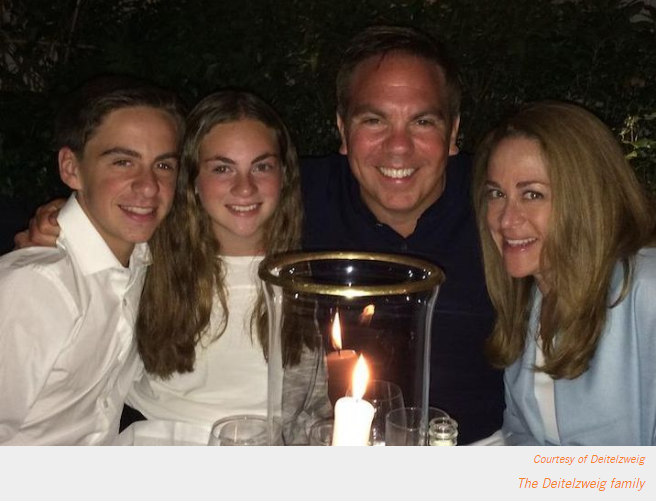
Deitelzweig: Sitting on my front porch with my family and my dog Murphy (named after Daniel Murphy of the Mets — we kept the name despite his trade).
Bisnow: What is your favorite restaurant in the world?
Deitelzweig: KFC. I only have KFC on special occasions like July 4th or my birthday.
Bisnow: If you could sit down with President Donald Trump, what would you say?
Deitelzweig: I would reminisce about our mutual childhoods in Queens, N.Y.
Bisnow: What’s the biggest risk you have ever taken?
Deitelzweig: When I switched from the safe world of being a real estate lawyer at Skadden, Arps, Slate, Meagher & Flom to the risk-taking world of real estate investments, I was so passionate about real estate development that I took a significant pay cut to make that transition. I wondered if I might have to eat mac and cheese every night if things didn’t work out.
Bisnow: What is your favorite place to visit in your hometown?
Deitelzweig: Lemon Ice King of Corona.
Bisnow: What keeps you up at night?
Deitelzweig: I think about every detail. Sometimes, I will literally go through a budget in my sleep and come up with ways to save money on operating expenses or come up with a more dramatic lighting choice on a job.
Bisnow: Outside of your work, what are you most passionate about?
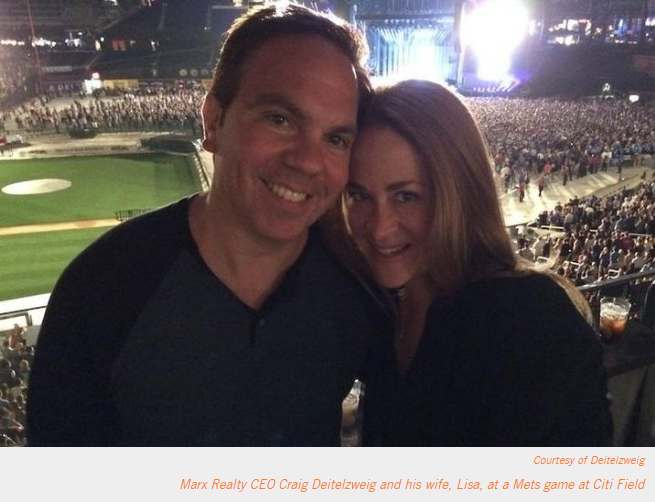
Deitelzweig: The NY Mets. One day they will be good.
Mounting Costs Push Construction Industry Harder Toward Tech SolutionsBisnow New York
Miriam Hall | February 6, 2019
The construction industry is famously slow to innovate and find new technologies to complete tasks. But the industry can’t afford to delay any longer.
New York City building costs are the highest in the world, and amid a yearslong boom that saw construction spending up to around $62B last year, developers and builders have grappled with a shrinking labor pool.
But despite pressure from exorbitant costs, soaring land prices, a tightening workforce — plus a national housing crisis making the building of cheaper rentals now a dire need — the industry as a whole has lagged in developing technology and finding innovative answers to problems.
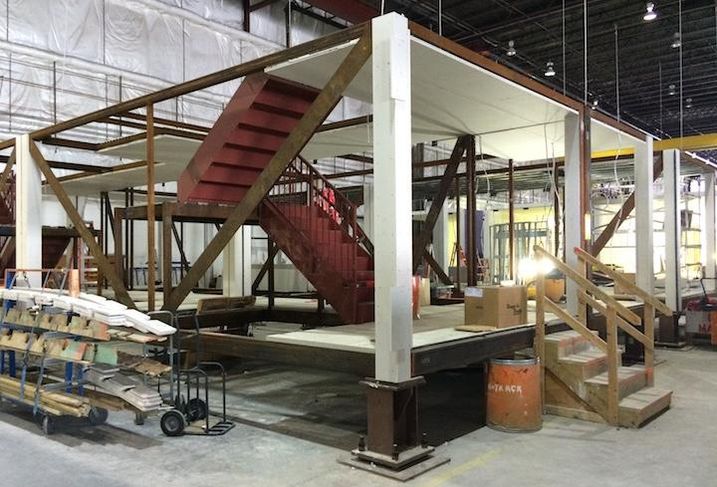
“We are so far behind it is absurd,” said FullStack Modular CEO Roger Krulak, whose firm makes volumetric modular buildings, which means all the modules are finished in the factory. FullStack has four projects underway in the city right now.
“Historically, construction has spent less than 2% of its revenue on R&D and tech … [But] finally, in the last two years or so, construction technology has got billions of investment.”
Krulak will be among a group of real estate and PropTech executives discussing the issue at Bisnow’s NYC CRE Tech Summit Feb. 19 at 160 Varick St.
Construction has been slow to adapt because it is a vast industry, set in its ways, with hundreds of billions of dollars at stake. But change is coming, particularly because it is now late in the cycle, interest rates are rising, cap rates are compressed, and finding ways to work fast and lean is more important than ever.
“Labor is not keeping pace with demand,” Krulak said. “Almost every construction project isn’t on time or on budget. All those things drive solutions.”
Advancements in prefabricated construction — where construction happens off-site and is then pieced together — is just one of the answers, Krulak said. This next cycle of development in the city will have a higher presence of prefab and modular construction than ever.
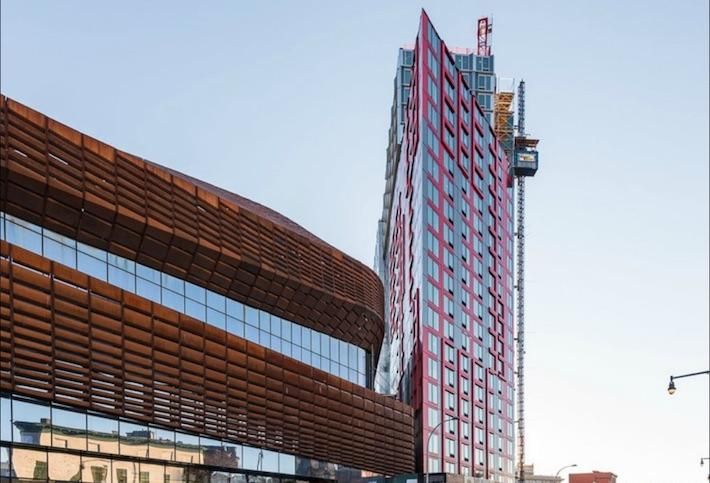
The Forest City-developed 461 Dean St. is the tallest modular building in the country, reaching 32 stories. Krulak said his firm is co-developing 20 Beach St. in the Rockaways as a prefab building financed by the city’s Department of Housing, Preservation and Development, but he declined to provide specifics on other projects. He also pointed to the the AC Hotel by Marriott at 842 Sixth Ave., which is aiming to be the tallest modular hotel in the world.
“The ROI [for prefab construction] is showing significant time saving, significant costs saving, they are able to do more projects,” DisruptCRE CEO Mariel Ebrahimi said. “From a sustainability perspective, these guys are really cutting down.”
She said technology can help with risk mitigation, providing ways to know when there is a potential injury, a system malfunction, danger or simply that a machine needs fixing — all elements that will bring down insurance costs.
In the past, incorporating technology into construction was more for public relations than any real cost-saving measure, Deloitte Consulting Real Estate Technology Strategy Lead Kevin Shtofman said, but there is now a major shift afoot.
“If you were a developer who had capital and you put money to work in 2010, you were buying near the bottom of the market … you were able to make money the traditional way, there wasn’t a lot of pressure from outside investors,” he said. “Now that interest rates are high, cap rates are compressed, there is pressure to continue to deliver similar rates of return … The only way to do that [is by] leveraging technology.”
The most promising tech development for Shtofman is in what is called robotic process automation, which refers to pieces of software code that automate tasks and transactions that would normally have to be done by a human.
That could be things like reading invoices, scraping data or paying vendors. The process is not limited to one system, so it can save money and frees up employees’ time from boring, monotonous tasks.
Shtofman said a large developer in New York City (he declined to say which) has, for the last 14 months, used an RPA process to automate the onboarding and offboarding of subcontractors. It has cut 60% of costs and meant HR could spend time on other, more engaging tasks, reducing employee turnover.
“The reason that the construction industry overall is embracing this new type of technology is that … the costs have come down enough that payback period is small and the ROI is large,” he said.
Marx Realty President Craig Deitelzweig said, in recent years, the cost of 3D modeling has come down enough for it to be a worthwhile investment, and his firm used it to get the dimensions right for the desk in the new lobby of the firm’s building, 10 Grand Central.
“In the past, you would have made it, then figured it out, or you would have just lived with it,” he said, adding the potential savings are in the hundreds of thousands of dollars.
However, he said many technology advancements that are being talked about — like robots that stack bricks and build walls — are not yet a reality, and that prefabrication doesn’t work for some high-end developments.
“Construction hasn’t been disrupted by technology yet,” he said. “It’s been helpful, but it hasn’t been to the level that has taken off and transformed.”
Barone Management founder Scott Barone agreed that while there have been significant advances in the last decades that has allowed for huge leaps in structure and design, construction in the city will remain traditional for the time being.
“If you are building a warehouse in Oklahoma, you could use a robotic bricklayer … In New York City, we are working a 100-foot-wide site that is going seven stories high,” he said. “I think that some of the technology, that type of more advanced stuff will come to New York City last.”
Evolution of downtown’s Department Building continues with new restaurant leaseBy Sean Keenan | February 6, 2019, 10:36 am EST
Downtown’s maturation seems to be bringing a lot of new—and new-looking—attractions to the neighborhood.
Take, for example, the stunning new Mercedes-Benz Stadium, the unnecessarily dazzling pedestrian bridge arched over Northside Drive, and the impending, multi-billion-dollar development of the desolate Gulch. Even downtown’s historic Central Atlanta Library—the last design by famed Brutalist architect Marcel Breuer—is due for a facelift.
Less common are the projects meant to preserve architecture that recalls Atlanta’s roots. (One notable, recent exception is the Flatiron Building’s repurposing as FlatironCity.)
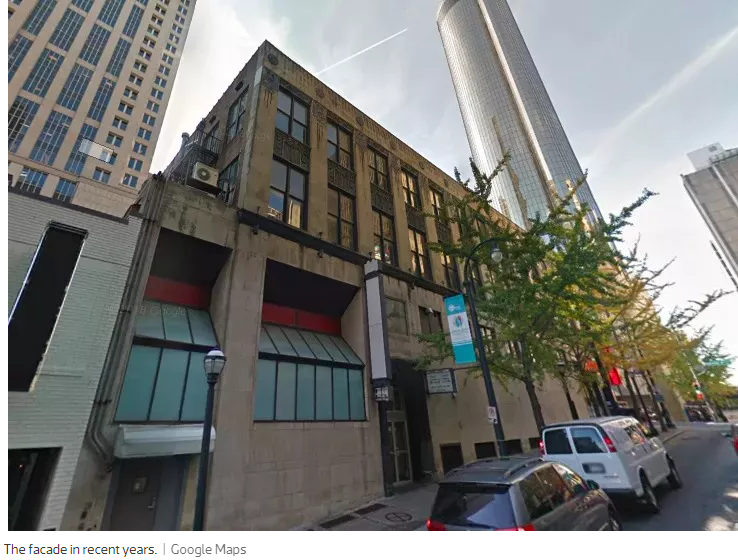
But 207 Peachtree Street, a 1920s building that once served as the destination Regenstein’s Department Store, is undergoing a $10.5-million renovation that will preserve its historic aesthetic.
Today, the structure has been rebranded as “The Department Building,” and the interiors are being renovated to create nearly 50,000 square feet of creative loft office space.
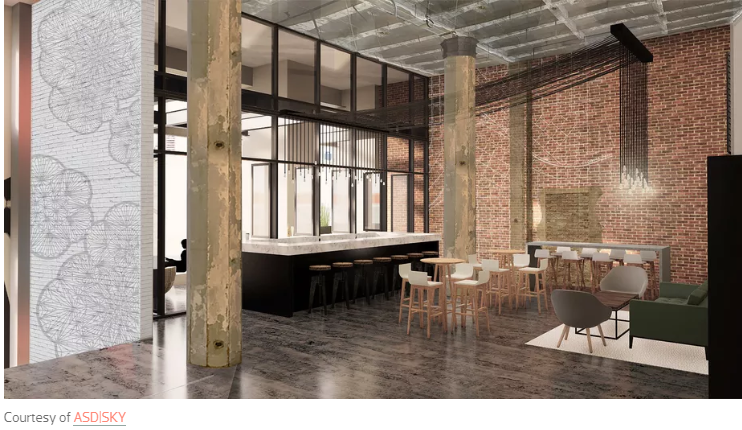
The Art Deco facade, however, is staying put. And even the insides are being redesigned by architecture firm ASD | SKY to pay homage to the structure’s long history, developers say.
 This week, owner Marx Realty announced the building had secured a ground-floor tenant, the first confirmed.
The Saito: Sushi, Steak, and Cocktails—named for renowned Master Chef Saito—just inked a lease for 2,200 square feet in the building’s lobby.
The restaurant promises “a dramatic outdoor terrace with removable glass walls to fit the historic aesthetic of The Department Building,” according to a news release.
Other elements of the building’s revival include “dramatic” 18-foot high ceilings, terra-cotta barrel vaulted ceilings, fluted columns, and original wood floors.
Also, incoming office and retail tenants can expect a rooftop “oasis” that boasts views of downtown destinations, as well as a sight line all the way to Stone Mountain.
A spokesperson for the developer told Curbed Atlanta that no other tenants have been secured, although interested parties include companies in the creative field, as well as the advertising and tech sectors.
 Which would make sense, because, per the release, the area is becoming a more desirable place to do business by the day.
“The Downtown neighborhood is re-emerging as a premier live-work-play destination in Atlanta,” Marx Realty CEO Craig Deitelzweig said in a prepared statement. “We are beyond excited to bring a building as historic and impressive in character as The Department Building into the 21st century.
Beyond FlatironCity, nearby adaptive-reuse projects in recent memory include the Switchyards project and Auburn Avenue’s Constellations.
By Alexandra Farcas | February 5, 2019
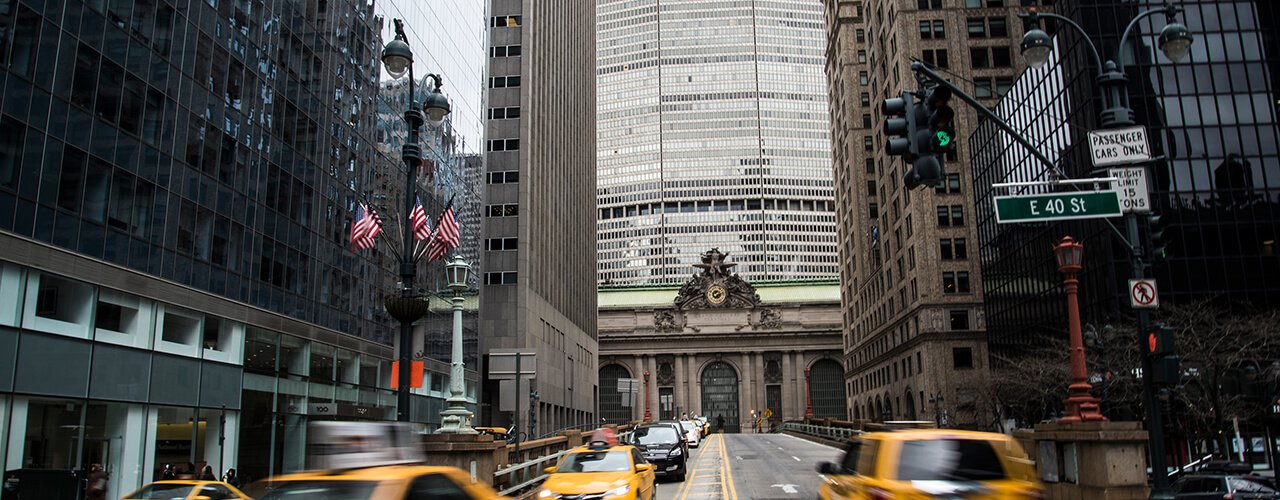
Marx Realty announced in a recent press release that media company The Week Publication has leased 12,000 square feet of office space at 10 Grand Central tower in Midtown Manhattan.
Completed in 1931, 10 Grand Central is a 35-story building that already houses several United Nations-affiliated offices and a myriad of other prestigious tenants. Previously known as the Commerce Building at 708 Third Avenue, the Ely Jacques Khan-designed tower is nearing completion of its $45 million overhaul. The renovation will have the lobby redesigned and permanently relocated from Third Avenue to East 44th Street and will include the creation of state-of-the-art hospitality-styled amenity spaces, along with a new 5,000 square-foot lounge.
Owner Marx Realty is also creating 10 pre-built office suites ranging in size from 2,500 to 8,000 square feet. Select suites will also offer access to private terraces.
“Marx Realty has collaborated with a world-renowned team 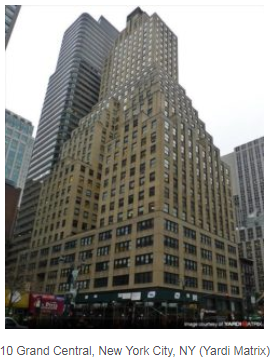
of designers and architects to bring these remarkable
upgrades to life at 10 Grand Central,” adds Craig
Deitelzweig, President and CEO of Marx Realty. “We are
proud to see that both current and incoming tenants are
very enthusiastic about these enormously powerful
changes. After all, office tenants view their workspace as
an extension of their brand.”
The move will relocate the U.S. division of the U.K.-based news magazine from its current headquarters at 55 West 39th Street for the coming 10 years, as they occupy the entire built-to-suit 22nd floor.
Clyde Reetz of CBRE represented The Week Magazine in the lease transaction. Leasing efforts on behalf of Marx Realty are led by JLL’s Howard Hersch, Sam Seiler and Cynthia Wasserberger.
More information on the project can be accessed here http://10grandcentral.com/
Saito — Sushi, Steak And Cocktails Inks Deal At ‘The Department Building’ DowntownFebruary 5, 2019
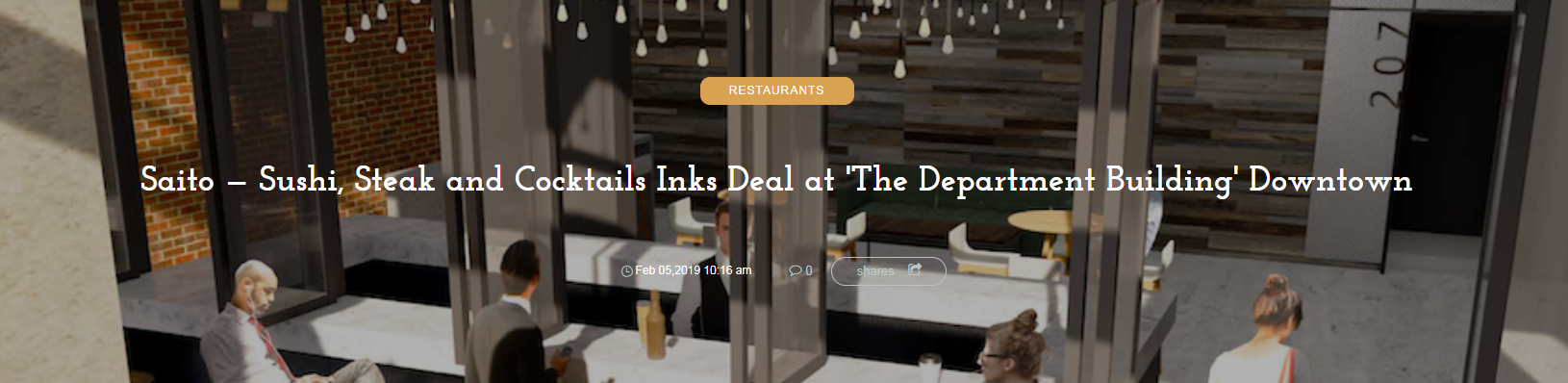
Restauranteur Stephen de Haan (Amalfi Pizza, Red Phone Booth) is partnering with Master Chef Saito on the forthcoming 207 Peachtree Street concept.
Stephen de Haan has inked a deal with Marx Realty to open Saito – Sushi, Steak and Cocktails at the newly rebranded The Department Building, at 207 Peachtree Street.
De Hann is partnering with Master Chef Saito on the 2,200-square-foot eatery.
“This will be the first Atlanta location for acclaimed Master Chef Saito and is part of Marx Realty’s ongoing commitment to offering office tenants exceptional amenities and experiences,” according to a press release Tuesday.
Marx Realty also owns the adjacent buildings where de Haan runs Amalfi Pizza and the Red Phone Booth, a bar and cigar lounge.
“Stephen de Haan is a terrific restauranteur and we are thrilled that we will be collaborating with him again, this time in partnership with Master Chef Saito,” Craig Deitelzweig, president and CEO of Marx Realty, said in the release.
“Future office tenants at The Department Building will be able to enjoy the convenience of having some of the finest sushi, steak and cocktails right in the lobby of their building. The restaurant will surely be one of the premier dining destinations in Atlanta.”
The Saito – Sushi, Steak and Cocktails space will have an outdoor terrace with removable glass walls to fit the historic aesthetic of The Department Building.
The building, formerly home to Regenstein’s department store, is being adapted for creative office use as part of a $10.5 million modernization and repositioning.
As part of Marx Realty’s plan, the firm intends to preserve the building envelope and art deco design elements while creating a modern 48,000-square-foot office and retail experience that will address the increasing demand for world-class workspaces and dining options in the Downtown neighborhood.
“To have the opportunity to work alongside Master Chef Saito, is truly an honor,” de Haan said.
“His tradition, eye for detail, and passion for service truly will deliver an unforgettable experience for our guests.”
Master Chef Saito was born and raised in Fukushima, Japan where he began his sushi apprenticeship at the age of 12.
Sixty years later and Saito has opened over 30 restaurants all over the world, in cities such as Paris, New York, and in the Hawaiian Islands.
“It is this Pacific regional influence that truly inspires Saito, utilizing fresh tropical fruits, balancing delicately with the freshest fish flown in daily to create inspired dishes including rolls and sashimi,” according to the release.
“De Haan is developing an equally inspired beverage program, utilizing techniques from the Red Phone Booth and traditional Japanese ingredients such as shiso and yuzu. Rare Japanese whiskey will be showcased at Saito, served over double reverse osmosis ice pressed into a sphere from a Taisin ice mold.”

Connect New York | February 5, 2019
Australian specialty café Little Collins has signed a 2,000-square-foot lease for a new flagship location at Marx Realty’s 10 Grand Central. The eatery is slated to open this summer.
“The Little Collins team was not only attracted to the fabulous location, but also our modern reimagining of Ely Jacques Kahn’s 1930s building,” said Marx Realty CEO Craig Deitelzweig. In fact, the design of their new space will be a combination of the building’s timeless Beaux Arts aesthetic, complemented by a sunny Australian attitude.”
Little Collins, named after a street in Melbourne, Australia, expanded from a successful first location at 667 Lexington Ave. to a second one in the General Motors Building at 767 Fifth Ave. Lately the café has focused its attention on the ever-growing office population in Midtown’s Grand Central submarket.
Marx Realty was represented in-house by VP Henry Henderson. NKF’s Ross Kaplan and Derek Koelsch represented Little Collins.
Atlanta Restaurateur Pairs Up With Sushi Master Chef For New Downtown ConceptFebruary 5, 2019

January 16, 2019
Weekly News Magazine Takes Full 22nd Floor; Communications Consultant Firm Secures Prebuilt Space
Marx Realty, a New York-based owner, developer and manager of office, retail and multifamily property across the United States, announced 14,200 square feet of new leases at 10 Grand Central, located at 155 E. 44th Street in the Grand Central submarket of Midtown Manhattan. The U.S. division of UK-based weekly news magazine The Week will be taking over the entire 12,000-square-foot space on the 22nd floor in a 10-year lease while communications consultant firm Montieth & Company will move into a 2,200 square feet pre-built suite on the 16th floor in a five-year lease. The announcement was made by Craig Deitelzweig, President and CEO of Marx Realty.
“We are happy to welcome The Week and Montieth & Company to 10 Grand Central as both companies join a prestigious and diverse roster of high-profile tenants,” said Deitelzweig. “These new deals, along with our incredibly strong leasing activity, is directly attributable to the significant repositioning of this 1930s era classic office building, including our best-in-class club-like amenity offerings, creating something truly aesthetically special.”
Marx Realty is nearing completion of its $45 million repositioning at the Ely Jacques Kahn-designed office tower recently rebranded as 10 Grand Central. The renovations include the relocation of the entryway from Third Avenue to 44th Street, along with a complete redesign of the lobby and the creation of new state-of-the-art hospitality-styled amenity spaces, including a new 5,000 square-foot lounge with seamless connections to a 2,500-square-foot terrace and a 36-seat conference facility on the seventh floor. The dramatic redesign is led by David Burns, principal of Studios Architecture. The new design pays homage to Ely Jacques Kahn’s original design intent.
Timeless walnut wood walls and brushed brass accents create a warm and inviting feel from the lobby through to the amenity floor. Concrete tiles arranged in a classic herringbone pattern punctuate the enduring Beaux Arts aesthetic while a striking array of lighting fixtures exude an air of dramatic sophistication in the lobby and amenity spaces. The seventh-floor lounge boasts oversized artwork and a café complete with built-in appliances as well as furnishings fashioned in “Grand Central Green,” a distinctive nod to the building’s proximity to Grand Central Station.
“Marx Realty has collaborated with a world-renowned team of designers and architects to bring these remarkable upgrades to life at 10 Grand Central,” added Deitelzweig. “We are very proud to see that both current and incoming tenants are very enthusiastic about these enormously powerful changes. After all, office tenants view their workspace as an extension of their brand.”
Marx Realty is also creating 10 well-appointed pre-built office suites ranging in size from 2,500 to 8,000 square feet as well as a 22,000-square-foot full-floor space which the firm will build out to tenant specifications. Each new suite exudes an air of sophistication, from polished concrete floors to a café with banquette seating, tile backsplashes, brushed brass cabinet and drawer pulls and beverage walls with built-in cappuccino machines. Contemporary sliding barn doors complement the sleek styling of these new office spaces. Select suites also offer access to private terraces.
A JLL team led by Howard Hersch, Sam Seiler and Cynthia Wasserberger is handling the leasing effort on behalf of Marx Realty. The Week Magazine was represented by Clyde Reetz of CBRE.
The Week and Montieth & Company join a number of recent new leases, expansions and extensions that include Benenson Capital Partners (real estate investment), White Oak Equity Partners (private equity firm), Marks O’Neill (law firm); PMC Treasury (financial consultancy); World Federalist Movement (non-profit); and Global Source Partners (hedge fund research provider). The building’s asking rents are of $92 per square foot in the high-rise tower, $78 per square foot in the mid-rise portion of the tower and $72 per square foot in the base.
About Marx Realty
Marx Realty is a division of Merchants National Properties (MNP). Founded in 1915, its current portfolio of properties includes over 4.7 million square feet of commercial office, retail and residential space as well as five mixed-use projects currently under development. Marx Realty is vertically integrated and involved in all phases of real estate management, development, construction and leasing. The company’s assets comprise 67 properties in 17 states across the continental United States.