
 Contact
The British publication, The Week magazine, along with a communications consulting firm signed leases with Marx Realty in the Midtown Grand Central submarket at 155 E. 44th St.
NEW YORK CITY—New York-based Marx Realty has inked two deals totaling 14,200 square feet at 155 E. 44th St. The US edition of the UK-based weekly magazine The Week signed a 10-year lease for the entire 12,000 square feet on the 22nd floor. Their relocation is scheduled for May 2019. The communications consultancy, Montieth & Company, recently moved into a 2,200 square-foot, pre-built space, after signing their five-year agreement.
The building’s asking rents are $92 per square foot in the high-rise tower, $78 per square foot in the mid-rise portion of the tower and $72 per square foot at the base.
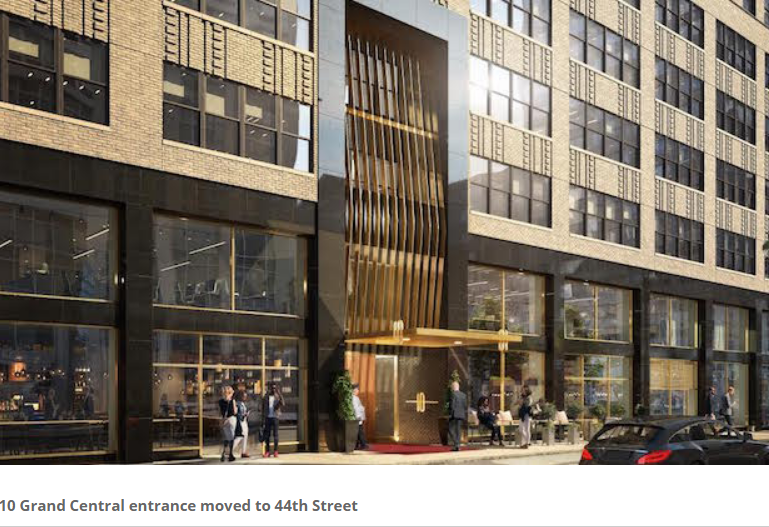
Marx Realty is completing a $45 million renovation of the 1930s Ely Jacques Kahn-designed office tower, recently rebranded as 10 Grand Central. It included relocating the entrance from Third Avenue to 44th Street, redesigning the lobby and creating amenities such as a lounge, cafe, terrace and conference room. David Burns, principal of Studios Architecture, is handling the redesign that pays special attention to the intent of the architect’s original design.The repositioning will also involve 10 pre-built office suites ranging from 2,500 to 8,000 square feet and a 22,000 square-foot, full-floor office space that Marx Realty is building out to tenant specifications. Other architectural touches include contemporary sliding barn doors and select offices having private terraces.
“The unique amenity offering, combined with a location proximate to the iconic Grand Central Terminal continues to attract the type of media, technology and financial services tenants that would otherwise land in Midtown South,” says Craig Deitelzweig, president and CEO of Marx Realty. “But these firms find that 10 Grand Central meets their aesthetic and space layout needs while benefiting from the built-in conveniences of the Grand Central neighborhood.”
The Week is moving from its current offices at 55 W. 39th St. between Fifth and Sixth avenues to its new location on 44th Street, between Lexington and Third avenues.
It will join tenants including real estate investment firm Benenson Capital Partners; private equity firm White Oak Equity Partners; law firm Marks O’Neill; financial consultancy PMC Treasury; non-profit World Federalist Movement; and hedge fund research provider Global Source Partners.
JLL’s Howard Hersch, Sam Seiler and Cynthia Wasserberger are leading a team handling the leasing for Marx Realty. CBRE’s Clyde Reetz represented The Week.
January 9, 2019
Marx Realty is gearing up to be a bigger player in the office market. The old-line New York firm plans to buy $1 billion of offices this year. It’s scouting deals of up to $250 million in New York, Washington and Atlanta. As part of the push, Marx wants to add one or two acquisitions pros to its staff.
The shop would hold the investments in a new vehicle dubbed Marx Value Add Heritage Fund. The open-end fund, which has no initial equity target, would be backed mostly by the company’s capital, but also outside investors. Marx could purchase buildings outright, or via joint ventures with institutional investors.
Marx hired Craig Deitelzweig as chief executive in August 2017. At the time, the firm owned mostly older office and retail buildings nationwide. Deitelzweig, who moved over from Building and Land Technology, said he first set out to trim holdings in markets where Marx no longer planned to focus, and reposition properties in markets where he saw opportunity.
For example, Marx is investing $20 million to transform former Atlanta department store into modern offices. In Manhattan, it just finished investing $45 million to reposition the 35-story office building at 155 East 44th Street, a few blocks from Grand Central Terminal. That project created a full-floor amenity space with a lounge, kitchen, conference area and terrace. Marx also renamed the building 10 Grand Central. The repositioning helped boost occupancy to 87% from 78%, and net operating income increased by $2 million in one year. It’s projected to double in four years, Deitelzweig said.
“Our approach is different than our competitors in how we embrace hospitality and office in a true way,” he added. “At 10 Grand Central, for example, we have a uniformed doorman opening wood entry doors. The lobby has its own scent, like you’d find in a high-end hotel. ‘Experiential office’ is what we are calling it, and we’re able to meaningfully grow net operating income and rent by being unique in this regard.”
As Marx steps up acquisitions, Deitelzweig said it will look for Class-B buildings that can be repositioned to attract tenants seeking more-modern space.
“Our goal is to turn a property into what we call ‘trophy A-minus,” he said. “We could be across the street from a true trophy, but what the potential tenant will find in our building…is a lower rental rate and a better experience for its employees and guests.”
Since Deitelzweig joined, Marx hasn’t purchased anything in Atlanta, but is actively looking in the city’s Midtown and West Midtown submarkets. In Manhattan, it bought 135 and 161 Bowery (totaling some 50,000 square feet) for $48 million via an off-market deal in July. In a September deal, it paid $21.2 million for the 21,000-sf office and retail building at 819 Seventh Avenue NW in Washington. It plans to reposition that property, adding floors and a rooftop terrace.
The two acquisition positions Deitelzweig is looking to fill would be based in New York, reporting to managing director Paul DiCarlo. Candidates should have 2-7 years of experience.
Before his three-year stint at Building and Land of Stamford, Conn., Deitelzweig worked at Rockrose Development of New York, Investcorp of Bahrain, Ruben Cos. of New York and law firm Skadden Arps.
Marx, founded in 1915 by Joseph Marx, was acquired in 2006 by Merchants’ National Properties, which now operates under the Marx brand. Overall, the company owns 67 properties in 17 states, totaling 6.7 million sf. It also owns five development sites that could accommodate some 2.3 million sf of commercial space.
Marx Realty Debuts Concierge-Style Software Interface “MarxConnect” At 10 Grand CentralCitybizlist | December 27, 2018
Marx Realty, a New York-based owner, developer and manager of office, retail and multifamily property across the United States, announced the debut of its proprietary software interface, MarxConnect, a closed-source software program that serves as a high-tech service hub for office tenants. The interface, a result of collaboration between Marx Realty and computer science students at Princeton University School of Applied Engineering, will be launched at 10 Grand Central, Marx Realty’s 35-story office tower located at 155 East 44th Street in New York in February 2019, upon the unveiling of the building’s new lobby. The announcement was made by Craig Deitelzweig, President and CEO of Marx Realty.
“MarxConnect is another example of our ongoing commitment to offering the very best experience to our tenants,” said Deitelzweig. “We are wholly dedicated to providing a hotel-like concierge experience for our tenants,from the pre-built office spaces to the new lounge and terrace to the user-friendly access control. MarxConnect will seamlessly integrate into tenants’ and guests’ day to day experiences while exceeding tenant service expectations.”
The cutting-edge technology will be implemented widely across the Marx portfolio and will provide a suite of services, including:
- Access and Security. Tenants and their employees will use their smartphone’s Bluetooth signal to access the building and elevators, walking seamlessly past the security access points.
- Visitor Registration. Visitors will receive an email that will generate a barcode, allowing them to check in without waiting in a security desk queue.
- Direct access to the landlord. Tenants will be able to chat directly with landlord representatives.
- Scheduling and catering. Tenants will be able to quickly book shared conference rooms and amenity spaces, as well as submit service requests to property management.
The introduction of MarxConnect coincides with the comprehensive repositioning underway at 10 Grand Central. The company is nearing completion ofa $45 million repositioning focused on impactful design, including a relocated and dramatic four-story entry portal, a new lobby reminiscent of members-only hospitality spaces, a well-appointed lounge, a furnished and landscaped outdoor terrace with a firepit and an oversized conference facility as well as pre-built suites with high-end features and finishes at a level not yet seen in the market. Pre-built suites range from 2,500 to 8,000 square feet as well as a 22,000-square-foot full-floor space which Marx Realty will build out to tenant specifications.
“We are eliminating the need for bulky turnstiles and implementing a wireless system that will allow for a seamless and secure experience for every user, saving employees time and increasing productivity,” added Deitelzweig. “MarxConnect is the perfect addition to the curated package of services and amenities at 10 Grand Central and we look forward to continually improving our tenants’ experience across the Marx Realty portfolio.”
David Burns of Studios Architecture provided design and architecture services and a JLL team led by Howard Hersch, Sam Seiler, and Cynthia Wasserberger is handling the leasing effort at 10 Grand Central.
About Marx Realty
Marx Realty is a division of Merchants National Properties (MNP). Founded in 1915, its current portfolio of properties includes over 4.7 million square feet of commercial office, retail and residential space as well as five mixed-use projects currently under development. Marx Realty is vertically integrated and involved in all phases of real estate management, development, construction and leasing. The company’s assets comprise 67 properties in 17 states across the continental United States.
Marx Realty completes $45 million repositioning of 10 Grand Central; Burns of Studios architecture is behind the redesignNYREJ | December 18, 2018
Manhattan, NY Marx Realty has completed the expansive amenity space added to the seventh floor at the recently-rebranded 10 Grand Central. As part of a $45 million repositioning of the Ely Jacques Kahn-designed office tower located at 155 E. 44th St., the 7,500 s/f indoor/outdoor lounge, terrace and conference space now features a hotel-like ambiance with plush seating, a conference facility with a 36-seat table and an outdoor terrace with an aesthetic reminiscent of a 1930s-era garden party.
“Our experience repositioning classically designed office buildings served as a road map for 10 Grand Central,” said Craig Deitelzweig, president and CEO of Marx Realty. “Today’s tenant wants amenities that have a hospitality-infused design aesthetic while creating an experience that enhances a tenant’s brand. The lounge and terrace are warm and inviting and the 36-person conference table is perfect for large meetings, presentations or a James Beard-worthy dinner. There is nothing else like this in today’s office market.”
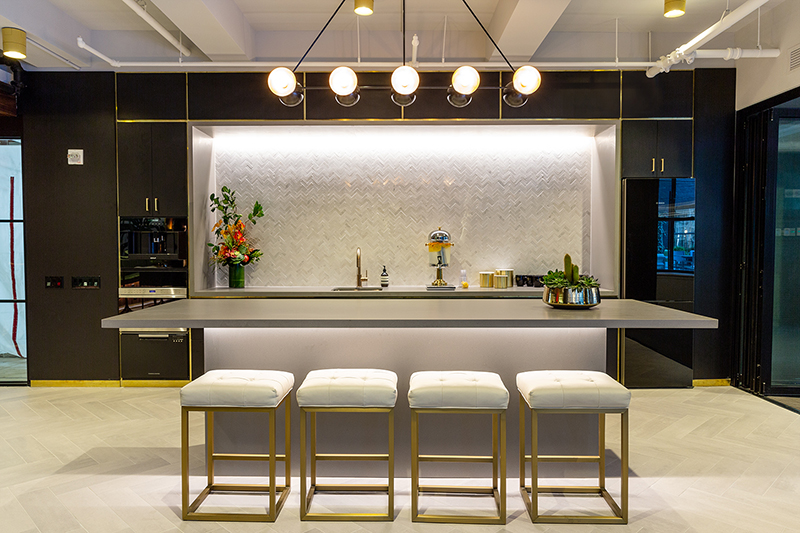
10 Grand Central Lounge Cafe.
Walnut wood accents and wall coverings add an air of authenticity to The Lounge while brushed brass fixtures and inlays punctuate the classic, yet contemporary, design sensibility. Velvet banquette cushions fashioned in “Grand Central Green” are an ode to the building’s proximity to Grand Central Terminal. The space boasts a fully-equipped café with built-in appliances and a large center island and an eclectic mix of light fixtures add to the hospitality-like vibe. A glass wall of doors and windows open to The Ivy Terrace outdoor space – replete with ample seating, a fire pit and ivy-covered walls – floods the space with natural light.
“Our vision was always to transform the seventh-floor space into something truly memorable,” said Deitelzweig. “The combination of the comfortable interior space and the lush landscaping of the chic outdoor terrace sets a new standard for office buildings in New York. The fixtures, finishes and furnishings are inspired by the world’s finest hotels and clubs and create an ambiance that is especially attractive to creative and financial services firms.”
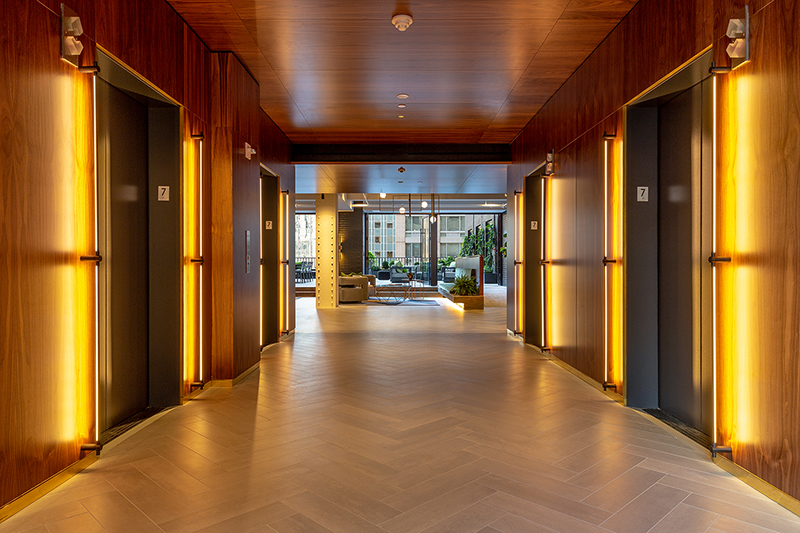
10 Grand Central Lounge Entry
In addition to the robust amenity offering, 10 Grand Central includes several well-appointed pre-built office suites. Tenants are drawn to these spaces as an extension of their own brand. As such, Marx Realty is creating 10 upscale pre-built office suites ranging in size from 2,500 to 8,000 s/f as well as a 22,000-square-foot full-floor space which the firm will build out to tenant specifications. Each new suite exudes an air of sophistication, from polished concrete floors to a café with banquette seating, tile backsplashes, brushed brass cabinet and drawer pulls and beverage walls with built-in cappuccino machines. Contemporary sliding barn doors complement the sleek styling of these new office spaces. Select suites also offer access to private terraces.
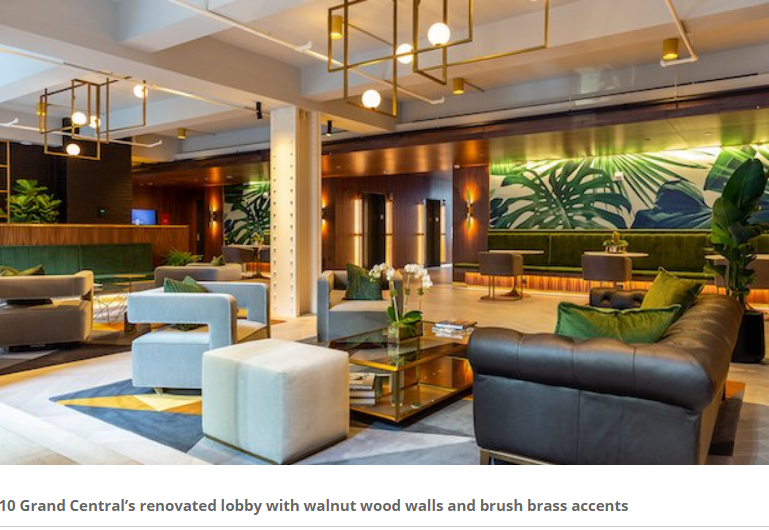
Slated for completion in February 2019, a redesigned lobby will feature concrete herringbone floors, brushed brass accents and walnut wood walls. A jewel box reception desk crafted by a Brooklyn-based artisan and soft lighting will create an ambiance that speaks to a full-service, hospitality-like vibe. The entrance to 10 Grand Central will be relocated to the building’s original 44th Street location, creating a property that is definitively oriented toward Grand Central Terminal. The dramatic four-story entryway will feature towering brushed brass fins, gloss black brickwork and oversized warm walnut wood doors, creating a strong strategic presence. Unlike a typical office building, the entry at 10 Grand Central will be attended by a uniformed doorman.
“The updated design sensibility throughout 10 Grand Central unlocks the value of this classic Beaux Arts building while staying true to Ely Jacques Kahn’s original design intent,” said Mr. Deitelzweig.
David Burns, principal of Studios Architecture, is behind the dramatic redesign. A JLL team led by Howard Hersch, Sam Seiler and Cynthia Wasserberger is handling the leasing effort.
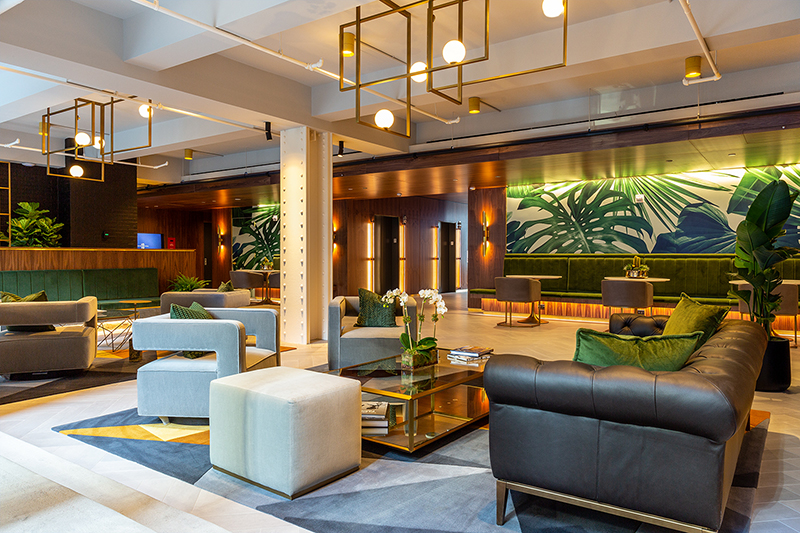
10 Grand Central Lounge
Connect New York
Commercial Real Estate News
December 6, 2018
Marx Realty has completed the expansive amenity space added to the seventh floor at the recently-rebranded 10 Grand Central, wth a 7,500-square-foot lounge, terrace and conference space. It’s part of a $45-million repositioning of the Ely Jacques Kahn-designed office tower at 155 E. 44th St.
“Our experience repositioning classically-designed office buildings served as a road map for 10 Grand Central,” says Craig Deitelzweig, president and CEO of Marx Realty. “Today’s tenant wants amenities that have a hospitality-infused design aesthetic, while creating an experience that enhances a tenant’s brand.
“The lounge and terrace are warm and inviting, and the 36-person conference table is perfect for large meetings, presentations or a James Beard-worthy dinner,” he added.
The New York Post reported this week that the repositioning helped land a 7,000-square-foot lease from Seven Bucks Productions, Dwyane Johnson’s multi-platform production. A spokeswoman for Marx Realty declined to comment on the report.
Craig Deitelzweig of Marx Realty Talks DC Design, Amenities and TechBy Christina Sturdivant-Sani | November 29, 2018 7:00 AM
When Craig Deitelzweig was a teenager, he worked the midnight shift as a doorman in a New York City residential rental building during holidays and breaks from school.
Developer David Walentas, the founder of Brooklyn-based Two Trees, lived in that building and frequent encounters made a distinct impression. “I really became impressed by him and how he could change New York,” Deitelzweig, the CEO of New York-based Marx Realty, told Commercial Observer in a recent interview. “I wanted to be part of changing the skyline of the city as well.”
Deitelzweig, 45, remembers Walentas finding him asleep on the job one night after studying, around 2 a.m. “He was standing right over me. He was very nice and said, ‘It looks like maybe you’ve been studying too much for the SATs,’ ” recalled Deitelzweig, who graduated from Tulane University’s A.B. Freeman School of Business and Fordham Law School.
One of Deitelzweig’s first jobs out of law school was as an attorney in the real estate group at the law firm Skadden, Arps, Slate, Meagher & Flom, based in New York City. “Almost everything in real estate is legal in some way—whether it’s a lease or zoning or purchase agreements; understanding those nuances and the risks involved is very helpful,” he said.
Deitelzweig has worked at multiple firms over the past two decades, stacking a real estate deal sheet with acquisitions, asset management and repositioning projects spanning from New York City and Boston to Washington D.C. and Atlanta.
After overseeing a portfolio of office, multifamily and hotel assets for Stamford, Conn.-based Building and Land Technologies, he joined Marx in August 2017.
“Marx was founded 103 years ago so it has a long rich history and was always a pioneer in real estate in so many different ways. And Marx has terrific real estate throughout the country; we’re actually in 16 states,” said Deitelzweig, who’s married with two children, ages 16 and 18, and lives in the Armock area of New York’s Westchester County.
In Manhattan, Marx is currently repositioning a 35-story Art Deco office tower at 708 Third Avenue, rebranded as 10 Grand Central, to feature a seventh-floor hotel-style lounge with a conference and modern kitchen, opening onto an outdoor terrace, as Commercial Observer previously reported.
As part of the firm’s nationwide dealmaking, Deitelzweig has zoned in on Washington, D.C. There, he’s already negotiated three deals in his year and change at Marx including a complex acquisition of 819 7th Street NW. He did other deals in D.C. while working at other New York City companies—as the manger of the office division of Rockrose Development and as the leader of leasing and asset management activities at Ruben Company.
Marx is laser focused on acquiring assets in D.C.’s Central Business District (CBD), Deitelzweig said. “In every market that we’re in, we always look to where the brokers’ offices are located and if you look in D.C., all of them are in CBD, so we like to surround ourselves in that circle.” The area is seeing an influx of a lot of tenants, including premiere law firms, plus new developments, he added.
In a phone interview with CO, Deitelzweig shared more about what makes D.C. special, how he’s transformed buildings in the past and his strategy for the future.
Commercial Observer: How does the D.C. market differ from other cities where you’ve done real estate deals?
Deitelzweig: D.C. has been well ahead of the curve in terms of amenities. For instance, rooftop terraces that are so prevalent in D.C. buildings came into place about 10 years earlier than in New York.
New York right now has just really gotten into the amenity buildup and so it has really helped to see what works in D.C. [so we can bring that vibe to Gotham]. We always try to put a New York sensibility and style in our D.C. projects, too. What we’re working on right now at 10 Grand Central in New York is really marrying hospitality and office in a way that have never been done. And we plan to do that in D.C., too, with our next acquisition.
Are there any specific buildings in D.C. that you think are rich in amenities?
Nothing even close to what we’re doing at 10 Grand Central, but we’ve always tried to create a wonderful experience at all the buildings I’ve worked on in D.C. For instance, at 1776 Eye Street, [Rockrose, where Deitelzweig was working at the time], was among the first firms to build a fitness center that wasn’t in the basement and got natural light. It’s also the first and remains the only building to have a rooftop basketball court. These are just certain ways to make your building stand out and be a more special place for employees and tenants.
Is that part of what contributed to 1776 Eye Street winning multiple design awards in 2015?
In part, that was a repositioning and we put in a glass facade in the very front of the building that went out on the street—it’s really one of the first buildings that has that. It gave a real vibrancy to the lobby itself. We knew the building was a success when we saw tourists taking photos of the lobby because we had these iconic lights fins that were quite dramatic. We always like to create some type of drama in our spaces.
At Rockrose, you helped acquire and renovate 2000 L Street, which was reportedly the largest privately owned renovation in D.C. history. Can you tell us about that project?
We acquired 2000 L and the adjacent building 2001 K [in 2013] in order to get the air rights because K Street is a wider street and we were able to use those air rights to add four floors to 2000 L. That’s what we like to do—think of creative ways to add value. And in that instance, we reskinned the entire building and connected the two buildings as well as created a very dramatic atrium.
Again, it’s all about the tenant experience. Each building is sort of unique and we like to creatively look at the building, figure out what qualities we want to enhance and make the building the best that it can be.
Marx purchased individual floors at 819 7th Street NW until it recently acquired the entire building. Was that the first time Marx has done a purchase that way?
It’s definitely the first time we’ve done it that way. We always look for off-market opportunities and in this particular instance, we realized that we could obtain control of the full building by acquiring one floor at a time. And now that we own the whole building, we’re looking at ways to polish its natural beauty, add value and make it into a true trophy asset.
Have you been surprised by the development of any D.C. neighborhoods as of late?
I would have thought that Dupont Circle would have taken off more in terms of technology tenants. [Marx] has a property at 2200 P Street NW and we’re determining the right strategy for that property. But we know whether it’s residential or office, we will want it to be geared toward the technology sector.
Why the technology sector in particular?
Because Dupont Circle has great transportation and it has the look and feel that technology tenants would want. It also has a strong residential backbone, great retail and restaurants—all things that should attract technology employees to that market.
It seems like a lot of tech companies are also moving to Northern Va. Are you looking at any developments in the suburbs of D.C.?
We are not. We’re solely focused on D.C. itself because we like to be in a supply-constrained neighborhood where there’s wonderful transportation.
D.C. has long been known as a government town. Do you think the city has any other attributes?
Surprisingly, D.C. has a fairly large tech sector that people don’t really realize as much as they should—some of that has stemmed from the government. There are a lot of creative folks who live in D.C. and a large millennial population that’s well educated. Those customers really want a product that is unique, special and has a sense of place.
So, outside of work, what do you like to do?
It’s not going to sound exciting but when I visit other places, I love to see real estate. So when my family goes with me on a trip, it always somehow becomes a business trip. We’re always looking at architecture, museum, hotels, restaurants, clubs and applying that to our real estate.
Are there any cities across the globe that you’re inspired by?
I think London has really terrific new office buildings. I love when a city has a sense of place and we always try to do that in everything that we do, too, so if we’re building in D.C., we want it to have a D.C. sensibility to it. If we’re building in New York, we want to have the nature that you would expect in New York.
Amenities, Transit Push D.C.’s Central Business District to New HeightsNovember 16, 2018

AtlantaINtown.com
By Collin Kelley
New York-based Marx Realty has announced plans to modernize the 1920’s era Art Deco building at 207 Peachtree Street in Downtown that was once home to Regenstein’s Department Store.
The $10.5 million overhaul is expected to keep the building’s design elements while creating a new 48,000 square-foot office and retail space within. The structure will be known as The Department Building.

The renovated building will feature 18-foot high, terra cotta barrel vaulted ceilings, fluted columns, and original wood floors. A new rooftop deck will offer views up and down Peachtree Street and the distant Stone Mountain. The redesign is being managed by local design firm ASD | SKY.
Marx Realty also announced that marketing and leasing for The Department Building is being managed by a JLL team led by Jeff Belamy and Liz Koteles.
“The Department Building will appeal to users in the 5,000 – 30,000 square feet range seeking efficient, creative office space in a unique environment with immediate access to MARTA and significant surrounding amenities” according to Jeff Bellamy, Managing Director with JLL.
“Buildings with this type of character are in high-demand in Atlanta and rarely exist,” says developer
The latest effort to lure creative office users downtown will involve a $10.5-million Peachtree Street renovation that pays homage to a historic building’s architecture and original purpose, developers say.
New York-based Marx Realty has announced plans for the modernization and rebranding of 207 Peachtree, a 1920s building at the southeast corner of Andrew Young International Boulevard and Peachtree Street.
Originally the downtown location of popular Regenstein’s Department Store, a purveyor of top-shelf fashion, the mostly empty structure will be renamed The Department Building.
Plans call for retaining the exterior’s Art Deco flourishes while adding 48,000 square feet of creative offices and a rooftop amenity with views spanning from Hard Rock Cafe across the street to Stone Mountain. (Downtown’s Hooters occupies a Peachtree storefront but a different address).
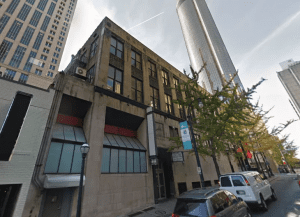
Future office tenants can expect a functional lobby area, 18-foot ceilings, fluted columns, and original wood floors, officials say.
“Buildings with this type of character are in high-demand in Atlanta and rarely exist,” Craig Deitelzweig, Marx Realty president and CEO, said in a press release.
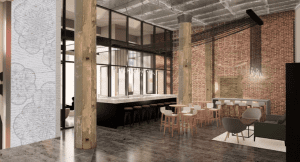
The project is being managed by local design firm ASD | SKY.
The firm’s Atlanta projects have included Skyline Park at Ponce City Market and the Olympia Building’s painstaking resuscitation downtown.
The revamped 207 Peachtree building could suit a single large tenant or smaller outfits needing as little as 5,000 square feet. Developers are emphasizing its proximity to MARTA’s Peachtree Station, the Connector, and “abundant parking.”
Plans for The Department Building echo several adaptive-reuses of older buildings in surrounding blocks in post-recession downtown, including the Flatiron Building (now FlatironCity), the Switchyards project, and Auburn Avenue’s Constellations.
Rebranded as The Department Building, the property will offer 48,000 square feet of modern creative office space with historic design features.
GlobeSt.com
By Steve Lubetkin | October 31, 2018 at 05:30 AM
ATLANTA, GA—Marx Realty, a New York-based owner, developer and manager of office, retail and multifamily property across the United States, is undertaking a $10.5 million modernization and repositioning of 207 Peachtree in Atlanta, GA. Marx says its plan keeps the historic building envelope and beautiful Art Deco design elements while creating a new 48,000 square-foot office and retail space within.
In tandem with the renovation plans, Marx Realty plans to reintroduce the historic structure as The Department Building. Originally built in the 1920s, the building was first occupied by Regenstein’s Department Store, a favorite among locals and one of Atlanta’s go to for high-quality fashion. The renovated building will feature 18-foot high ceilings, terracotta barrel vaulted ceilings, fluted columns, and original wood floors. The building also offers expansive loft style floorplates, oversized windows, and a one-of-a-kind rooftop amenity with unobstructed views up and down Peachtree Street and of Stone Mountain. The redesign is being managed by local design firm ASD | SKY.
“Marx Realty is thrilled to announce the reintroduction of the historic Department Building,” says Craig Deitelzweig, president and CEO of Marx Realty. “While maintaining its beautiful original detail and timeless architecture, the dramatic enhancements will welcome a new generation of creative office users to the space, making this a truly unique building that will continue to redefine Downtown Atlanta’s architecture and corporate landscape.”
The building’s renovations will also include new elevators and building systems, as well as a new dedicated lobby, which will highlight the distinctive features from the original historical building. All the renovations embrace the building’s history and make use of period architectural details throughout. The building offers a unique opportunity that blends an authentic historical feel with state-of-the-art office space suitable for today’s technology-driven tenants.

The Department Building’s premier location in the heart of Downtown Atlanta and its iconic historical architecture will also offer a branding opportunity that Marx says is ideal for a single-tenant full-building presence, including a signage opportunity. The building is walking distance from MARTA’s Peachtree Station and minutes from the Downtown Connector and I-85. The surrounding neighborhood is rich in amenities and offers abundant parking. The renovated building joins several other important landmarks in the Downtown area including SunTrust Plaza, the Center for Civil and Human Rights, the Georgia-Pacific Center, and the Westin Peachtree Plaza.
“Buildings with this type of character are in high demand in Atlanta and rarely exist,” says Deitelzweig. “We have renovated this building in a manner that enhances the original detail of the building while elevating the space to appeal to today’s creative and technology tenants.”
Marx named Jones Lang LaSalle’s Jeff Belamy and Liz Koteles to handle marketing and leasing.
“The Department Building will appeal to users in the 5,000 – 30,000 square feet range seeking efficient, creative office space in a unique environment,” says Bellamy, a JLLmanaging director.