Contact
Marx Realty CEO Craig Deitelzweig Spied the Office-Hospitality Connection Early
He and the firm have brought the complementary relationship to life at properties such as 10 Grand Central and 545 Madison Avenue
By Amanda Schiavo July 21, 2026 10:00 am
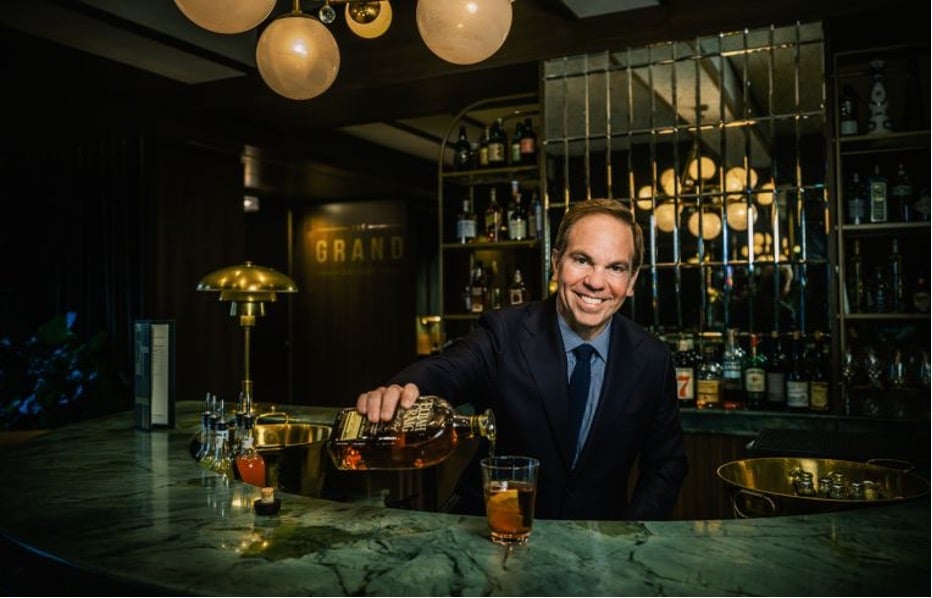
Craig Deitelzweig at Marx Realty’s 10 Grand Central
PHOTO: Chris Sorensen/for Commercial Observer
When he isn’t home tending to his alpacas — yes, he has alpacas — Craig Deitelzweig, the chief executive officer of owner Marx Realty, is working out ways to beautify the company’s office portfolio, intent on making where people go to work a destination, not a chore.
Deitelzweig, a former lawyer who graduated from Fordham University’s law school, became CEO of Marx Realty in 2017 and set out to reposition the firm’s portfolio, grow the company, and improve the value of the office properties in the key markets where the firm operates.
Repositioning, Deitelzweig said, is an area where he developed a voracious appetite, relishing the process of turning something old into something new, which the firm has done with two of its crown jewels in Manhattan: 10 Grand Central and 545 Madison Avenue.
And, while Marx Realty owns some of Manhattan’s most prominent office buildings, the firm’s portfolio also consists of properties in Washington, D.C., including the Herald at 1307 New York Avenue and the Grogan at 819 Seventh Street.
Commercial Observer caught up with Deitelzweig in June to discuss what Marx Realty has been up to, and the importance of creating distinctive, hospitality-infused office spaces.
This interview has been edited for length and clarity.
Commercial Observer: What was your career journey from law to CEO of Marx Realty?
Craig Deitelzweig: I started my career first in the litigation group and then in the real estate group at Skadden Arps. Then, from that firm I went to a private developer, and while at the developer I was initially in the legal and business side of things, but then, over time, I realized that I had this aptitude for repositioning office properties.
First they put me on some properties that they had in Boston, which were sort of the redheaded stepchild of the company. They were just really troubled assets, and they sort of let me do my thing before I even knew I had a thing to do, and those repositionings were really successful. Even back then we were always thinking of how we can make a building distinctive and special, and really my goal has always been to make people feel good in a space.
I’m not sure where that came from, but I just never understood why office buildings had to be so unspecial, so sterile, white, cold and harsh. I always thought that there should be warmth, spirit and a sense of place in these office buildings.
So that’s what I first did in Boston, and then once that was a success, I did the same in D.C. and then in New York. Then from that developer I went to a private equity firm and did the same thing there. I worked on different asset classes in addition to office, including multifamily and hotels. The hotel world was really where I realized how special spaces can be, and also really tried to apply some of those design techniques, and just bringing in the general hospitable nature of hotels into other sectors. What’s happened over time is all these sectors have converged.
From that private equity firm I went back to a developer, then back to a private equity firm, and then ultimately landed here at Marx.
What assets and markets make up the Marx portfolio?
We’re in 16 states, which surprises a lot of people. I think a lot of people think of us just here in New York, but we have a pretty big portfolio in D.C. as well, and then we have a mix of office and retail.
On the retail front, we own Cross County Center in Yonkers, N.Y., which is the nation’s first open-air shopping center. We’ve also invested a lot into that over the years. Similar to what some people were saying about office being dead, they were saying the same with retail, and we’ve proven that to be false.
We’re constantly evolving all of our retail spaces, so in that center right now we’re under construction on two new large retail spaces for another 58,000 square feet, and a 4-acre park in between, which will have trees and different seating areas, and will act as a front door to the center. We’re doing that because we just want to make sure that the center is future-proofed, and we just believe that people want spaces to collaborate and to have fun, and to feel good.
You said you developed an aptitude for repositioning. What is it about repositioning that you feel drawn to?
I love the idea of making something that is not performing the way it should be, that’s not wowing, and making that building into something that does well, and figuring out how to do it. When I look at a building, I can see what it should be. I can really look past all of the elements that are tired or inconsistent, and just really focus on what that building can be, and in my head come up with a creative way to make the building what it should be.
Marx is known for its hospitality-infused approach to the office, and we’re sitting in a shining example of that at 10 Grand Central. How did you first approach the idea of office and hospitality coming together?
I’d been thinking about it for years before coming to Marx. Again, I just never understood why every office building had to feel the same. We call it the “REIT special,” because all these buildings are often owned by real estate investment trusts, and they just aren’t necessarily very thoughtful about their approach to design. All of their buildings kind of check the box, and we never want to just check the box.
So, when I came to Marx, I wanted to infuse hospitality across our portfolio and really rethink about what the office should be. We were pioneers, and doing this well before the market understood the demand and shifted in terms of what tenants desired. That shift started before COVID-19, but accelerated after COVID.
When we started to renovate this building in 2018, we told our architects that we wanted our lobby to look like no other lobby in the city. At that time — and it’s easy to forget, because since then people have copied us — every lobby was either white or gray marble, with harsh bright, white lights. They also had security guards who acted more like prison guards, and at our buildings instead of security guards we have doormen and concierges.
I had been working in a REIT building for many years, and the guards all knew me, and one day when I forgot my wallet they wouldn’t let me in. I had to call up to my assistant, who said yes, in fact, I do work here, and they required her to come down and vouch for me. And I just thought this doesn’t feel good, and this isn’t what people want in an office. Certainly, we want good security, but we also want to be thoughtful and make people feel special at work.
What elements go into welcoming employees into your office buildings?
Ours were the first office buildings to have doormen outside in proper uniforms, smiling and welcoming, and also knowing everybody, and opening the doors, which is also a security feature.
And in the lobby we have a lot of warm elements, and it took a lot of iterations. It was interesting because our brokers at the time thought that what we were doing was wrong. They just couldn’t get their heads around it. They thought it would only be attractive to creative tenants, and what we found as soon as we repositioned the property was that it actually had broad appeal. Our first tenant was actually an insurance company. That tenant really wanted spaces that inspired their employees, and actually they wanted their brand to change a little bit, to feel a little less fuddy-duddy.
A lot of tenants actually want their brand to be associated with the building brand, and what we do, which is also very different from other office owners, is each of our buildings is its own brand.
10 Grand Central is a different brand than 545 Madison Avenue, which is a different brand than 430 Park Avenue, which is a different brand than the Herald. All of them are very distinct, and everything we do is on point with that brand, so it has to be authentic.
What was done throughout 10 Grand Central?
Whenever we reposition a building we look at the history, and with 10 Grand Central we had discovered that the initial entrance to the building was actually where our entrance is today. It was moved to Third Avenue, so we moved it back to where it should be, and really embraced Grand Central, turned our back to Third, and became part of the Grand Central mix.
In addition to tenants preferring to be in the Grand Central submarket, it also was just helpful with the whole rebranding of the building.
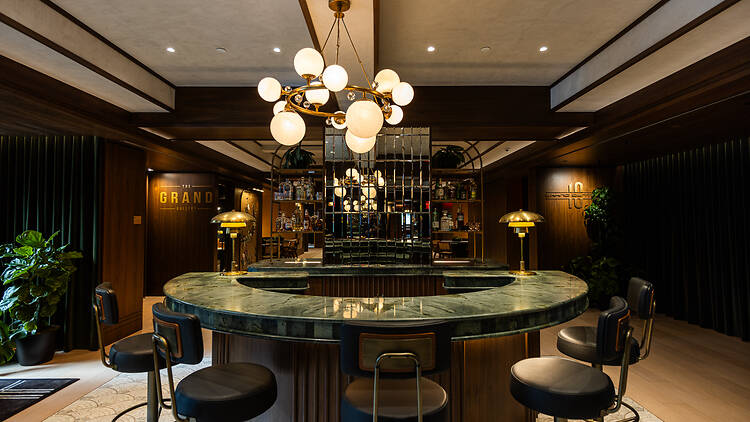
Then we did an amenity floor. We thought it was important because we want our buildings to be like a hotel. The best hotels will have everything in it, from breakfast to dinner. The way we look at it is from cappuccino to cocktails, and that’s why we recently introduced a speakeasy here called Highball Ltd. We partnered with Jeff Bell of Please Don’t Tell, who really understands cocktails, and the food is by Michelin-star chef Marc Forgione.
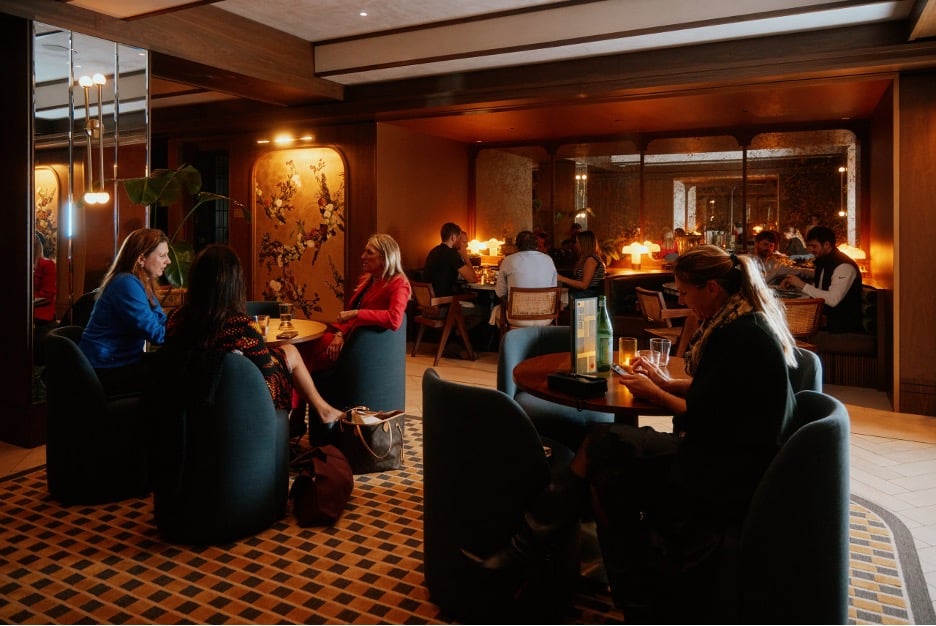
The space itself was inspired by luxury train cars from the 1930s and that’s why it’s called highball, because that’s when you go fast on a train, and the cocktails are sort of related to that as well, so it just seemed like a really good fit. The point was that we wanted our tenants to have a place in the evening where they could also have cocktails for a business meeting, or to celebrate life success, or birthdays, all in the same building.
The tenants love it, and when we tour tenants it’s one of the things that resonates the most.
Why invest in revamping an older building versus starting fresh from the ground up?
There are some elements in an older building that you can’t get in a brand-new building. You don’t get that soul. So, if you can actually marry the soul and heritage of an older building with all the new elements that you would get from a brand-new construction, you really have the best of both worlds.
PHOTO: Chris Sorensen/for Commercial Observer
We often think about hotels in the same way. Some of the best hotels in the world are from these older properties. Like the George V in Paris. If that was a brand-new property, it wouldn’t have the charm and the specialness that you get from a building that has heritage to it.
We just think it’s really special, especially for New York, to have these buildings from different time periods, and that’s what makes a city special.
We do have new buildings that are glass and steel, and we find those actually harder to reposition because there you have to sort of make a story from one that doesn’t really exist.
Can you give us an example of that?
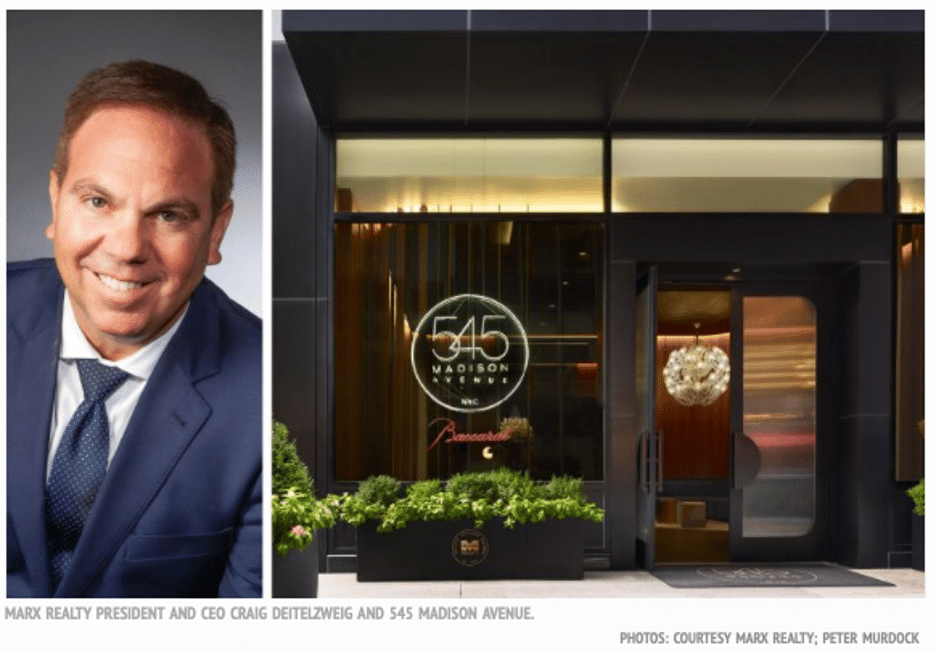
So, with 545 Madison Avenue, that building was constructed just 14 years ago, and it seemed sort of lackluster. So we had to really give it a spirit, and to do that we partnered with Baccarat. 545 Madison is the first luxury co-branded office building in the country. We used those Baccarat elements in everything we did throughout the building.
We also created what we call a new international style, taking the building’s prior history from the 1960s and redoing it in a modern, international-style way and rethinking what that would look like. We wanted to be groovy, so that’s why we have a fireplace extended from the ceiling of the Leonard Lounge.
You mentioned that offices started to change slowly before the pandemic. How has the makeup of the workplace evolved since then?
Well, so, when we did the new lobby and the new amenity floor here at 10 Grand Central, it took off immediately. Demand just was super strong. I think the tenants and the brokerage community were pleasantly surprised, as it was something they had never seen before, and so they just really gravitated toward it.
I think if you go into any great space, it just feels so right, and I think that’s how it felt here. It all resonated very quickly, and then they wanted it for their spaces as well.
Back then there was still this kind of consensus that everyone needed those open floor plates. What’s happened is there’s still those open floor plates, but there’s a lot more collaboration areas — so more lounges and couches — and then also we’re finding today that there are a lot more perimeter offices, too.
We’ve also had spaces come back to us. We had a space come back to us that we did seven years ago, and we found that we don’t have to do anything to it. The tenants said, “This is perfect, and we don’t need any changes.”
I think if you actually design space right from the get-go, it ends up being reusable and really adaptable as well.
Let’s wrap up with the question on everyone’s mind: How did you end up owning alpacas?
My daughter is going to get mad at me for telling this story. Well, first, I grew up in Queens, and my dream as a kid was to live on a farm. And now we live on a farm in Westchester, and we have alpacas — Zeus, Lucky and Bruno — and chickens, and a big vegetable and flower garden as well.
But my daughter lived in Peru for a summer and fell in love with these alpacas. When she came home, she said, “Daddy, can I have an alpaca for my birthday?” and I was like, “Of course not, what a ridiculous thing to ask.” But then she was getting ready to go off to college and she said, “You know, Daddy, can I please have an alpaca? I’ll come home from college.” I said, “Of course.” But now they have become my alpacas. I get up at 5 every morning and feed the animals. I love it. It’s really special.
Data Intelligence Firm Curinos Takes 14K SF at Marx Realty’s 10 Grand Central
By Amanda Schiavo July 15, 2026 3:06 pm
Marx Realty President and CEO Craig Deitelzweig and 10 Grand Central.
PHOTOS: Courtesy Marx Realty
Curinos, a global data intelligence firm serving the financial industry, is relocating to Marx Realty’s 10 Grand Central after signing a 14,000-square-foot lease, Commercial Observer has learned.
Curinos will move from its current office about two blocks north at 485 Lexington Avenue, though it is unclear when the move will happen.
The length of the lease was not disclosed. Asking rents at 10 Grand Central — which is now 98 percent leased, according to the landlord — ranges from $85 to $135 per square foot.
Adam Ardise and Rachel Rosenfeld from Cushman & Wakefield represented Curinos in the lease, while JLL’s Mitchell Konsker, Thomas Swartz, Carlee Palmer and Margaux Kelleher represented Marx Realty. Spokespeople for C&W and JLL did not immediately respond to CO’s requests for comment.
“The robust leasing activity at 10 Grand Central demonstrates the ongoing appeal of thoughtfully designed workplaces and white glove service that combine to give companies an elevated office experience,” Craig Deitelzweig, CEO of Marx Realty, said in a statement.
“Curinos’ decision to relocate within the Grand Central market speaks to the differentiated hospitality-infused experience we’ve created at 10 Grand Central and further strengthens the building’s exceptional tenant roster,” Deitelzweig added.
10 Grand Central is a hospitality-infused office building that offers tenants a variety of amenities, including a reservable house car for transportation, a lounge and cafe on the seventh floor, a 1930s French garden-style outdoor terrace, and a newly opened speakeasy-style restaurant called Highball Ltd.
Other tenants at 10 Grand Central include data center developer Edged, bank holding company Merchants Bancorp and research firm Green Street Advisors.
Private equity firm Niobrara Capital signs 10-year lease at Baccarat Building
Niobrara Capital has inked a 10-year, full-floor lease at 545 Madison Ave. in Midtown.
The private equity firm signed for 11,000 square feet at the building owned by Marx Realty.
Niobrara Capital is relocating from its previous office at 345 Park Ave. because “they wanted to be in the Plaza District and fell in love with the building,” according to a spokesperson for Marx Realty.
Also known as the Baccarat Building, 545 Madison Ave. is home to the U.S. headquarters of luxury French crystal label Baccarat. In partnership with the brand, the building features Baccarat chandeliers, fixtures, barware and accessories. Other current tenants include private equity firms Millennium Partners, Snow Phipps, Kohlberg, Orangewood Capital and Vialto Group.
“The building’s warm, club-like sensibility, refined design and unmistakable Baccarat touches continue to resonate with premier firms looking for a workplace that feels elevated, elegant and distinctive,” said Marx Realty CEO Craig Deitelzweig in a statement.
Niobrara Capital will take the entire ninth floor of the 140,000-square-foot building. The asking rent was $145 per square foot, according to Marx Realty.
CJ Heitner and John Cilmi of Newmark represented Niobrara Capital on the deal. Tara Stacom, Peter Trivelas, Harry Blair and Remy Leibersohn of Cushman & Wakefield represented Marx Realty.
The property was built in 1955 and redeveloped in 2008.
Private Equity Firm Signs Full-Floor Lease at Marx Realty’s 545 Madison
Niobrara Capital, a private equity firm focused on investing in technology and technology-enabled services businesses, has signed an 11,000-square-foot lease for the entire ninth floor at Marx Realty’s 545 Madison, located in Midtown Manhattan’s Plaza District. The property is also known as the Baccarat Building following Marx Realty’s office co-branding partnership with lifestyle house Baccarat.
“The continued leasing momentum at 545 Madison speaks to the power of pairing this exceptional Plaza District address with a truly differentiated hospitality-infused experience,” said Craig Deitelzweig, president and CEO of Marx Realty. “The building’s warm, club-like sensibility, refined design and unmistakable Baccarat touches continue to resonate with premier firms looking for a workplace that feels elevated, elegant and distinctive.”
A Newmark team led by CJ Heitner and John Cilmi represented Niobrara Capital. Marx Realty was represented by Tara Stacom, Peter Trivelas, Harry Blair, and Remy Leibersohn of Cushman & Wakefield.
Private equity firm takes full-floor office on Madison Avenue
Niobrara Capital has leased the entire ninth floor of Marx Realty’s 545 Madison Ave. (Peter Murdock)
A Manhattan-based private equity firm is moving its office to Madison Avenue.
Niobrara Capital signed a lease on an 11,000-square-foot space at 545 Madison Ave. in the Plaza District. The firm is currently on the third floor of 345 Park Ave. It is expected to move into 545 Madison by the end of the year and is set to occupy the entire ninth floor of the 18-story, 153,600-square-foot office building.
The lease is for 10 years, and asking rent was $145 per square foot.
Cushman & Wakefield’s Tara Stacom, Peter Trivelas, Harry Blair, and Remy Leibersohn represented landlord Marx Realty in the deal.
Niobrara Capital’s deal brings 545 Madison to 90% leased. Other private equity firms at the property include Millennium Partners, Snow Phipps, Kohlberg, Orangewood Capital and Vialto Group.
Marx Realty refers to 545 Madison as the Baccarat Building, because of the office co-cobranding partnership it has with the French glassware firm. The lobby and entryway feature Baccarat chandeliers while a tenant lounge on the eighth floor has Baccarat fixtures, barware and accessories.
Marx Realty CEO and President Craig Deitelzweig said in a statement that those touches have proven attractive to potential tenants.
“The continued leasing momentum at 545 Madison speaks to the power of pairing this exceptional Plaza District address with a truly differentiated hospitality-infused experience,” he said. “The building’s warm, club-like sensibility, refined design and unmistakable Baccarat touches continue to resonate with premier firms looking for a workplace that feels elevated, elegant and distinctive.”
Newmark’s C.J. Heitner and John Cilmi led a team that represented Niobrara Capital in the deal. Neither representatives from Newmark nor Niobrara Capital responded to requests for comment before press time.
Niobrara Capital, a private equity firm focused on tech companies across the U.S. and Europe, has signed an 11,000-square-foot lease on the entire ninth floor of Marx Realty’s545 Madison Avenue, also known as the Baccarat Building.
The length of the lease was not disclosed. The asking rent was $145 per square foot, according to Marx Realty.
It’s unclear whether the deal represents a new location or a relocation for Niobrara, which lists an office about four blocks away at 345 Park Avenue on its website.
Newmark’s CJ Heitner and John Cilmi represented Niobrara Capital in the lease, while Cushman & Wakefield’s Tara Stacom, Peter Trivelas, Harry Blair andRemy Liebersohn represented the owner.
C&W declined to comment, while Newmark did not immediately respond to a request for comment.
“The continued leasing momentum at 545 Madison speaks to the power of pairing this exceptional Plaza District address with a truly differentiated hospitality-infused experience,” Craig Deitelzweig, president and CEO of Marx Realty, said in a statement. “The building’s warm, club-like sensibility, refined design and unmistakable Baccarat touches continue to resonate with premier firms looking for a workplace that feels elevated, elegant and distinctive.”
The deal represents Marx Realty’s first lease signed after partnering with luxury crystal manufacturer Baccarat, which unveiled its collaboration at 545 Madison in 2025. There are Baccarat enhancements throughout the 17-story, 140,000-square-foot building.
Several other private equity firms call 545 Madison home, including Kohlberg and Vialto Group.
Marx Realty launches speakeasy at 10 Grand Central – 6,000 s/f
April 13, 2026
Manhattan, NY Marx Realty (MNPP) has entered a partnership with the downtown speakeasy Please Don’t Tell (PDT), to introduce Highball Ltd. at its 10 Grand Central office tower in Midtown. The new bar – grounded in the glamour of the era of Jazz Age New York and Art Deco skyscrapers – will further elevate the building’s hospitality-infused repositioning while introducing a food and beverage destination to Midtown. Highball Ltd. is the newest project from Jeff Bell, managing partner of the East Village speakeasy PDT, and his partners, Apres Cru Hospitality.
“Highball Ltd. represents the next chapter in our mission to provide an exceptional experience that blurs the lines between workplace and luxury hotel,” said Craig Deitelzweig, CEO of Marx Realty. “By partnering with Jeff Bell and ApresCru, we are creating an authentic, design-forward speakeasy experience that pays homage to the architectural history of the building and its location near Grand Central Terminal. We are not only setting new benchmarks in workplace design, but transforming 10 Grand Central into a true social destination – and our tenants are already enamored with the concept.”
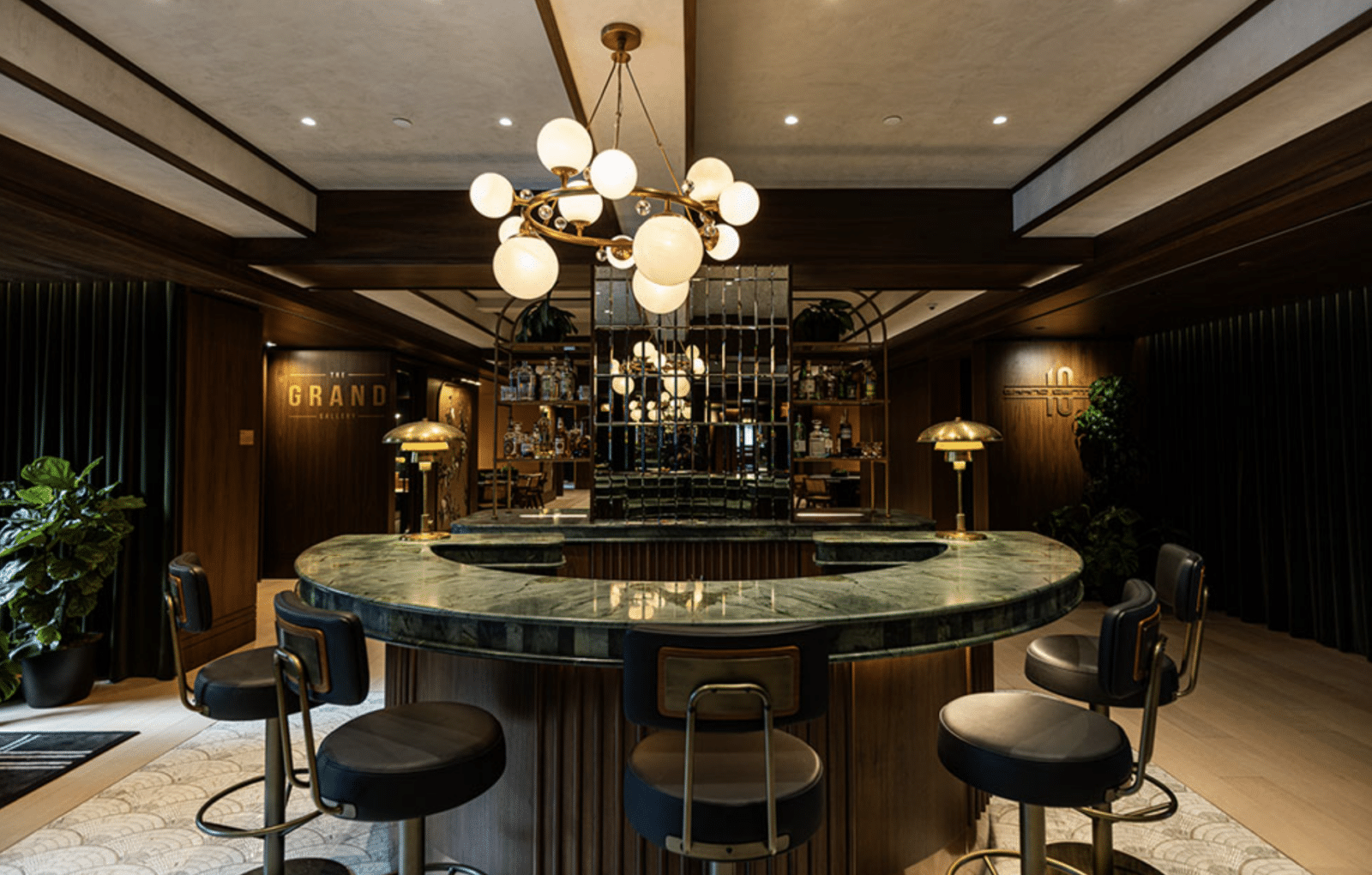
Highball Ltd. will be within The Meeting Galleries space, an amenity suite featuring four spaces: Highball Ltd. (formerly known as The Bar Car), a pre-function space appointed with Baccarat barware, artwork and a floor-to-ceiling bronze fireplace; The Grand Gallery, a 200-person town hall space; The Podcast Gallery, a recording studio equipped with technology; and, The Screening Gallery, a theater with stadium seating and a 150-inch screen beneath a constellation-inspired ceiling reminiscent of Grand Central’s celestial dome.
“The proximity to Grand Central is an exciting entry to Midtown for us,” said Jeff Bell, managing partner of PDT. “The beautiful space reminds me of a luxury pullman car and provided a lot of inspiration for the menu. There is such a rich history to draw from with the overlap in the golden age of cocktails and the golden age of train travel.”
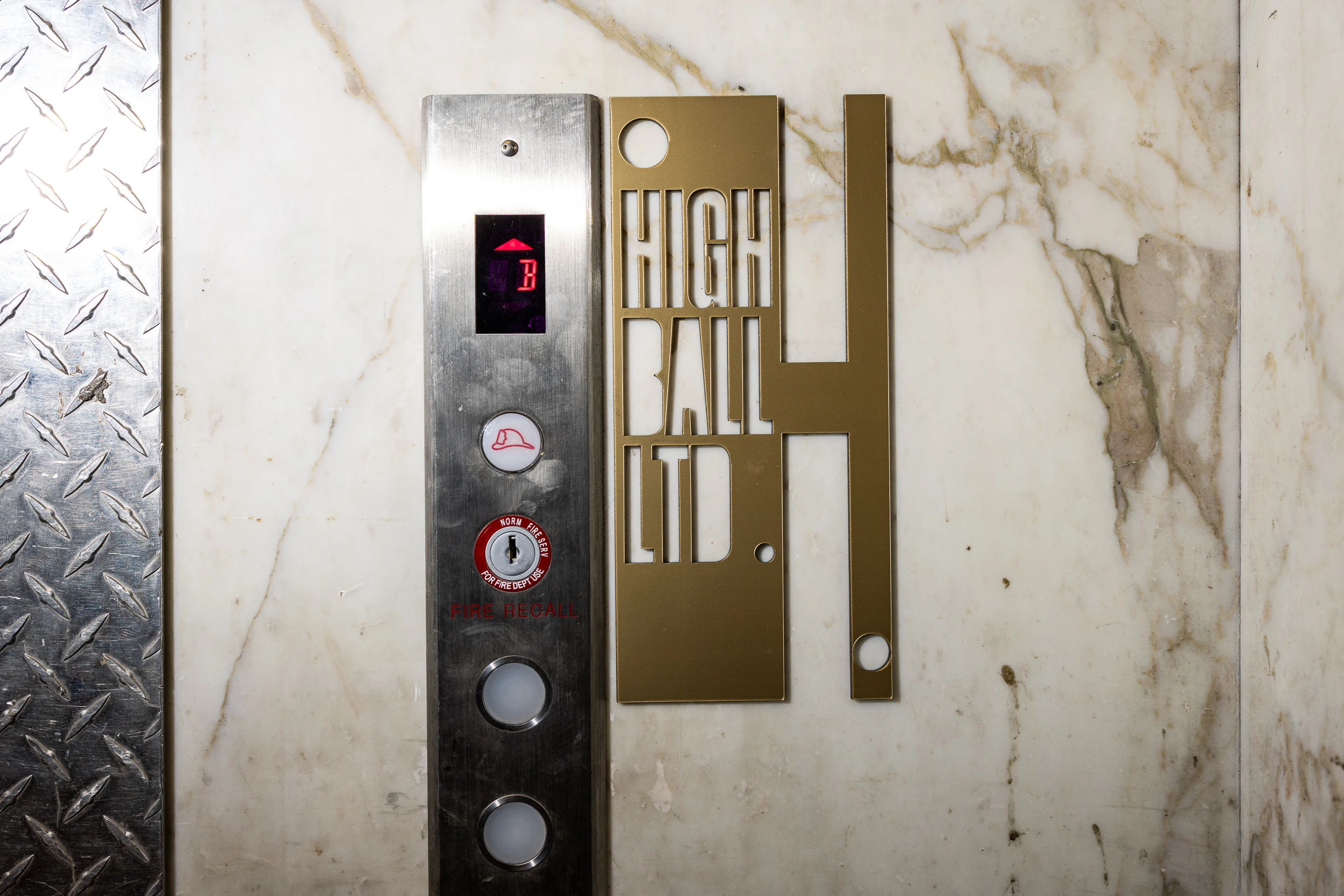
After finding the hidden entrance on Third Ave. (look for the red light), layered wayfinding, and the freight elevator, guests are transported to a cocktail oasis on the 11th floor. Highball Ltd. fuses the timeless glamour of the building’s 1930s-era Beaux Arts design with distinct design nods to the golden age of luxury train travel. Highball Ltd. will tap the demand for a simple, yet upscale, cocktail experience in a part of Midtown long defined by office towers and now increasingly energized by new food and beverage openings.
Beginning with a repositioning at 10 Grand Central that added a sophisticated lounge and terrace amenity in 2018 – marking the early expression of Marx Realty’s now widely recognized hospitality-infused workplace strategy – the firm recently added an 11,000 s/f space known as The Meeting Galleries. Located on the 11th floor at 10 Grand Central, Highball Ltd. is now part of that space and celebrates craft cocktails and elevated food. While some seats will be held for walk-ins nightly, reservations are encouraged.
The name, Highball Ltd., has a double meaning: a nod to the classic whiskey cocktail and the historic “highball” railroad signal, by which a ball raised to the top of a pole indicated that the track ahead was clear, allowing the train to proceed at full speed. The concept complements the luxury train-inspired design of the space and will appeal to a diverse audience while addressing the rising demand for social experiences combining a food menu with crafted cocktails. The beverage menu includes Dom Perignon Champagne alongside vintage spirits, Japanese whiskey and a mix of house highballs, signature cocktails and classics like a martini and negroni.
The partnership with Marx Realty brings the PDT team to Midtown for the first time in a reimagined experience tailored to appeal to the diverse mix of Midtown professionals, residents and visitors. PDT pioneered the modern speakeasy movement in 2007 when it opened its original location hidden behind a telephone booth inside Crif Dogs in the East Village. Bell and PDT have been behind numerous bar and hotel experiences including the Waldorf Astoria in New York, the Mandarin Oriental Hong Kong, and the new jetBlue lounge at JFK. Bell has also developed a line of cocktail mixers, currently served in jetBlue’s Mint Class. In July 2025 he opened Mixteca, an agave-focused bar in the West Village, and six months later Kees, a sophisticated cocktail lounge that channels the glamour of mid-century New York, located downstairs from Mixteca.
“High quality cocktail ingredients are now mainstream,” said Bell. “Guests are focused on better spirits and mixers even for simple cocktails like a Gin + Tonic. With our version, we stay true to the formula but add a layer of complexity with kabosu and shiso. It’s still a refreshing and sessionable drink.”
Velvet seating, brushed brass accents and softly arched architectural details evoke 1930s luxury railcars throughout the space, while mood lighting, bespoke millwork and a signature scent deliver Marx Realty’s well-known hospitality-infused ambiance. The result is a swanky and refined members-only atmosphere that feels both clandestine and glamorous, an unexpected counterpoint to Midtown’s corporate core.
When Every Bar Is a ‘Speakeasy,’ What Actually Is a Speakeasy?
April 14, 2026
Long after Prohibition, a few high-end cocktail bars show it’s still possible to retain their speakeasy forebears’ air of mystery and adventure.
Inside Highball Ltd., a speakeasy-style bar in a Midtown Manhattan skyscraper. Elizabeth Arvelos Coetzee/WSJ
By Mark Ellwood
April 14, 2026 11:45 am ET
Just off a busy sidewalk in Midtown Manhattan, a red carpet leads to a freight elevator. You might not even notice it unless you first saw the red light shining on the sidewalk above a pair of nondescript black doors. Nearby, a discreet, retro-inflected brass plaque reads Highball Ltd. Step in and ride to the 11th floor and the confusion clears.
The brand new, 65-person cocktail bar is the brainchild of celebrated bartender Jeff Bell, known for his work at the pioneering Please Don’t Tell, or PDT, in New York’s East Village. When Bell was given the task of turning the tiny, nondescript room in Midtown into a buzzy destination, he immediately thought “speakeasy.”
To enter Highball Ltd., guests ride a freight elevator up to the 11th floor.
Elizabeth Arvelos Coetzee/WSJ
“People love when they’ve discovered a place, when it’s a journey to get to it,” he said. But a century after the term first emerged to describe the clandestine drinking dens of Prohibition, its meaning has blurred. When passwords are posted to Instagram and tables booked on an app, what is a speakeasy—and can it be anything more than a gimmick? A few places around the world offer some clues.
To be in-the-know
In the 1920s, at the height of Prohibition, speakeasies were far from elitist, according to Charlotte Voisey, who runs the New Orleans-based hospitality nonprofit Tales of the Cocktail. “They didn’t care who was there as long as they could keep selling liquor and having a good time.”
The 1990s cocktail revival introduced a layer of snobbery to speakeasy-style bars, long after any subterfuge was necessary. New spots were intended to cater to in-the-know drinkers of a different kind. “It was about dedication to cocktail culture, not just speakeasy mechanisms,” Voisey said. In other words, picky bartenders wanted to ensure their clientele consisted of drinkers primed to appreciate their efforts.
The epitome of this approach was New York’s Milk & Honey, which the late Sasha Petraske opened on the eve of the millennium in 1999 behind a facade that resembled a tailor’s shop (another, similarly craft-focused operation, Attaboy, still occupies the site). Long before likes and shares, there wasn’t a door policy exactly, but you could be subject to an unspoken, discreet screening at the host table.
Like many high-end bars, Highball focuses on reviving and riffing on classic cocktails.Elizabeth Arvelos Coetzee/WSJ
Reservations only—and a not-so-grand entrance
The arrival of social media forced operators to reimagine the word-of-mouth approach. Today, the places that call themselves speakeasies are about intentionality. Instead of texting the bartender, as you might have done 20 years ago, you’re expected to plan ahead enough to book a two-top on Resy.
That doesn’t mean there isn’t room for a little mystery. Famously, PDT is accessed via a phone booth which sits in the brightly lit Crif Dogs fast food joint next door.
Bell said the decision to create an alternative entrance was driven more by practicalities than theatricalities. By being attached to Crif Dogs, PDT could piggyback on the restaurant’s liquor license. But ask anyone who has been and they’re likely to lead with the thrill of picking up the receiver in the booth to enter.
This theatricality has become another earmark of the speakeasy genre. Raised by Wolves in San Diego sits behind a liquor store, accessible via a rotating seating area. The award-winning Florería Atlántico in Buenos Aires—which expanded to Washington, D.C. last fall—sits beneath a working florist, accessed via a staircase concealed by a fridge.
“It’s giving you permission to escape your day, because you’re walking through a literal or physical portal,” said David Kaplan, co-owner of New York’s Death & Co, where bowtie-clad bartenders serve elaborate cocktails behind a barely marked door.
YONKERS — New stores, electronics retailer and restaurants have expressed interest in leasing space in the new retail area planned for Cross County Center.
The $90 million expansion, slated for the center’s north lot, includes two new buildings totaling 58,000 square feet of retail space, along with a four-acre park, boardwalk and underground parking garage.
Prospective tenants, from an international fashion brand to an electronics retailer and restaurants, have already shown interest in the space even though construction is not expected to be completed for another 18 months, project officials said.
Craig Deitelzweig, CEO of Marx Realty that owns the center, said the vision is to create a new front door to the center, with new stores, green space and sitting areas leading to a boardwalk lined with dining places.
“We want this to be the town center,” Deitelzweig said. “Our goal is to have people who want to come to the center starting in the morning and staying all the way through the evening.”
Cross County Center expansion to create community space, drive foot traffic
Opened in 1954, the center has grown from 30 stores to more than 100 tenants spanning retail, dining, education, entertainment and hospitality. Branded as the nation’s first open-air shopping mall, Cross County Center attracts about 14 million visitors annually and is now 97% leased.
The center is home to a mix of about 83 tenants ranging from national brands to local businesses. It is anchored by Target and Macy’s, along with SUNY Westchester Yonkers and a Hyatt Place hotel. New stores have consistently been added over the years.
The expansion reflects strong demand for retail space. About 88% of the 58,000 square feet of retail space has already been accounted for, with plans being finalized for a “world-class retailer” interested in occupying an entire two-story, 44,000-square-foot-building, Deitelzweig said.
The goal is to host a diverse tenant mix to attract a broad range of customers. Most visitors come from Westchester County and New York City, with a large share made up of young adults ages 16 to 23 and families.
The center also hosts year-round events, including holiday celebrations, summer festivals, yoga and Zumba classes. The new park will create space for new events such as concerts, picnics, farmers markets and soccer games or expanding existing programs.
“I always wanted to add a new park here,” Deitelzweig said. “It’s another way for us to connect with the community. We’ll make sure this space is really activated.”
The expansion will replace a portion of the north parking lot. An underground parking garage with elevator access will be built beneath the site. Construction will be carried out in phases, with the goal of minimizing disruption to operations while maintaining access to nearby businesses.
Why does demand remain strong at Cross County Center?
While e-commerce and the pandemic have taken a toll on some Westchester malls, shuttering the former Galleria at White Plains and the former White Plains Mall, other retail centers have rebounded. Cross County Center, for example, is thriving with nearly full occupancy and strong demand for additional space.
In 2024, Westchester’s mall vacancy rate dropped to 1%, far below the national average of 8.7%, according to CoStar.
Deitelzweig said sales revenues have continued to grow, attributing Cross County Center’s success to ongoing efforts to meet evolving customer needs. Those efforts include attracting and retaining trending, high-performing tenants and reinvesting in capital improvements, including upgrades to sidewalks, landscaping, lighting and storefronts.
The center is home to the first Zara, Shake Shack and Raising Cane’s locations in Westchester, as well as one of the best-performing Target and Macy’s stores in the country, Deitelzweig said. Four additional stores are slated to open, including Coach, Crocs, Crumble Cookies and Elite Nails & Spa.
He added that the center has also benefited from younger generations’ growing preference for in-person experiences and post-pandemic hybrid work schedules.
“The way we’ve succeeded for 70 years is by understanding your customers,” Deitelzweig said. “Sometimes it’s about understanding them before they even understand what they want.”
Selective on tenants as customer preferences evolve
Businesses are drawn to Cross County Center by the high foot traffic that is largely generated through events and the spillover effect of neighboring brands, although securing a spot is competitive.
Deitelzweig said the center is selective about its tenants and continues to adapt based on store performance and a commitment to maintaining well-kept storefronts. The shift toward experiential retail has prompted tenants to lease larger spaces, with more businesses focusing on experiences.
Build-A-Bear, a toy store that opened in September, offers customers the chance to design their own stuffed animals. At the center of the store, a large wheel of plush white stuffing slowly rotates as customers bring their toys to life by choosing a shell, outfit and accessories, adding a heartbeat and even recording a personalized sound bite.
Porsha Soto, the store’s manager, said the Cross County location is the company’s sixth in New York and was drawn to the center’s strong base of family-oriented customers. She hopes the expansion will bring more foot traffic and provide a better experience.
“It’s really exciting to have this space that feels welcoming and warm,” Soto said, referring to the park.
What could come next at Cross County Center?
As the center continues to grow, both the property owner and customers see potential for future developments.
Ive Lisse, of Yonkers, who visits the center about twice a month and attends some of its events, said she enjoys stores such as Old Navy, Zara, H&M, Foot Locker and Shake & Shack and hopes to see more children’s entertainment options like Sky Zone.
That sentiment echoed Deitelzweig’s vision to add businesses that offer immersive, family-friendly experiences. He said he is also open to residential development where there is a need, provided it fits into the fabric of the center.
“Customers’ desires change constantly,” Deitelzweig said. “You always have to be mindful of what customers need.”
Just a few weeks after revered longtime PDT bartender Jeff Bell announced the opening of Kees, his new subterranean lounge at 1 Cornelia Street, the cocktail guru has revealed yet another project. In partnership with Marx Realty, Bell is opening a new speakeasy-style concept, this one complete with a hidden entrance and a “complex entry process.” Highball Ltd. is officially open for business—if you can only find it inside the office tower at 10 Grand Central.
Photograph: Eric Medsker
Before we get to how you can actually get in, a bit about the space, which is carved out of the building’s 11th-floor Meeting Galleries amenity, a new 11,000-square-foot hub. The entire project is essentially an homage to Grand Central Terminal: the design draws inspiration from all things train, specifically honoring the “golden age of luxury train travel,” according to an official description. The idea is that you’ll feel as though you’re sipping a very good cocktail in the bar car of a train.
The name of the destination is also on theme—doubly so. The moniker nods both to the classic whiskey cocktail and the “highball” railroad signal, when a ball raised to the top of a pole indicated that the track ahead was clear and the running train could proceed.
Photograph: Eric Medsker
Highball Ltd. is actually just one quarter of the four distinct spaces that will make up the Meeting Galleries complex, which will also include a 200-person town hall venue called the Grand Gallery, a recording studio featuring state-of-the-art technology dubbed the Podcast Gallery, and the Screening Gallery—a “plush theater with stadium seating and a 150-inch screen beneath a constellation-inspired ceiling reminiscent of Grand Central’s celestial dome.”
But back to the secrecy of it all: you’ll want to look for a red light on Third Avenue near 44th Street. That’s the hidden entrance. Step inside, hop into the freight elevator and head up to the 11th floor. Perfect cocktails await… once you find the red light, of course.